

�
�
�
�
�
�
�
�
�
�
�
�
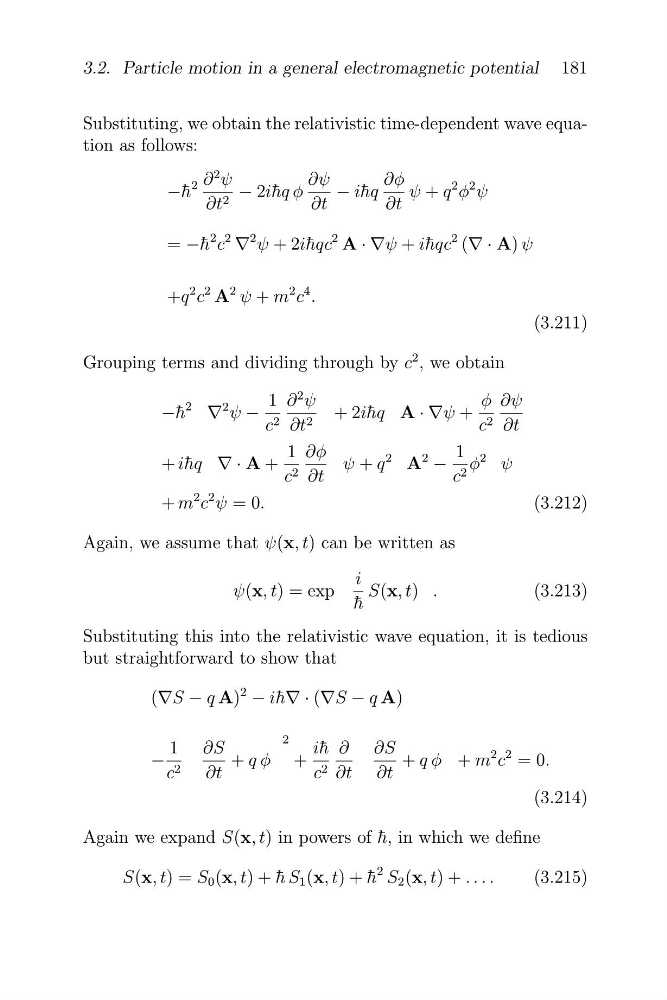
Substituting, we obtain the relativistic time-dependent wave equation as follows:
h
2 ∂
2 ψ
∂ψ
∂φ
−¯
− 2i¯
− i¯
ψ + q
2 φ
2 ψ
hq φ
hq
∂t 2
∂t
∂t
= −h ¯
2 c
2 v
2 ψ + 2i¯
hqc
2 (v · A) ψ
hqc
2 A · vψ + i¯
2
2 4
+q c
2 A
2 ψ + m c .
(3.211)
Grouping terms and dividing through by c
2 , we obtain
1 ∂
2 ψ
φ ∂ψ
−h ¯
2 v
2 ψ −
hq
+ 2i¯ A · vψ +
c 2 ∂t 2
c 2 ∂t
1 ∂φ
1
+ i¯ v · A + 2
2 A
2 − 2 φ
2 ψ
hq
ψ + q
c ∂t
c
+ m
2 c
2 ψ = 0.
(3.212)
Again, we assume that ψ(x, t) can be written as
i
ψ(x, t) = exp
S(x, t) .
(3.213)
h ¯
Substituting this into the relativistic wave equation, it is tedious
but straightforward to show that
(vS − q A)
2 − ih ¯v · (vS − q A)
2
1 ∂S
ih ¯ ∂ ∂S
− 2
+ q φ + 2
+ q φ + m
2 c
2 = 0.
c
∂t
c ∂t ∂t
(3.214)
Again we expand S(x, t) in powers of ¯
h, in which we define
h
2
S(x, t) = S 0 (x, t) + ¯
h S 1 (x, t) + ¯ S 2 (x, t) + . . . .
(3.215)
3.2. Particle motion in a general electromagnetic potential 181
�
�
�
�
�
�
�
�
�
�
�
Substituting, we obtain the relativistic time-dependent wave equation as follows:
h
2 ∂
2 ψ
∂ψ
∂φ
−¯
− 2i¯
− i¯
ψ + q
2 φ
2 ψ
hq φ
hq
∂t 2
∂t
∂t
= −h ¯
2 c
2 v
2 ψ + 2i¯
hqc
2 (v · A) ψ
hqc
2 A · vψ + i¯
2
2 4
+q c
2 A
2 ψ + m c .
(3.211)
Grouping terms and dividing through by c
2 , we obtain
1 ∂
2 ψ
φ ∂ψ
−h ¯
2 v
2 ψ −
hq
+ 2i¯ A · vψ +
c 2 ∂t 2
c 2 ∂t
1 ∂φ
1
+ i¯ v · A + 2
2 A
2 − 2 φ
2 ψ
hq
ψ + q
c ∂t
c
+ m
2 c
2 ψ = 0.
(3.212)
Again, we assume that ψ(x, t) can be written as
i
ψ(x, t) = exp
S(x, t) .
(3.213)
h ¯
Substituting this into the relativistic wave equation, it is tedious
but straightforward to show that
(vS − q A)
2 − ih ¯v · (vS − q A)
2
1 ∂S
ih ¯ ∂ ∂S
− 2
+ q φ + 2
+ q φ + m
2 c
2 = 0.
c
∂t
c ∂t ∂t
(3.214)
Again we expand S(x, t) in powers of ¯
h, in which we define
h
2
S(x, t) = S 0 (x, t) + ¯
h S 1 (x, t) + ¯ S 2 (x, t) + . . . .
(3.215)
3.2. Particle motion in a general electromagnetic potential 181