

�
�
�
�
�
�
only.
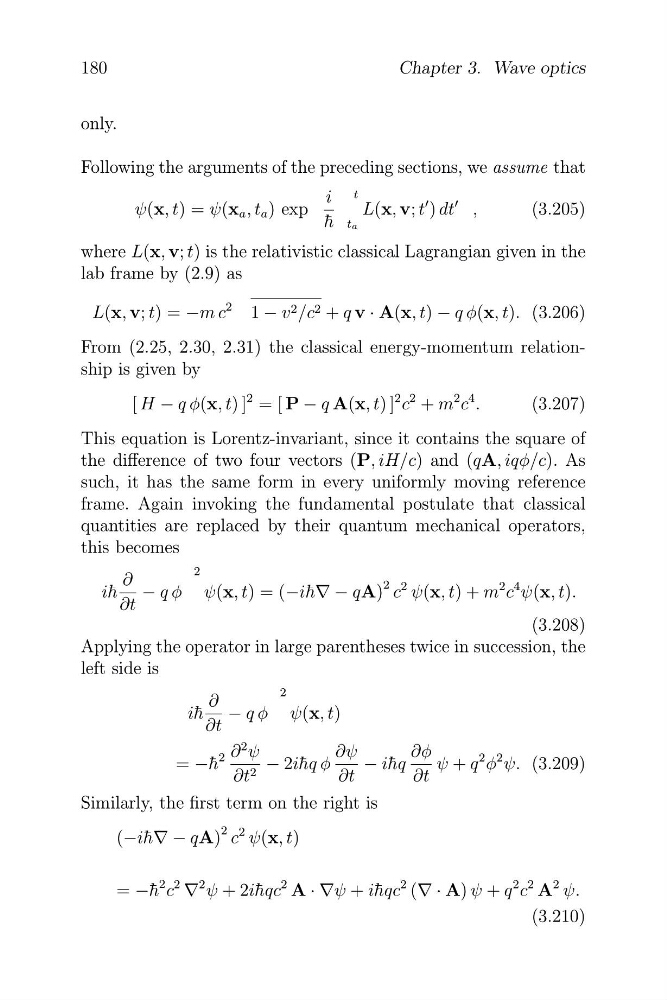
Following the arguments of the preceding sections, we assume that
ψ(x, t) = ψ(x a , t a ) exp
i t
L(x, v; t
� ) dt
� ,
(3.205)
h ¯ ta
where L(x, v; t) is the relativistic classical Lagrangian given in the
lab frame by (2.9) as
L(x, v; t) = −m c
2
1 − v 2 /c 2 + q v · A(x, t) − q φ(x, t). (3.206)
From (2.25, 2.30, 2.31) the classical energy-momentum relationship is given by
2
2 4
[ H − q φ(x, t) ]
2 = [ P − q A(x, t) ]
2 c + m c .
(3.207)
This equation is Lorentz-invariant, since it contains the square of
the difference of two four vectors (P, iH/c) and (qA, iqφ/c). As
such, it has the same form in every uniformly moving reference
frame. Again invoking the fundamental postulate that classical
quantities are replaced by their quantum mechanical operators,
this becomes
2
ih ¯
∂ − q φ ψ(x, t) = (−ih ¯v − qA)
2 c
2 ψ(x, t) + m
2 c
4 ψ(x, t).
∂t
(3.208)
Applying the operator in large parentheses twice in succession, the
left side is
2
∂
ih ¯ − q φ ψ(x, t)
∂t
∂
2 ψ
∂ψ
∂φ
= −h ¯
2
− 2i¯
− i¯
ψ + q
2 φ
2 ψ. (3.209)
hq φ
hq
∂t 2
∂t
∂t
Similarly, the first term on the right is
(−ih ¯v − qA)
2 c
2 ψ(x, t)
= −h ¯
2 c
2 v
2 ψ + 2i¯
hqc
2 (v · A) ψ + q
2 c
2 A
2 ψ.
hqc
2 A · vψ + i¯
(3.210)
180
Chapter 3. Wave optics
�
�
�
�
�
only.
Following the arguments of the preceding sections, we assume that
ψ(x, t) = ψ(x a , t a ) exp
i t
L(x, v; t
� ) dt
� ,
(3.205)
h ¯ ta
where L(x, v; t) is the relativistic classical Lagrangian given in the
lab frame by (2.9) as
L(x, v; t) = −m c
2
1 − v 2 /c 2 + q v · A(x, t) − q φ(x, t). (3.206)
From (2.25, 2.30, 2.31) the classical energy-momentum relationship is given by
2
2 4
[ H − q φ(x, t) ]
2 = [ P − q A(x, t) ]
2 c + m c .
(3.207)
This equation is Lorentz-invariant, since it contains the square of
the difference of two four vectors (P, iH/c) and (qA, iqφ/c). As
such, it has the same form in every uniformly moving reference
frame. Again invoking the fundamental postulate that classical
quantities are replaced by their quantum mechanical operators,
this becomes
2
ih ¯
∂ − q φ ψ(x, t) = (−ih ¯v − qA)
2 c
2 ψ(x, t) + m
2 c
4 ψ(x, t).
∂t
(3.208)
Applying the operator in large parentheses twice in succession, the
left side is
2
∂
ih ¯ − q φ ψ(x, t)
∂t
∂
2 ψ
∂ψ
∂φ
= −h ¯
2
− 2i¯
− i¯
ψ + q
2 φ
2 ψ. (3.209)
hq φ
hq
∂t 2
∂t
∂t
Similarly, the first term on the right is
(−ih ¯v − qA)
2 c
2 ψ(x, t)
= −h ¯
2 c
2 v
2 ψ + 2i¯
hqc
2 (v · A) ψ + q
2 c
2 A
2 ψ.
hqc
2 A · vψ + i¯
(3.210)
180
Chapter 3. Wave optics