

�
�
�
�
168
Chapter 3. Wave optics
Substituting, and collecting terms in the various powers of ¯
h, we
obtain
0 =
(vS 0 − qA)
2 + 2m
∂S 0 + qφ
∂t
∂S 1
+ h ¯ 2vS 1 · (vS 0 − qA) − iv · (vS 0 − qA) + 2m ∂t
∂S 2
+ h ¯
2
2vS 2 · (vS 0 − qA) − iv
2 S 1 + (vS 1 )
2 + 2m ∂t
h
3
+ O ¯ .
(3.165)
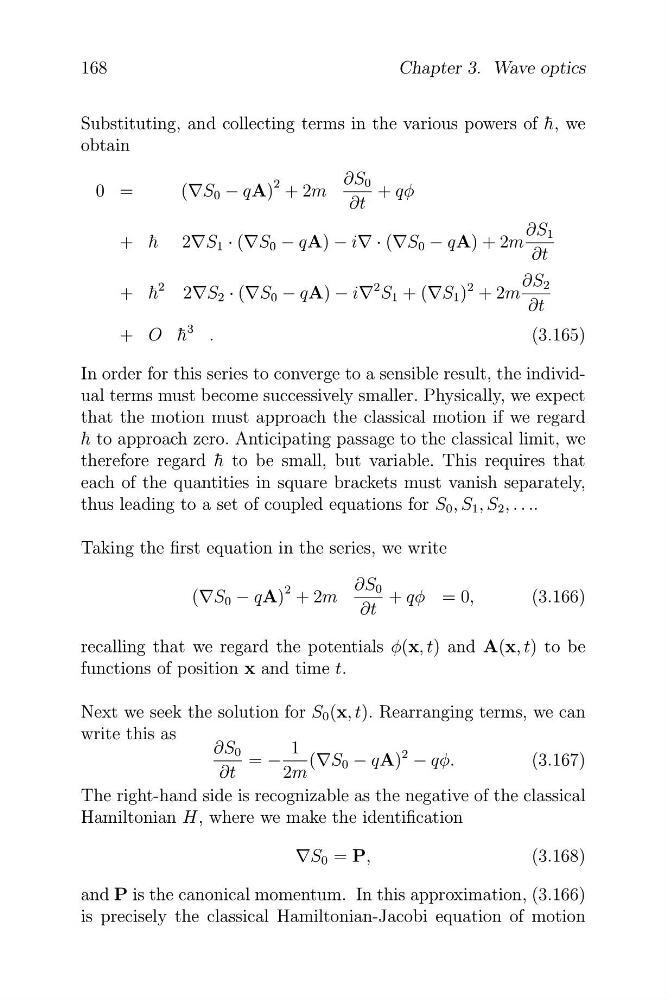
In order for this series to converge to a sensible result, the individual terms must become successively smaller. Physically, we expect
that the motion must approach the classical motion if we regard
h ¯ to approach zero. Anticipating passage to the classical limit, we
therefore regard h ¯ to be small, but variable. This requires that
each of the quantities in square brackets must vanish separately,
thus leading to a set of coupled equations for S 0 , S 1 , S 2 , . . ..
Taking the first equation in the series, we write
2
∂S 0
(vS 0 − qA) + 2m
+ qφ = 0,
(3.166)
∂t
recalling that we regard the potentials φ(x, t) and A(x, t) to be
functions of position x and time t.
Next we seek the solution for S 0 (x, t). Rearranging terms, we can
write this as
∂S 0
1
= −
(vS 0 − qA)
2 − qφ.
(3.167)
∂t
2m
The right-hand side is recognizable as the negative of the classical
Hamiltonian H, where we make the identification
vS 0 = P,
(3.168)
and P is the canonical momentum. In this approximation, (3.166)
is precisely the classical Hamiltonian-Jacobi equation of motion
�
�
�
168
Chapter 3. Wave optics
Substituting, and collecting terms in the various powers of ¯
h, we
obtain
0 =
(vS 0 − qA)
2 + 2m
∂S 0 + qφ
∂t
∂S 1
+ h ¯ 2vS 1 · (vS 0 − qA) − iv · (vS 0 − qA) + 2m ∂t
∂S 2
+ h ¯
2
2vS 2 · (vS 0 − qA) − iv
2 S 1 + (vS 1 )
2 + 2m ∂t
h
3
+ O ¯ .
(3.165)
In order for this series to converge to a sensible result, the individual terms must become successively smaller. Physically, we expect
that the motion must approach the classical motion if we regard
h ¯ to approach zero. Anticipating passage to the classical limit, we
therefore regard h ¯ to be small, but variable. This requires that
each of the quantities in square brackets must vanish separately,
thus leading to a set of coupled equations for S 0 , S 1 , S 2 , . . ..
Taking the first equation in the series, we write
2
∂S 0
(vS 0 − qA) + 2m
+ qφ = 0,
(3.166)
∂t
recalling that we regard the potentials φ(x, t) and A(x, t) to be
functions of position x and time t.
Next we seek the solution for S 0 (x, t). Rearranging terms, we can
write this as
∂S 0
1
= −
(vS 0 − qA)
2 − qφ.
(3.167)
∂t
2m
The right-hand side is recognizable as the negative of the classical
Hamiltonian H, where we make the identification
vS 0 = P,
(3.168)
and P is the canonical momentum. In this approximation, (3.166)
is precisely the classical Hamiltonian-Jacobi equation of motion