

�
�
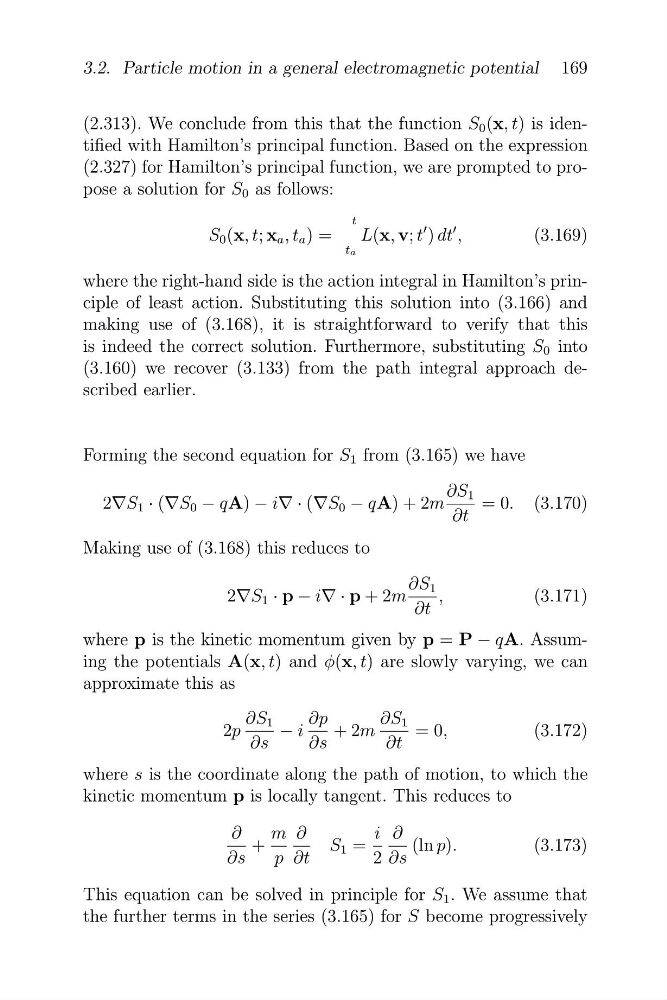
Forming the second equation for S 1 from (3.165) we have
∂S 1
2vS 1 · (vS 0 − qA) − iv · (vS 0 − qA) + 2m
= 0. (3.170)
∂t
Making use of (3.168) this reduces to
∂S 1
2vS 1 · p − iv · p + 2m
,
(3.171)
∂t
where p is the kinetic momentum given by p = P − qA. Assuming the potentials A(x, t) and φ(x, t) are slowly varying, we can
approximate this as
∂S 1
∂p
∂S 1
2p
− i
+ 2m
= 0,
(3.172)
∂s
∂s
∂t
where s is the coordinate along the path of motion, to which the
kinetic momentum p is locally tangent. This reduces to
∂
m ∂
i ∂
∂s
+ p ∂t
S 1 = 2 ∂s
(ln p).
(3.173)
This equation can be solved in principle for S 1 . We assume that
the further terms in the series (3.165) for S become progressively
3.2. Particle motion in a general electromagnetic potential 169
(2.313). We conclude from this that the function S 0 (x, t) is identified with Hamilton’s principal function. Based on the expression
(2.327) for Hamilton’s principal function, we are prompted to propose a solution for S 0 as follows:
t
S 0 (x, t; x a , t a ) =
L(x, v; t
� ) dt
� ,
(3.169)
ta
where the right-hand side is the action integral in Hamilton’s principle of least action. Substituting this solution into (3.166) and
making use of (3.168), it is straightforward to verify that this
is indeed the correct solution. Furthermore, substituting S 0 into
(3.160) we recover (3.133) from the path integral approach described earlier.
�
Forming the second equation for S 1 from (3.165) we have
∂S 1
2vS 1 · (vS 0 − qA) − iv · (vS 0 − qA) + 2m
= 0. (3.170)
∂t
Making use of (3.168) this reduces to
∂S 1
2vS 1 · p − iv · p + 2m
,
(3.171)
∂t
where p is the kinetic momentum given by p = P − qA. Assuming the potentials A(x, t) and φ(x, t) are slowly varying, we can
approximate this as
∂S 1
∂p
∂S 1
2p
− i
+ 2m
= 0,
(3.172)
∂s
∂s
∂t
where s is the coordinate along the path of motion, to which the
kinetic momentum p is locally tangent. This reduces to
∂
m ∂
i ∂
∂s
+ p ∂t
S 1 = 2 ∂s
(ln p).
(3.173)
This equation can be solved in principle for S 1 . We assume that
the further terms in the series (3.165) for S become progressively
3.2. Particle motion in a general electromagnetic potential 169
(2.313). We conclude from this that the function S 0 (x, t) is identified with Hamilton’s principal function. Based on the expression
(2.327) for Hamilton’s principal function, we are prompted to propose a solution for S 0 as follows:
t
S 0 (x, t; x a , t a ) =
L(x, v; t
� ) dt
� ,
(3.169)
ta
where the right-hand side is the action integral in Hamilton’s principle of least action. Substituting this solution into (3.166) and
making use of (3.168), it is straightforward to verify that this
is indeed the correct solution. Furthermore, substituting S 0 into
(3.160) we recover (3.133) from the path integral approach described earlier.