

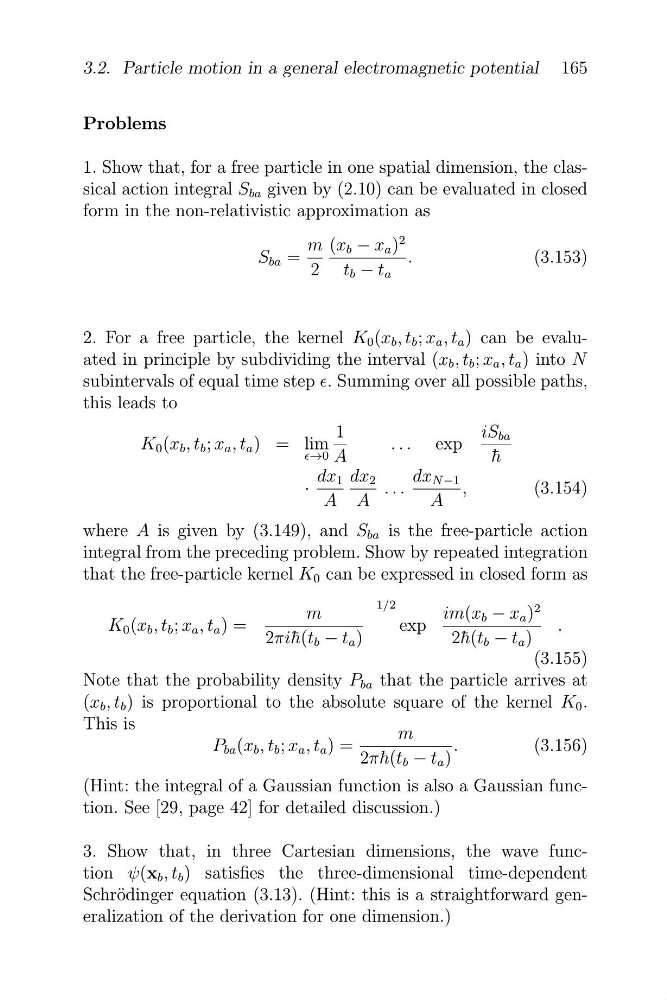
Problems
1. Show that, for a free particle in one spatial dimension, the classical action integral S ba given by (2.10) can be evaluated in closed
form in the non-relativistic approximation as
m (x b − x a )
2
S ba =
.
(3.153)
2 t b − t a
2. For a free particle, the kernel K 0 (x b , t b ; x a , t a ) can be evaluated in principle by subdividing the interval (x b , t b ; x a , t a ) into N
subintervals of equal time step f. Summing over all possible paths,
this leads to
1
iS ba
K 0 (x b , t b ; x a , t a ) = lim
. . . exp
E→0 A
h ¯
dx 1 dx 2
dx N −1
·
. . .
,
(3.154)
A A
A
where A is given by (3.149), and S ba is the free-particle action
integral from the preceding problem. Show by repeated integration
that the free-particle kernel K 0 can be expressed in closed form as
m
1/2
im(x b − x a )
2
K 0 (x b , t b ; x a , t a ) =
exp
.
2πih ¯(t b − t a )
2¯ h(t b − t a )
(3.155)
Note that the probability density P ba that the particle arrives at
(x b , t b ) is proportional to the absolute square of the kernel K 0 .
This is
m
P ba (x b , t b ; x a , t a ) =
.
(3.156)
2πh ¯(t b − t a )
(Hint: the integral of a Gaussian function is also a Gaussian function. See [29, page 42] for detailed discussion.)
3. Show that, in three Cartesian dimensions, the wave function ψ(x b , t b ) satisfies the three-dimensional time-dependent
Schr¨ odinger equation (3.13). (Hint: this is a straightforward generalization of the derivation for one dimension.)
3.2. Particle motion in a general electromagnetic potential 165
1. Show that, for a free particle in one spatial dimension, the classical action integral S ba given by (2.10) can be evaluated in closed
form in the non-relativistic approximation as
m (x b − x a )
2
S ba =
.
(3.153)
2 t b − t a
2. For a free particle, the kernel K 0 (x b , t b ; x a , t a ) can be evaluated in principle by subdividing the interval (x b , t b ; x a , t a ) into N
subintervals of equal time step f. Summing over all possible paths,
this leads to
1
iS ba
K 0 (x b , t b ; x a , t a ) = lim
. . . exp
E→0 A
h ¯
dx 1 dx 2
dx N −1
·
. . .
,
(3.154)
A A
A
where A is given by (3.149), and S ba is the free-particle action
integral from the preceding problem. Show by repeated integration
that the free-particle kernel K 0 can be expressed in closed form as
m
1/2
im(x b − x a )
2
K 0 (x b , t b ; x a , t a ) =
exp
.
2πih ¯(t b − t a )
2¯ h(t b − t a )
(3.155)
Note that the probability density P ba that the particle arrives at
(x b , t b ) is proportional to the absolute square of the kernel K 0 .
This is
m
P ba (x b , t b ; x a , t a ) =
.
(3.156)
2πh ¯(t b − t a )
(Hint: the integral of a Gaussian function is also a Gaussian function. See [29, page 42] for detailed discussion.)
3. Show that, in three Cartesian dimensions, the wave function ψ(x b , t b ) satisfies the three-dimensional time-dependent
Schr¨ odinger equation (3.13). (Hint: this is a straightforward generalization of the derivation for one dimension.)
3.2. Particle motion in a general electromagnetic potential 165