

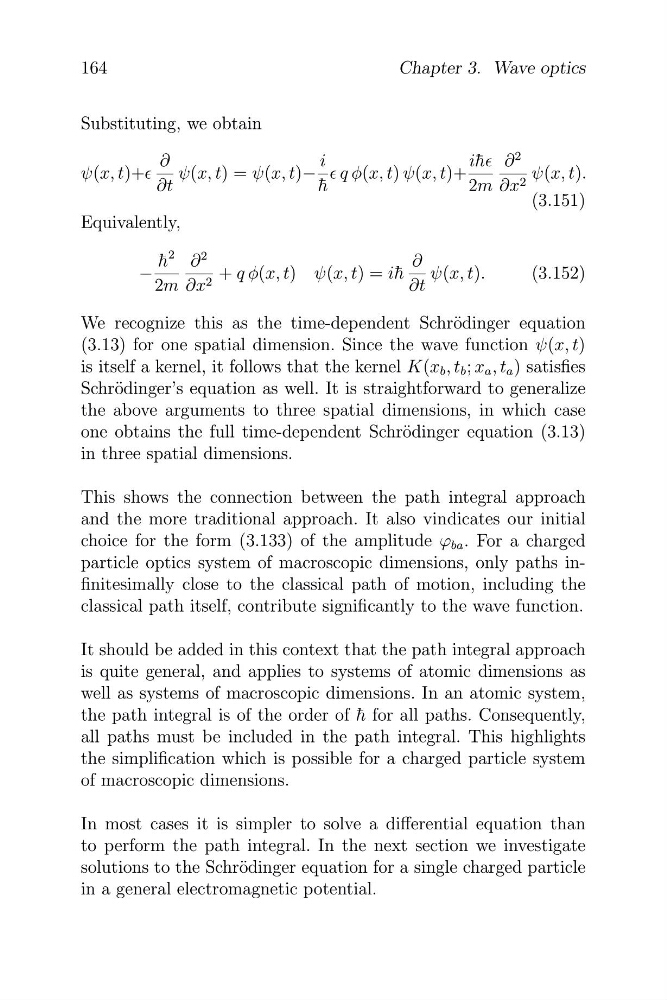
Substituting, we obtain
∂
i
hf
i¯ ∂
2
ψ(x, t)+f ψ(x, t) = ψ(x, t)− f q φ(x, t) ψ(x, t)+
ψ(x, t).
∂t
h ¯
2m ∂x 2
(3.151)
Equivalently,
h
2 ∂
2
¯
∂
−
+ q φ(x, t) ψ(x, t) = ih ¯
ψ(x, t).
(3.152)
2m ∂x 2
∂t
164
Chapter 3. Wave optics
We recognize this as the time-dependent Schr¨ odinger equation
(3.13) for one spatial dimension. Since the wave function ψ(x, t)
is itself a kernel, it follows that the kernel K(x b , t b ; x a , t a ) satisfies
Schr¨ odinger’s equation as well. It is straightforward to generalize
the above arguments to three spatial dimensions, in which case
one obtains the full time-dependent Schr¨ odinger equation (3.13)
in three spatial dimensions.
This shows the connection between the path integral approach
and the more traditional approach. It also vindicates our initial
choice for the form (3.133) of the amplitude ϕ ba . For a charged
particle optics system of macroscopic dimensions, only paths infinitesimally close to the classical path of motion, including the
classical path itself, contribute significantly to the wave function.
It should be added in this context that the path integral approach
is quite general, and applies to systems of atomic dimensions as
well as systems of macroscopic dimensions. In an atomic system,
the path integral is of the order of ¯
h for all paths. Consequently,
all paths must be included in the path integral. This highlights
the simplification which is possible for a charged particle system
of macroscopic dimensions.
In most cases it is simpler to solve a differential equation than
to perform the path integral. In the next section we investigate
solutions to the Schr¨ odinger equation for a single charged particle
in a general electromagnetic potential.
∂
i
hf
i¯ ∂
2
ψ(x, t)+f ψ(x, t) = ψ(x, t)− f q φ(x, t) ψ(x, t)+
ψ(x, t).
∂t
h ¯
2m ∂x 2
(3.151)
Equivalently,
h
2 ∂
2
¯
∂
−
+ q φ(x, t) ψ(x, t) = ih ¯
ψ(x, t).
(3.152)
2m ∂x 2
∂t
164
Chapter 3. Wave optics
We recognize this as the time-dependent Schr¨ odinger equation
(3.13) for one spatial dimension. Since the wave function ψ(x, t)
is itself a kernel, it follows that the kernel K(x b , t b ; x a , t a ) satisfies
Schr¨ odinger’s equation as well. It is straightforward to generalize
the above arguments to three spatial dimensions, in which case
one obtains the full time-dependent Schr¨ odinger equation (3.13)
in three spatial dimensions.
This shows the connection between the path integral approach
and the more traditional approach. It also vindicates our initial
choice for the form (3.133) of the amplitude ϕ ba . For a charged
particle optics system of macroscopic dimensions, only paths infinitesimally close to the classical path of motion, including the
classical path itself, contribute significantly to the wave function.
It should be added in this context that the path integral approach
is quite general, and applies to systems of atomic dimensions as
well as systems of macroscopic dimensions. In an atomic system,
the path integral is of the order of ¯
h for all paths. Consequently,
all paths must be included in the path integral. This highlights
the simplification which is possible for a charged particle system
of macroscopic dimensions.
In most cases it is simpler to solve a differential equation than
to perform the path integral. In the next section we investigate
solutions to the Schr¨ odinger equation for a single charged particle
in a general electromagnetic potential.