

3.2. Particle motion in a general electromagnetic potential 163
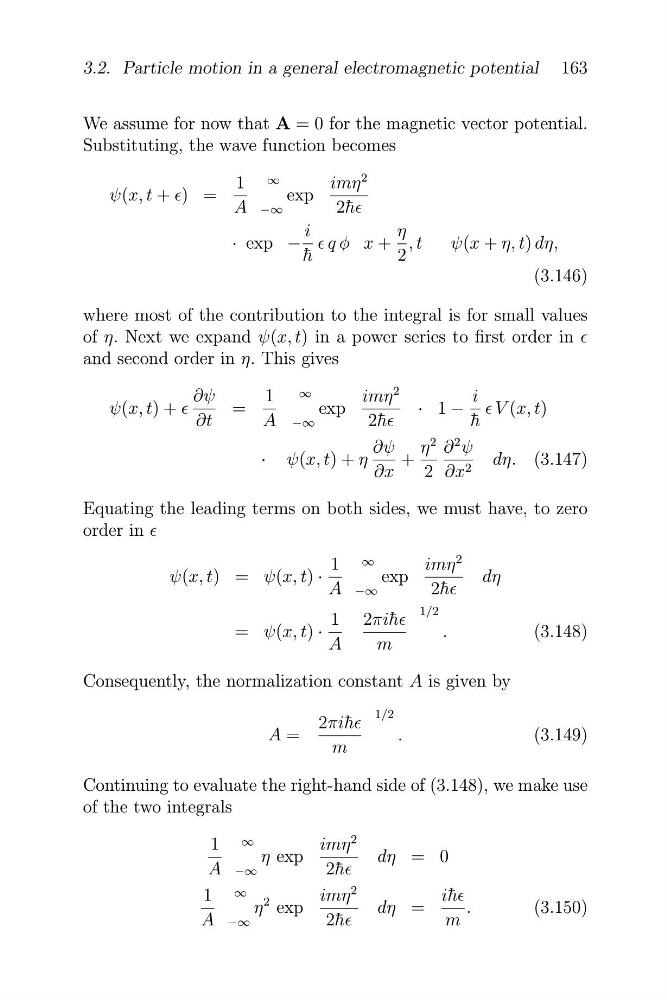
We assume for now that A = 0 for the magnetic vector potential.
Substituting, the wave function becomes
1 ∞
imη
2
ψ(x, t + f) =
exp
A −∞
η
· exp
�
2¯ hf
i
− f q φ x + , t
�
ψ(x + η, t) dη,
h ¯
2
(3.146)
where most of the contribution to the integral is for small values
of η. Next we expand ψ(x, t) in a power series to first order in f
and second order in η. This gives
∂ψ
1 ∞
imη
2
i
ψ(x, t) + f
=
exp
·
�
1 − f V (x, t)
∂t
A
hf
h ¯
�
−∞
2¯
∂ψ η
2 ∂
2 ψ
· ψ(x, t) + η
+
dη. (3.147)
∂x
2 ∂x 2
Equating the leading terms on both sides, we must have, to zero
order in f
1 ∞
imη
2
ψ(x, t) = ψ(x, t) ·
exp
hf
dη
A
1
�
−∞
2¯
1/2
2πihf ¯
= ψ(x, t) ·
�
.
(3.148)
A
m
Consequently, the normalization constant A is given by
�
� 1/2
2πihf ¯
A =
.
(3.149)
m
Continuing to evaluate the right-hand side of (3.148), we make use
of the two integrals
1 ∞
imη
2
η exp
A
dη = 0
−∞
2¯ hf
1 ∞
2
2
imη
η
ihf ¯
exp
dη =
.
(3.150)
A −∞
2¯ hf
m
We assume for now that A = 0 for the magnetic vector potential.
Substituting, the wave function becomes
1 ∞
imη
2
ψ(x, t + f) =
exp
A −∞
η
· exp
�
2¯ hf
i
− f q φ x + , t
�
ψ(x + η, t) dη,
h ¯
2
(3.146)
where most of the contribution to the integral is for small values
of η. Next we expand ψ(x, t) in a power series to first order in f
and second order in η. This gives
∂ψ
1 ∞
imη
2
i
ψ(x, t) + f
=
exp
·
�
1 − f V (x, t)
∂t
A
hf
h ¯
�
−∞
2¯
∂ψ η
2 ∂
2 ψ
· ψ(x, t) + η
+
dη. (3.147)
∂x
2 ∂x 2
Equating the leading terms on both sides, we must have, to zero
order in f
1 ∞
imη
2
ψ(x, t) = ψ(x, t) ·
exp
hf
dη
A
1
�
−∞
2¯
1/2
2πihf ¯
= ψ(x, t) ·
�
.
(3.148)
A
m
Consequently, the normalization constant A is given by
�
� 1/2
2πihf ¯
A =
.
(3.149)
m
Continuing to evaluate the right-hand side of (3.148), we make use
of the two integrals
1 ∞
imη
2
η exp
A
dη = 0
−∞
2¯ hf
1 ∞
2
2
imη
η
ihf ¯
exp
dη =
.
(3.150)
A −∞
2¯ hf
m