

146
Chapter 3. Wave optics
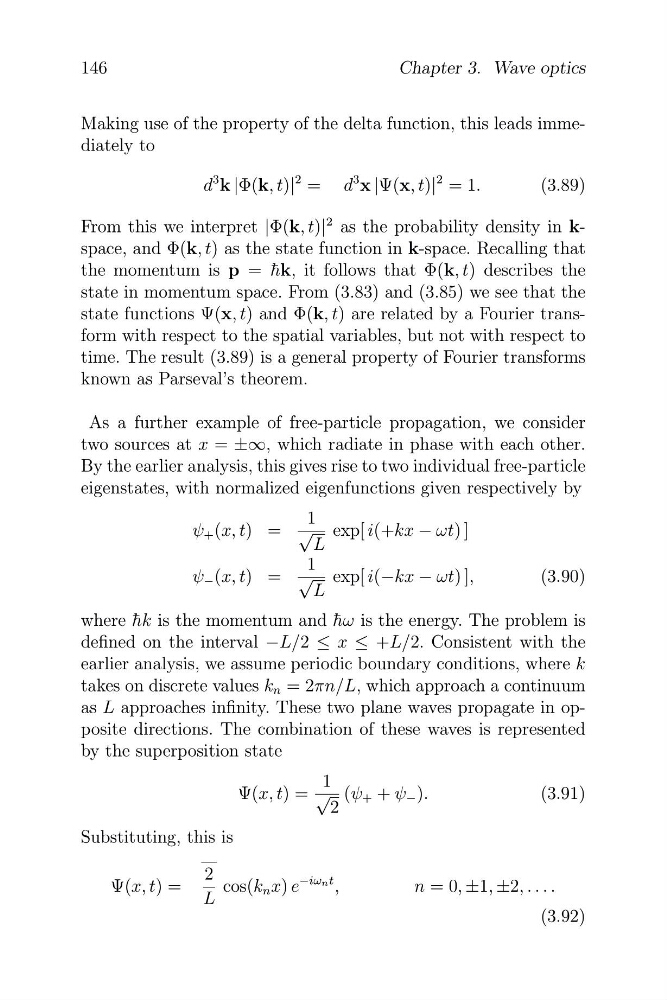
Making use of the property of the delta function, this leads immediately to
d
3
d
3 k |Φ(k, t)|
2 =
x |Ψ(x, t)|
2 = 1.
(3.89)
From this we interpret |Φ(k, t)|
2 as the probability density in kspace, and Φ(k, t) as the state function in k-space. Recalling that
the momentum is p = h ¯k, it follows that Φ(k, t) describes the
state in momentum space. From (3.83) and (3.85) we see that the
state functions Ψ(x, t) and Φ(k, t) are related by a Fourier transform with respect to the spatial variables, but not with respect to
time. The result (3.89) is a general property of Fourier transforms
known as Parseval’s theorem.
As a further example of free-particle propagation, we consider
two sources at x = ±∞, which radiate in phase with each other.
By the earlier analysis, this gives rise to two individual free-particle
eigenstates, with normalized eigenfunctions given respectively by
1
ψ + (x, t) = √ exp[ i(+kx − ωt) ]
L
1
ψ − (x, t) = √ exp[ i(−kx − ωt) ],
(3.90)
L
where ¯
hk is the momentum and ¯
hω is the energy. The problem is
defined on the interval −L/2 ≤ x ≤ +L/2. Consistent with the
earlier analysis, we assume periodic boundary conditions, where k
takes on discrete values k n = 2πn/L, which approach a continuum
as L approaches infinity. These two plane waves propagate in opposite directions. The combination of these waves is represented
by the superposition state
1
Ψ(x, t) = √ (ψ + + ψ − ).
(3.91)
2
Substituting, this is
2
−iωnt
Ψ(x, t) =
cos(k n x) e
,
n = 0, ±1, ±2, . . . .
L
(3.92)
Chapter 3. Wave optics
Making use of the property of the delta function, this leads immediately to
d
3
d
3 k |Φ(k, t)|
2 =
x |Ψ(x, t)|
2 = 1.
(3.89)
From this we interpret |Φ(k, t)|
2 as the probability density in kspace, and Φ(k, t) as the state function in k-space. Recalling that
the momentum is p = h ¯k, it follows that Φ(k, t) describes the
state in momentum space. From (3.83) and (3.85) we see that the
state functions Ψ(x, t) and Φ(k, t) are related by a Fourier transform with respect to the spatial variables, but not with respect to
time. The result (3.89) is a general property of Fourier transforms
known as Parseval’s theorem.
As a further example of free-particle propagation, we consider
two sources at x = ±∞, which radiate in phase with each other.
By the earlier analysis, this gives rise to two individual free-particle
eigenstates, with normalized eigenfunctions given respectively by
1
ψ + (x, t) = √ exp[ i(+kx − ωt) ]
L
1
ψ − (x, t) = √ exp[ i(−kx − ωt) ],
(3.90)
L
where ¯
hk is the momentum and ¯
hω is the energy. The problem is
defined on the interval −L/2 ≤ x ≤ +L/2. Consistent with the
earlier analysis, we assume periodic boundary conditions, where k
takes on discrete values k n = 2πn/L, which approach a continuum
as L approaches infinity. These two plane waves propagate in opposite directions. The combination of these waves is represented
by the superposition state
1
Ψ(x, t) = √ (ψ + + ψ − ).
(3.91)
2
Substituting, this is
2
−iωnt
Ψ(x, t) =
cos(k n x) e
,
n = 0, ±1, ±2, . . . .
L
(3.92)