

3.1. Quantum mechanical description of particle motion
145
where d
3 k is the volume element in k-space corresponding to one
state (dN = 1). Separately from (3.68, 3.81),
a k
(2π)
3/2
1
iω k t
d
3
−ik·x
√ =
Φ(k, t) = e
x Ψ(x, t) e
,
(3.84)
V
V
V V
where the integral is over the cubic volume V . Again taking the
limit of V very large, this becomes equivalent to
1
d
3
−i(k·x−ω k t)
Φ(k, t) =
x Ψ(x, t) e
,
(3.85)
(2π) 3/2
where the integral is now over all space. In order for this integral
to converge, it is necessary that the state function falls to zero
for very large x. This is equivalent to saying that the particle is
localized over some finite region of space.
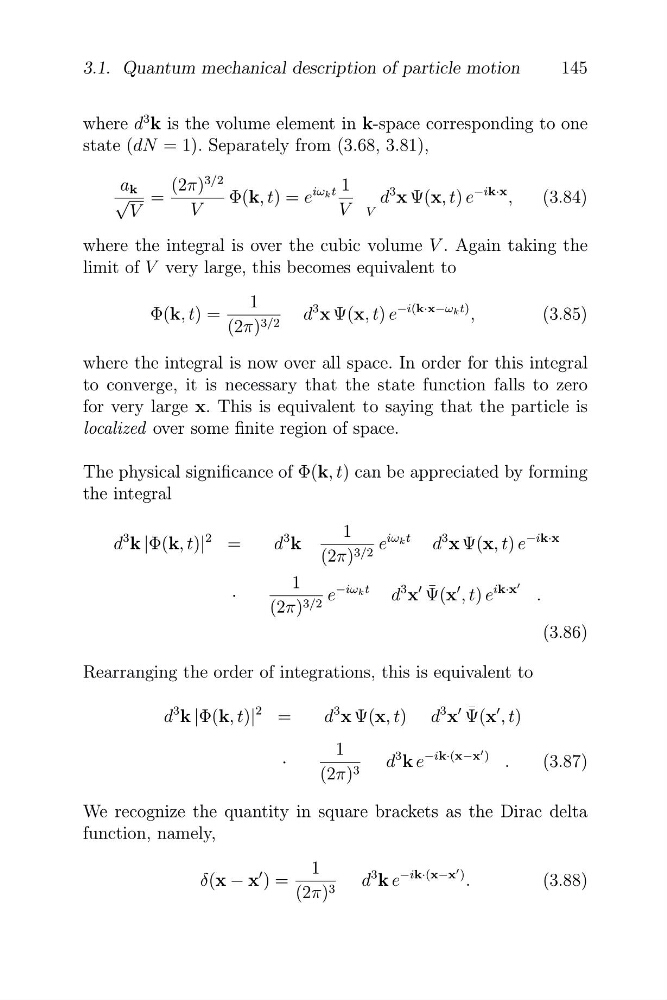
The physical significance of Φ(k, t) can be appreciated by forming
the integral
1
iω k t
−ik·x
d
3 k |Φ(k, t)|
2 =
d
3 k
e
d
3 x Ψ(x, t) e
(2π) 3/2
1
�
−iω k t
d
3 � ¯ �
ik·x
·
e
x Ψ(x , t) e
.
(2π) 3/2
(3.86)
Rearranging the order of integrations, this is equivalent to
d
3
d
3 � ¯ �
d
3 k |Φ(k, t)|
2 =
x Ψ(x, t)
x Ψ(x , t)
1
� )
−ik·(x−x
·
d
3 k e
.
(3.87)
(2π) 3
We recognize the quantity in square brackets as the Dirac delta
function, namely,
1
� )
−ik·(x−x
δ(x − x
� ) =
d
3 k e
.
(3.88)
(2π) 3
145
where d
3 k is the volume element in k-space corresponding to one
state (dN = 1). Separately from (3.68, 3.81),
a k
(2π)
3/2
1
iω k t
d
3
−ik·x
√ =
Φ(k, t) = e
x Ψ(x, t) e
,
(3.84)
V
V
V V
where the integral is over the cubic volume V . Again taking the
limit of V very large, this becomes equivalent to
1
d
3
−i(k·x−ω k t)
Φ(k, t) =
x Ψ(x, t) e
,
(3.85)
(2π) 3/2
where the integral is now over all space. In order for this integral
to converge, it is necessary that the state function falls to zero
for very large x. This is equivalent to saying that the particle is
localized over some finite region of space.
The physical significance of Φ(k, t) can be appreciated by forming
the integral
1
iω k t
−ik·x
d
3 k |Φ(k, t)|
2 =
d
3 k
e
d
3 x Ψ(x, t) e
(2π) 3/2
1
�
−iω k t
d
3 � ¯ �
ik·x
·
e
x Ψ(x , t) e
.
(2π) 3/2
(3.86)
Rearranging the order of integrations, this is equivalent to
d
3
d
3 � ¯ �
d
3 k |Φ(k, t)|
2 =
x Ψ(x, t)
x Ψ(x , t)
1
� )
−ik·(x−x
·
d
3 k e
.
(3.87)
(2π) 3
We recognize the quantity in square brackets as the Dirac delta
function, namely,
1
� )
−ik·(x−x
δ(x − x
� ) =
d
3 k e
.
(3.88)
(2π) 3