

3.1. Quantum mechanical description of particle motion
147
The resulting intensity is
2
|Ψ(x, t)|
2 = cos
2 (k n x).
(3.93)
L
We notice immediately that the time has dropped out, thus forming a standing wave. This satisfies the normalization condition
L/2
dx |Ψ(x, t)|
2 = 1
(3.94)
−L/2
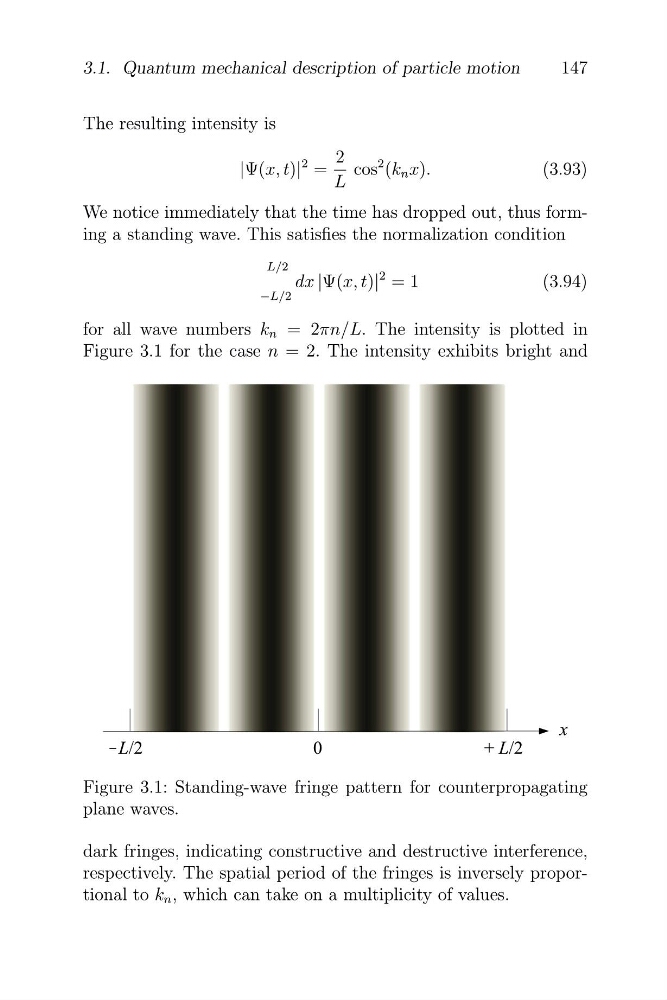
for all wave numbers k n = 2πn/L. The intensity is plotted in
Figure 3.1 for the case n = 2. The intensity exhibits bright and
–
Figure 3.1: Standing-wave fringe pattern for counterpropagating
plane waves.
dark fringes, indicating constructive and destructive interference,
respectively. The spatial period of the fringes is inversely proportional to k n , which can take on a multiplicity of values.
147
The resulting intensity is
2
|Ψ(x, t)|
2 = cos
2 (k n x).
(3.93)
L
We notice immediately that the time has dropped out, thus forming a standing wave. This satisfies the normalization condition
L/2
dx |Ψ(x, t)|
2 = 1
(3.94)
−L/2
for all wave numbers k n = 2πn/L. The intensity is plotted in
Figure 3.1 for the case n = 2. The intensity exhibits bright and
–
Figure 3.1: Standing-wave fringe pattern for counterpropagating
plane waves.
dark fringes, indicating constructive and destructive interference,
respectively. The spatial period of the fringes is inversely proportional to k n , which can take on a multiplicity of values.