

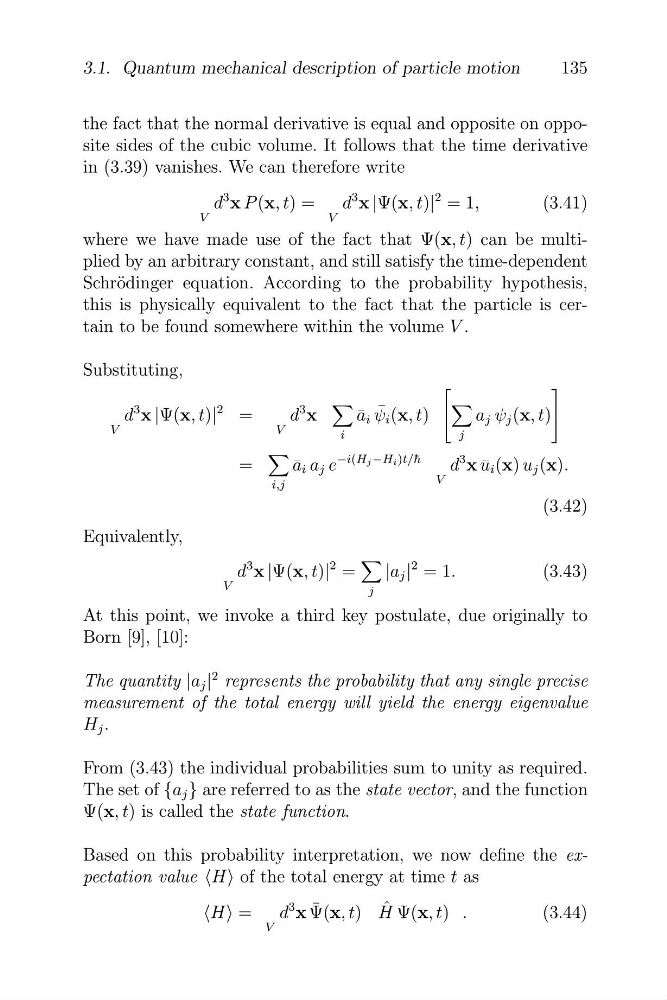
the fact that the normal derivative is equal and opposite on opposite sides of the cubic volume. It follows that the time derivative
in (3.39) vanishes. We can therefore write
d
3
d
3
x P (x, t) =
x |Ψ(x, t)|
2 = 1,
(3.41)
V
V
where we have made use of the fact that Ψ(x, t) can be multiplied by an arbitrary constant, and still satisfy the time-dependent
Schr¨ odinger equation. According to the probability hypothesis,
this is physically equivalent to the fact that the particle is certain to be found somewhere within the volume V .
Substituting,
⎡
⎤
4
4
d
3
d
3
¯
⎣
⎦
x |Ψ(x, t)|
2 =
x
a ¯ i ψ i (x, t)
a j ψ j (x, t)
V
V
i
j
4
−i(H j −H i )t/¯ h
=
a ¯ i a j e
d
3 x u ¯ i (x) u j (x).
V
i,j
(3.42)
Equivalently,
4
d
3 x |Ψ(x, t)|
2 =
|a j |
2 = 1.
(3.43)
V
j
At this point, we invoke a third key postulate, due originally to
Born [9], [10]:
The quantity |a j |
2 represents the probability that any single precise
measurement of the total energy will yield the energy eigenvalue
H j .
From (3.43) the individual probabilities sum to unity as required.
The set of {a j } are referred to as the state vector, and the function
Ψ(x, t) is called the state function.
Based on this probability interpretation, we now define the expectation value (H) of the total energy at time t as
d
3 ¯
ˆ
(H) =
x Ψ(x, t) H Ψ(x, t) .
(3.44)
V
3.1. Quantum mechanical description of particle motion
135
in (3.39) vanishes. We can therefore write
d
3
d
3
x P (x, t) =
x |Ψ(x, t)|
2 = 1,
(3.41)
V
V
where we have made use of the fact that Ψ(x, t) can be multiplied by an arbitrary constant, and still satisfy the time-dependent
Schr¨ odinger equation. According to the probability hypothesis,
this is physically equivalent to the fact that the particle is certain to be found somewhere within the volume V .
Substituting,
⎡
⎤
4
4
d
3
d
3
¯
⎣
⎦
x |Ψ(x, t)|
2 =
x
a ¯ i ψ i (x, t)
a j ψ j (x, t)
V
V
i
j
4
−i(H j −H i )t/¯ h
=
a ¯ i a j e
d
3 x u ¯ i (x) u j (x).
V
i,j
(3.42)
Equivalently,
4
d
3 x |Ψ(x, t)|
2 =
|a j |
2 = 1.
(3.43)
V
j
At this point, we invoke a third key postulate, due originally to
Born [9], [10]:
The quantity |a j |
2 represents the probability that any single precise
measurement of the total energy will yield the energy eigenvalue
H j .
From (3.43) the individual probabilities sum to unity as required.
The set of {a j } are referred to as the state vector, and the function
Ψ(x, t) is called the state function.
Based on this probability interpretation, we now define the expectation value (H) of the total energy at time t as
d
3 ¯
ˆ
(H) =
x Ψ(x, t) H Ψ(x, t) .
(3.44)
V
3.1. Quantum mechanical description of particle motion
135