

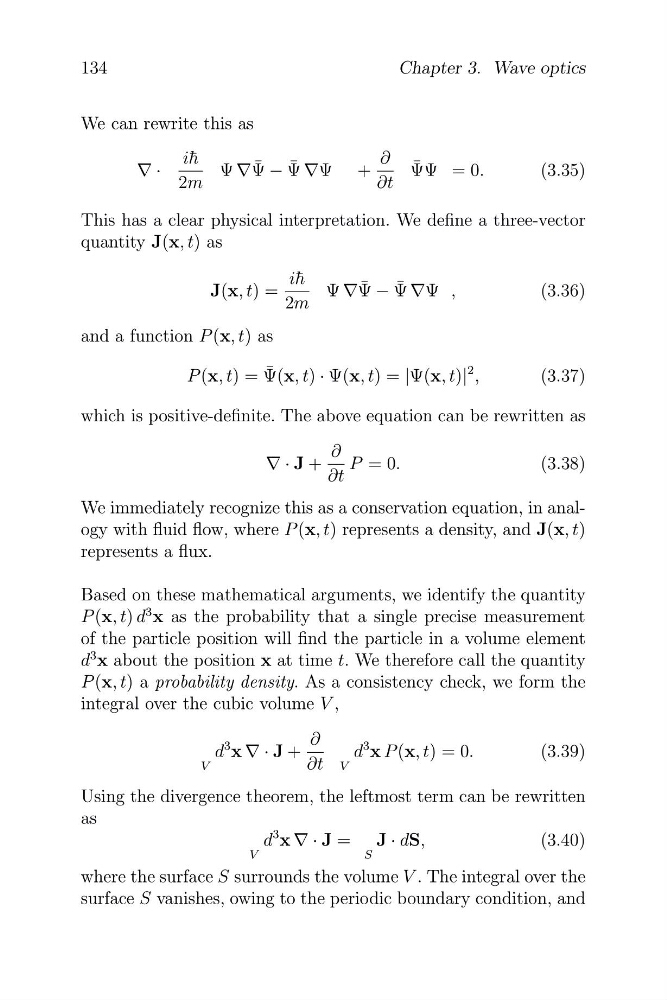
We can rewrite this as
ih ¯
∂
Ψ vΨ ¯ − ¯
¯
v ·
Ψ vΨ +
ΨΨ = 0.
(3.35)
2m
∂t
This has a clear physical interpretation. We define a three-vector
quantity J(x, t) as
J(x, t) =
i¯ h
2m
Ψ v ¯
Ψ − ¯
Ψ vΨ ,
(3.36)
and a function P (x, t) as
P (x, t) = ¯
Ψ(x, t) · Ψ(x, t) = |Ψ(x, t)|
2 ,
(3.37)
which is positive-definite. The above equation can be rewritten as
∂
v · J +
P = 0.
(3.38)
∂t
We immediately recognize this as a conservation equation, in analogy with fluid flow, where P (x, t) represents a density, and J(x, t)
represents a flux.
Based on these mathematical arguments, we identify the quantity
P (x, t) d
3 x as the probability that a single precise measurement
of the particle position will find the particle in a volume element
d
3 x about the position x at time t. We therefore call the quantity
P (x, t) a probability density. As a consistency check, we form the
integral over the cubic volume V ,
∂
d
3
d
3
x v · J +
x P (x, t) = 0.
(3.39)
V
∂t V
Using the divergence theorem, the leftmost term can be rewritten
as
d
3 x v · J = J · dS,
(3.40)
V
S
where the surface S surrounds the volume V . The integral over the
surface S vanishes, owing to the periodic boundary condition, and
134
Chapter 3. Wave optics
ih ¯
∂
Ψ vΨ ¯ − ¯
¯
v ·
Ψ vΨ +
ΨΨ = 0.
(3.35)
2m
∂t
This has a clear physical interpretation. We define a three-vector
quantity J(x, t) as
J(x, t) =
i¯ h
2m
Ψ v ¯
Ψ − ¯
Ψ vΨ ,
(3.36)
and a function P (x, t) as
P (x, t) = ¯
Ψ(x, t) · Ψ(x, t) = |Ψ(x, t)|
2 ,
(3.37)
which is positive-definite. The above equation can be rewritten as
∂
v · J +
P = 0.
(3.38)
∂t
We immediately recognize this as a conservation equation, in analogy with fluid flow, where P (x, t) represents a density, and J(x, t)
represents a flux.
Based on these mathematical arguments, we identify the quantity
P (x, t) d
3 x as the probability that a single precise measurement
of the particle position will find the particle in a volume element
d
3 x about the position x at time t. We therefore call the quantity
P (x, t) a probability density. As a consistency check, we form the
integral over the cubic volume V ,
∂
d
3
d
3
x v · J +
x P (x, t) = 0.
(3.39)
V
∂t V
Using the divergence theorem, the leftmost term can be rewritten
as
d
3 x v · J = J · dS,
(3.40)
V
S
where the surface S surrounds the volume V . The integral over the
surface S vanishes, owing to the periodic boundary condition, and
134
Chapter 3. Wave optics