

�
�
(3.30) represent two very useful mathematical properties in the
discussion to follow.
According to the second postulate above, a single precise measurement of the dynamical variable H must yield one and only
one of the eigenvalues H j . It is logical to enquire what determines
which of the eigenvalues it must be, or is likely to be, given a
specified experimental condition. We now turn our attention to
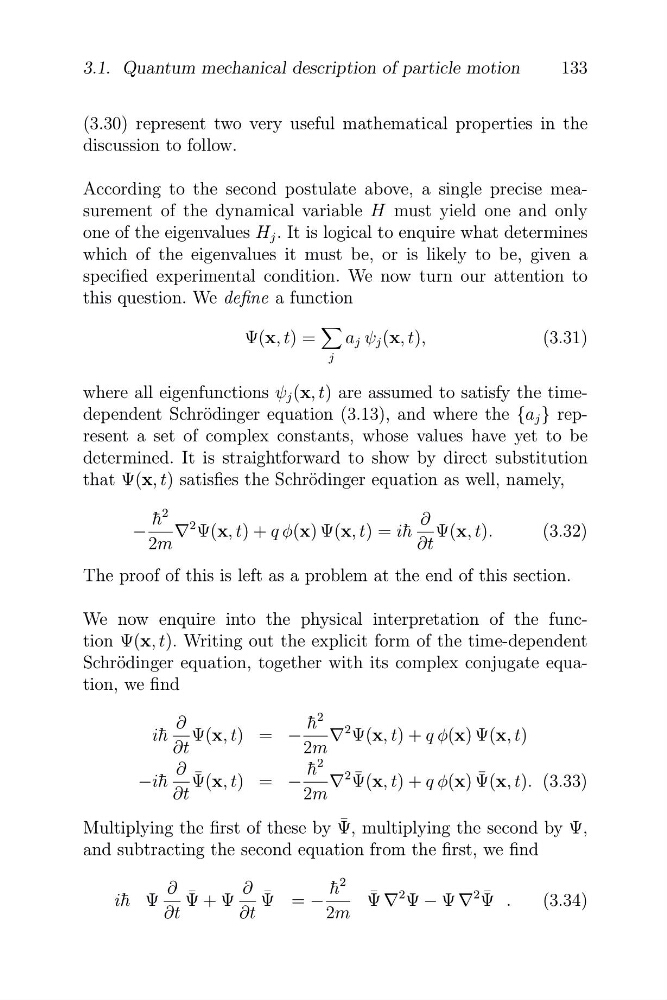
this question. We define a function
4
Ψ(x, t) =
a j ψ j (x, t),
(3.31)
j
where all eigenfunctions ψ j (x, t) are assumed to satisfy the timedependent Schr¨ odinger equation (3.13), and where the {a j } represent a set of complex constants, whose values have yet to be
determined. It is straightforward to show by direct substitution
that Ψ(x, t) satisfies the Schr¨ odinger equation as well, namely,
h
2
−
¯ v
2 Ψ(x, t) + q φ(x) Ψ(x, t) = ih ¯
∂ Ψ(x, t).
(3.32)
2m
∂t
The proof of this is left as a problem at the end of this section.
We now enquire into the physical interpretation of the function Ψ(x, t). Writing out the explicit form of the time-dependent
Schr¨ odinger equation, together with its complex conjugate equation, we find
h
2
ih ¯
∂ Ψ(x, t) = −
¯ v
2 Ψ(x, t) + q φ(x) Ψ(x, t)
∂t
2m
h
2
¯
2 ¯
−ih ¯ Ψ(x, t) = −
v
Ψ(x, t).
∂
¯
Ψ(x, t) + q φ(x) ¯
(3.33)
∂t
2m
¯
Multiplying the first of these by Ψ, multiplying the second by Ψ,
and subtracting the second equation from the first, we find
h
2
∂
∂
¯
¯
¯
¯
2 ¯
ih ¯ Ψ Ψ + Ψ Ψ = −
Ψ v
2 Ψ − Ψ v Ψ .
(3.34)
∂t
∂t
2m
3.1. Quantum mechanical description of particle motion
133
�
(3.30) represent two very useful mathematical properties in the
discussion to follow.
According to the second postulate above, a single precise measurement of the dynamical variable H must yield one and only
one of the eigenvalues H j . It is logical to enquire what determines
which of the eigenvalues it must be, or is likely to be, given a
specified experimental condition. We now turn our attention to
this question. We define a function
4
Ψ(x, t) =
a j ψ j (x, t),
(3.31)
j
where all eigenfunctions ψ j (x, t) are assumed to satisfy the timedependent Schr¨ odinger equation (3.13), and where the {a j } represent a set of complex constants, whose values have yet to be
determined. It is straightforward to show by direct substitution
that Ψ(x, t) satisfies the Schr¨ odinger equation as well, namely,
h
2
−
¯ v
2 Ψ(x, t) + q φ(x) Ψ(x, t) = ih ¯
∂ Ψ(x, t).
(3.32)
2m
∂t
The proof of this is left as a problem at the end of this section.
We now enquire into the physical interpretation of the function Ψ(x, t). Writing out the explicit form of the time-dependent
Schr¨ odinger equation, together with its complex conjugate equation, we find
h
2
ih ¯
∂ Ψ(x, t) = −
¯ v
2 Ψ(x, t) + q φ(x) Ψ(x, t)
∂t
2m
h
2
¯
2 ¯
−ih ¯ Ψ(x, t) = −
v
Ψ(x, t).
∂
¯
Ψ(x, t) + q φ(x) ¯
(3.33)
∂t
2m
¯
Multiplying the first of these by Ψ, multiplying the second by Ψ,
and subtracting the second equation from the first, we find
h
2
∂
∂
¯
¯
¯
¯
2 ¯
ih ¯ Ψ Ψ + Ψ Ψ = −
Ψ v
2 Ψ − Ψ v Ψ .
(3.34)
∂t
∂t
2m
3.1. Quantum mechanical description of particle motion
133