

=
�
132
Chapter 3. Wave optics
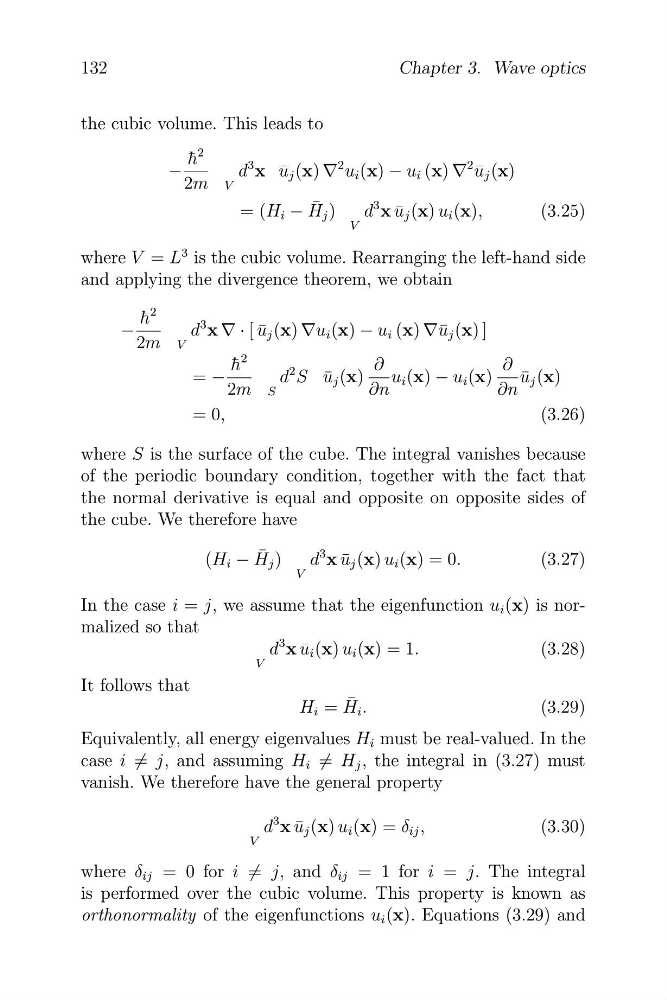
the cubic volume. This leads to
h
2
¯
−
d
3 x u ¯ j (x) v
2 u i (x) − u i (x) v
2 u ¯ j (x)
2m V
¯
d
3
= (H i − H j )
x u ¯ j (x) u i (x),
(3.25)
V
where V = L
3 is the cubic volume. Rearranging the left-hand side
and applying the divergence theorem, we obtain
h
2
¯
−
d
3 x v · [ ¯
u j (x) vu i (x) − u i (x) vu ¯ j (x) ]
2m V
h
2
= −
¯
d
2 S u ¯ j (x)
∂ u i (x) − u i (x)
∂ u ¯ j (x)
2m S
∂n
∂n
= 0,
(3.26)
where S is the surface of the cube. The integral vanishes because
of the periodic boundary condition, together with the fact that
the normal derivative is equal and opposite on opposite sides of
the cube. We therefore have
(H i − H ¯ j )
d
3 x u ¯ j (x) u i (x) = 0.
(3.27)
V
In the case i = j, we assume that the eigenfunction u i (x) is normalized so that
d
3 x u ¯ i (x) u i (x) = 1.
(3.28)
V
It follows that
¯
H i = H i .
(3.29)
Equivalently, all energy eigenvalues H i must be real-valued. In the
case i � j, and assuming H i = H j , the integral in (3.27) must
vanish. We therefore have the general property
d
3 x u ¯ j (x) u i (x) = δ ij ,
(3.30)
V
where δ ij = 0 for i � j, and δ ij = 1 for i = j. The integral
=
is performed over the cubic volume. This property is known as
orthonormality of the eigenfunctions u i (x). Equations (3.29) and
�
132
Chapter 3. Wave optics
the cubic volume. This leads to
h
2
¯
−
d
3 x u ¯ j (x) v
2 u i (x) − u i (x) v
2 u ¯ j (x)
2m V
¯
d
3
= (H i − H j )
x u ¯ j (x) u i (x),
(3.25)
V
where V = L
3 is the cubic volume. Rearranging the left-hand side
and applying the divergence theorem, we obtain
h
2
¯
−
d
3 x v · [ ¯
u j (x) vu i (x) − u i (x) vu ¯ j (x) ]
2m V
h
2
= −
¯
d
2 S u ¯ j (x)
∂ u i (x) − u i (x)
∂ u ¯ j (x)
2m S
∂n
∂n
= 0,
(3.26)
where S is the surface of the cube. The integral vanishes because
of the periodic boundary condition, together with the fact that
the normal derivative is equal and opposite on opposite sides of
the cube. We therefore have
(H i − H ¯ j )
d
3 x u ¯ j (x) u i (x) = 0.
(3.27)
V
In the case i = j, we assume that the eigenfunction u i (x) is normalized so that
d
3 x u ¯ i (x) u i (x) = 1.
(3.28)
V
It follows that
¯
H i = H i .
(3.29)
Equivalently, all energy eigenvalues H i must be real-valued. In the
case i � j, and assuming H i = H j , the integral in (3.27) must
vanish. We therefore have the general property
d
3 x u ¯ j (x) u i (x) = δ ij ,
(3.30)
V
where δ ij = 0 for i � j, and δ ij = 1 for i = j. The integral
=
is performed over the cubic volume. This property is known as
orthonormality of the eigenfunctions u i (x). Equations (3.29) and