

3.1. Quantum mechanical description of particle motion
127
where the operation is again multiplication. We assume for now
that the electromagnetic potentials have no explicit time dependence. We will generalize this to the time-dependent case in a later
section.
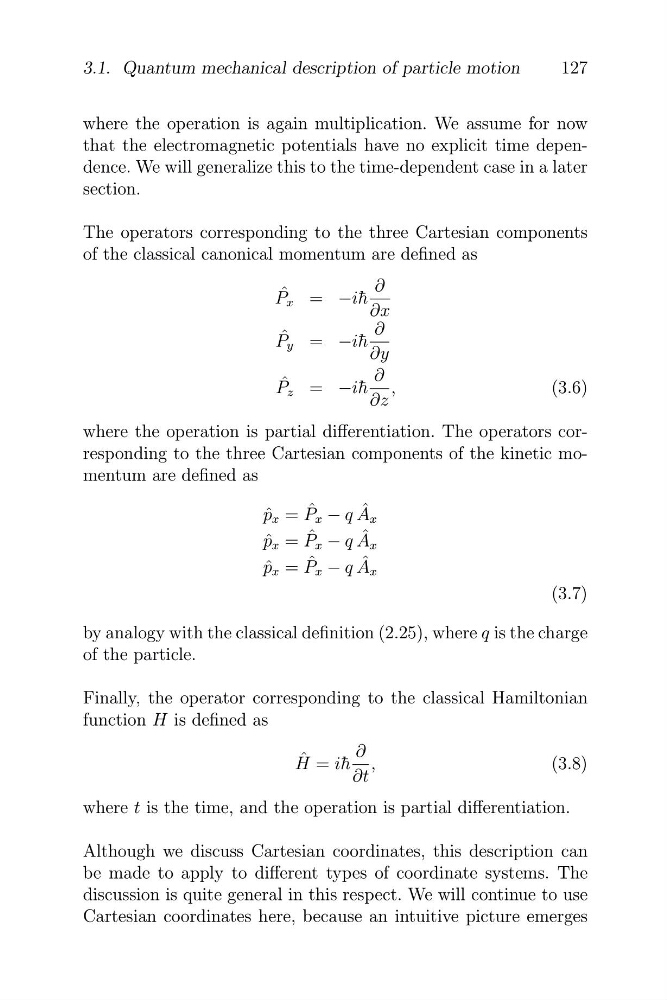
The operators corresponding to the three Cartesian components
of the classical canonical momentum are defined as
∂
ˆ
P x = −ih ¯ ∂x
∂
P ˆ y = −ih ¯ ∂y
∂
ˆ
P z = −ih ¯ ,
(3.6)
∂z
where the operation is partial differentiation. The operators corresponding to the three Cartesian components of the kinetic momentum are defined as
ˆ
ˆ
p ˆ x = P x − q A x
ˆ
ˆ
p ˆ x = P x − q A x
ˆ
ˆ
p ˆ x = P x − q A x
(3.7)
by analogy with the classical definition (2.25), where q is the charge
of the particle.
Finally, the operator corresponding to the classical Hamiltonian
function H is defined as
∂
ˆ
H = ih ¯ ,
(3.8)
∂t
where t is the time, and the operation is partial differentiation.
Although we discuss Cartesian coordinates, this description can
be made to apply to different types of coordinate systems. The
discussion is quite general in this respect. We will continue to use
Cartesian coordinates here, because an intuitive picture emerges
127
where the operation is again multiplication. We assume for now
that the electromagnetic potentials have no explicit time dependence. We will generalize this to the time-dependent case in a later
section.
The operators corresponding to the three Cartesian components
of the classical canonical momentum are defined as
∂
ˆ
P x = −ih ¯ ∂x
∂
P ˆ y = −ih ¯ ∂y
∂
ˆ
P z = −ih ¯ ,
(3.6)
∂z
where the operation is partial differentiation. The operators corresponding to the three Cartesian components of the kinetic momentum are defined as
ˆ
ˆ
p ˆ x = P x − q A x
ˆ
ˆ
p ˆ x = P x − q A x
ˆ
ˆ
p ˆ x = P x − q A x
(3.7)
by analogy with the classical definition (2.25), where q is the charge
of the particle.
Finally, the operator corresponding to the classical Hamiltonian
function H is defined as
∂
ˆ
H = ih ¯ ,
(3.8)
∂t
where t is the time, and the operation is partial differentiation.
Although we discuss Cartesian coordinates, this description can
be made to apply to different types of coordinate systems. The
discussion is quite general in this respect. We will continue to use
Cartesian coordinates here, because an intuitive picture emerges