

126
Chapter 3. Wave optics
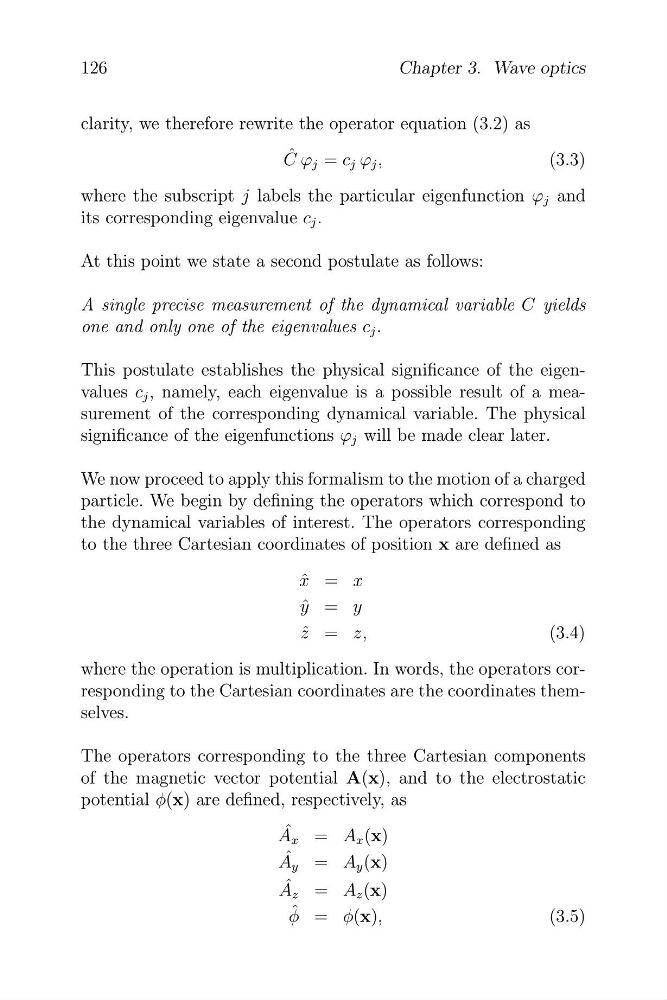
clarity, we therefore rewrite the operator equation (3.2) as
ˆ
C ϕ j = c j ϕ j ,
(3.3)
where the subscript j labels the particular eigenfunction ϕ j and
its corresponding eigenvalue c j .
At this point we state a second postulate as follows:
A single precise measurement of the dynamical variable C yields
one and only one of the eigenvalues c j .
This postulate establishes the physical significance of the eigenvalues c j , namely, each eigenvalue is a possible result of a measurement of the corresponding dynamical variable. The physical
significance of the eigenfunctions ϕ j will be made clear later.
We now proceed to apply this formalism to the motion of a charged
particle. We begin by defining the operators which correspond to
the dynamical variables of interest. The operators corresponding
to the three Cartesian coordinates of position x are defined as
x ˆ = x
y ˆ = y
z ˆ = z,
(3.4)
where the operation is multiplication. In words, the operators corresponding to the Cartesian coordinates are the coordinates themselves.
The operators corresponding to the three Cartesian components
of the magnetic vector potential A(x), and to the electrostatic
potential φ(x) are defined, respectively, as
ˆ
A x = A x (x)
A ˆ y = A y (x)
ˆ
A z = A z (x)
ˆ
φ = φ(x),
(3.5)
Chapter 3. Wave optics
clarity, we therefore rewrite the operator equation (3.2) as
ˆ
C ϕ j = c j ϕ j ,
(3.3)
where the subscript j labels the particular eigenfunction ϕ j and
its corresponding eigenvalue c j .
At this point we state a second postulate as follows:
A single precise measurement of the dynamical variable C yields
one and only one of the eigenvalues c j .
This postulate establishes the physical significance of the eigenvalues c j , namely, each eigenvalue is a possible result of a measurement of the corresponding dynamical variable. The physical
significance of the eigenfunctions ϕ j will be made clear later.
We now proceed to apply this formalism to the motion of a charged
particle. We begin by defining the operators which correspond to
the dynamical variables of interest. The operators corresponding
to the three Cartesian coordinates of position x are defined as
x ˆ = x
y ˆ = y
z ˆ = z,
(3.4)
where the operation is multiplication. In words, the operators corresponding to the Cartesian coordinates are the coordinates themselves.
The operators corresponding to the three Cartesian components
of the magnetic vector potential A(x), and to the electrostatic
potential φ(x) are defined, respectively, as
ˆ
A x = A x (x)
A ˆ y = A y (x)
ˆ
A z = A z (x)
ˆ
φ = φ(x),
(3.5)