

120
Chapter 2. Geometrical optics
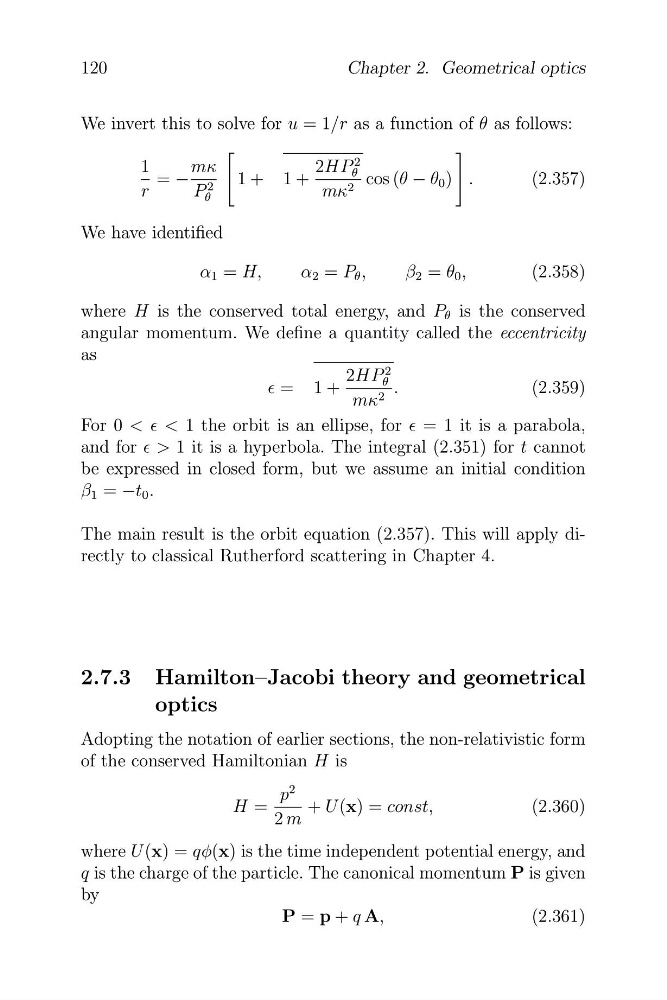
We invert this to solve for u = 1/r as a function of θ as follows:
⎡
⎤
1
mκ
2HP
2
= −
⎣ 1 + 1 +
θ cos (θ − θ 0 ) ⎦ .
(2.357)
r
P θ
2
mκ 2
We have identified
α 1 = H,
α 2 = P θ ,
β 2 = θ 0 ,
(2.358)
where H is the conserved total energy, and P θ is the conserved
angular momentum. We define a quantity called the eccentricity
as
2HP θ
2
f = 1 +
.
(2.359)
mκ 2
For 0 < f < 1 the orbit is an ellipse, for f = 1 it is a parabola,
and for f > 1 it is a hyperbola. The integral (2.351) for t cannot
be expressed in closed form, but we assume an initial condition
β 1 = −t 0 .
The main result is the orbit equation (2.357). This will apply directly to classical Rutherford scattering in Chapter 4.
2.7.3 Hamilton–Jacobi theory and geometrical
optics
Adopting the notation of earlier sections, the non-relativistic form
of the conserved Hamiltonian H is
2
p
H =
+ U (x) = const,
(2.360)
2 m
where U (x) = qφ(x) is the time independent potential energy, and
q is the charge of the particle. The canonical momentum P is given
by
P = p + q A,
(2.361)
Chapter 2. Geometrical optics
We invert this to solve for u = 1/r as a function of θ as follows:
⎡
⎤
1
mκ
2HP
2
= −
⎣ 1 + 1 +
θ cos (θ − θ 0 ) ⎦ .
(2.357)
r
P θ
2
mκ 2
We have identified
α 1 = H,
α 2 = P θ ,
β 2 = θ 0 ,
(2.358)
where H is the conserved total energy, and P θ is the conserved
angular momentum. We define a quantity called the eccentricity
as
2HP θ
2
f = 1 +
.
(2.359)
mκ 2
For 0 < f < 1 the orbit is an ellipse, for f = 1 it is a parabola,
and for f > 1 it is a hyperbola. The integral (2.351) for t cannot
be expressed in closed form, but we assume an initial condition
β 1 = −t 0 .
The main result is the orbit equation (2.357). This will apply directly to classical Rutherford scattering in Chapter 4.
2.7.3 Hamilton–Jacobi theory and geometrical
optics
Adopting the notation of earlier sections, the non-relativistic form
of the conserved Hamiltonian H is
2
p
H =
+ U (x) = const,
(2.360)
2 m
where U (x) = qφ(x) is the time independent potential energy, and
q is the charge of the particle. The canonical momentum P is given
by
P = p + q A,
(2.361)