

119
2.7. Hamilton–Jacobi theory
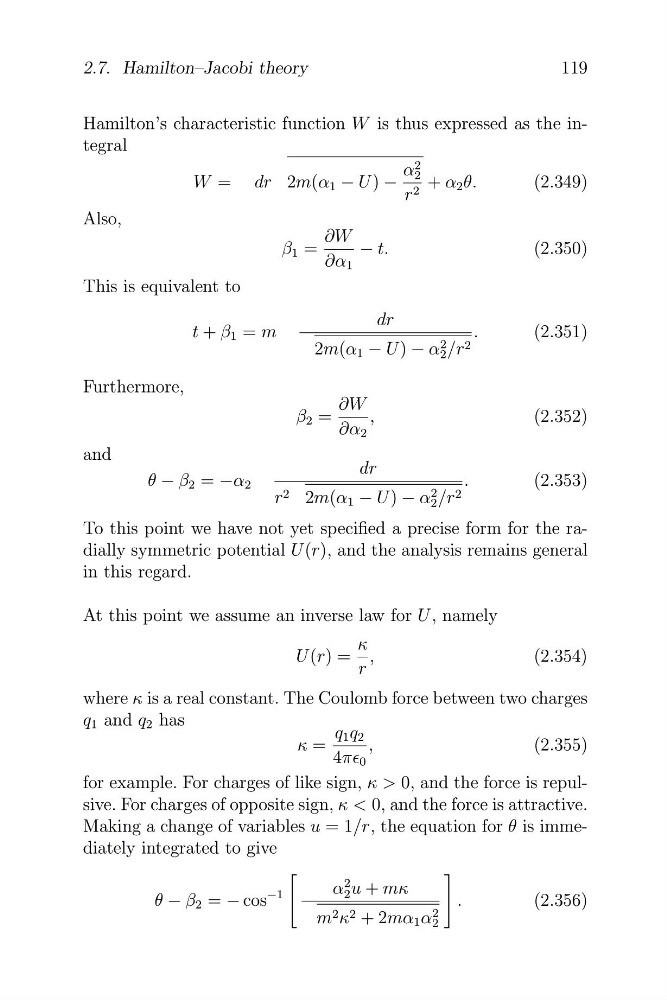
Hamilton’s characteristic function W is thus expressed as the integral
α
2
W = dr 2m(α 1 − U ) −
2 + α 2 θ.
(2.349)
2
r
Also,
∂W
β 1 =
− t.
(2.350)
∂α 1
This is equivalent to
dr
t + β 1 = m
.
(2.351)
2m(α 1 − U ) − α 2
2 /r 2
Furthermore,
∂W
β 2 =
,
(2.352)
∂α 2
and
dr
θ − β 2 = −α 2
.
(2.353)
r 2 2m(α 1 − U ) − α 2
2 /r 2
To this point we have not yet specified a precise form for the radially symmetric potential U (r), and the analysis remains general
in this regard.
At this point we assume an inverse law for U , namely
κ
U (r) = ,
(2.354)
r
where κ is a real constant. The Coulomb force between two charges
q 1 and q 2 has
q 1 q 2
κ =
,
(2.355)
4πf 0
for example. For charges of like sign, κ > 0, and the force is repulsive. For charges of opposite sign, κ < 0, and the force is attractive.
Making a change of variables u = 1/r, the equation for θ is immediately integrated to give
⎡
⎤
−1
α 2
2 u + mκ
θ − β 2 = − cos ⎣
⎦ .
(2.356)
m 2 κ 2 + 2mα 1 α
2
2
2.7. Hamilton–Jacobi theory
Hamilton’s characteristic function W is thus expressed as the integral
α
2
W = dr 2m(α 1 − U ) −
2 + α 2 θ.
(2.349)
2
r
Also,
∂W
β 1 =
− t.
(2.350)
∂α 1
This is equivalent to
dr
t + β 1 = m
.
(2.351)
2m(α 1 − U ) − α 2
2 /r 2
Furthermore,
∂W
β 2 =
,
(2.352)
∂α 2
and
dr
θ − β 2 = −α 2
.
(2.353)
r 2 2m(α 1 − U ) − α 2
2 /r 2
To this point we have not yet specified a precise form for the radially symmetric potential U (r), and the analysis remains general
in this regard.
At this point we assume an inverse law for U , namely
κ
U (r) = ,
(2.354)
r
where κ is a real constant. The Coulomb force between two charges
q 1 and q 2 has
q 1 q 2
κ =
,
(2.355)
4πf 0
for example. For charges of like sign, κ > 0, and the force is repulsive. For charges of opposite sign, κ < 0, and the force is attractive.
Making a change of variables u = 1/r, the equation for θ is immediately integrated to give
⎡
⎤
−1
α 2
2 u + mκ
θ − β 2 = − cos ⎣
⎦ .
(2.356)
m 2 κ 2 + 2mα 1 α
2
2