

�
�
�
�
118
Chapter 2. Geometrical optics
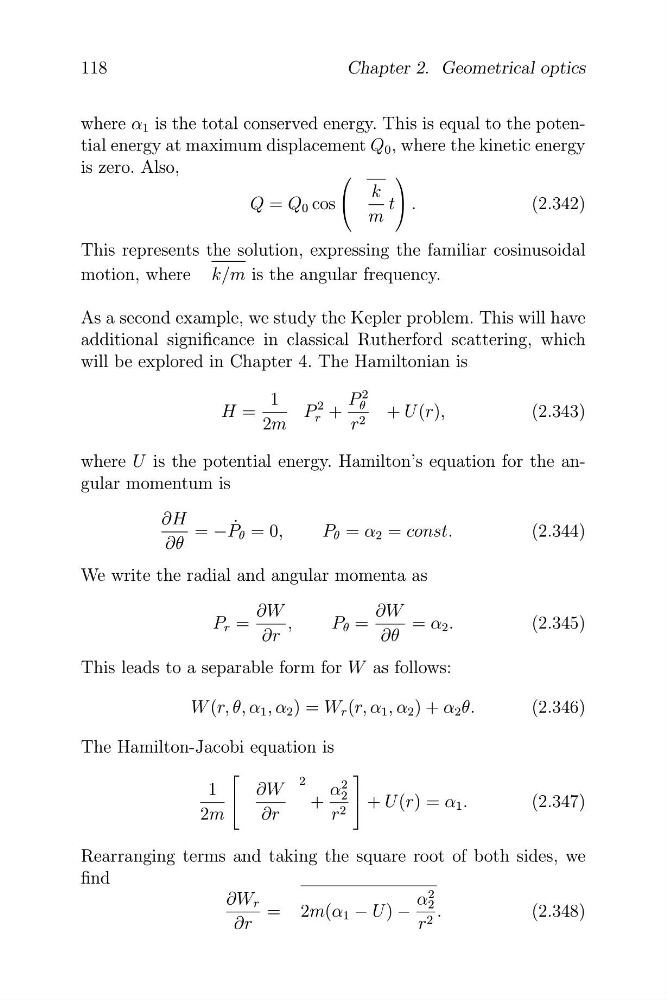
where α 1 is the total conserved energy. This is equal to the potential energy at maximum displacement Q 0 , where the kinetic energy
is zero. Also,
⎛
⎞
k
Q = Q 0 cos ⎝
t ⎠ .
(2.342)
m
This represents the solution, expressing the familiar cosinusoidal
motion, where k/m is the angular frequency.
As a second example, we study the Kepler problem. This will have
additional significance in classical Rutherford scattering, which
will be explored in Chapter 4. The Hamiltonian is
1
P θ
2
P
2
H =
+
+ U (r),
(2.343)
2m
r
r 2
where U is the potential energy. Hamilton’s equation for the angular momentum is
∂H = −P ˙ θ = 0,
P θ = α 2 = const.
(2.344)
∂θ
We write the radial and angular momenta as
∂W
∂W
P r =
,
P θ =
= α 2 .
(2.345)
∂r
∂θ
This leads to a separable form for W as follows:
W (r, θ, α 1 , α 2 ) = W r (r, α 1 , α 2 ) + α 2 θ.
(2.346)
The Hamilton-Jacobi equation is
⎡
⎤
1
∂W
2
α
2
⎣
+
2
⎦ + U (r) = α 1 .
(2.347)
2
2m
∂r
r
Rearranging terms and taking the square root of both sides, we
find
∂W r
α 2
2
= 2m(α 1 − U ) − .
(2.348)
2
∂r
r
�
�
�
118
Chapter 2. Geometrical optics
where α 1 is the total conserved energy. This is equal to the potential energy at maximum displacement Q 0 , where the kinetic energy
is zero. Also,
⎛
⎞
k
Q = Q 0 cos ⎝
t ⎠ .
(2.342)
m
This represents the solution, expressing the familiar cosinusoidal
motion, where k/m is the angular frequency.
As a second example, we study the Kepler problem. This will have
additional significance in classical Rutherford scattering, which
will be explored in Chapter 4. The Hamiltonian is
1
P θ
2
P
2
H =
+
+ U (r),
(2.343)
2m
r
r 2
where U is the potential energy. Hamilton’s equation for the angular momentum is
∂H = −P ˙ θ = 0,
P θ = α 2 = const.
(2.344)
∂θ
We write the radial and angular momenta as
∂W
∂W
P r =
,
P θ =
= α 2 .
(2.345)
∂r
∂θ
This leads to a separable form for W as follows:
W (r, θ, α 1 , α 2 ) = W r (r, α 1 , α 2 ) + α 2 θ.
(2.346)
The Hamilton-Jacobi equation is
⎡
⎤
1
∂W
2
α
2
⎣
+
2
⎦ + U (r) = α 1 .
(2.347)
2
2m
∂r
r
Rearranging terms and taking the square root of both sides, we
find
∂W r
α 2
2
= 2m(α 1 − U ) − .
(2.348)
2
∂r
r