

�
�
�
�
where p is the kinetic momentum and A is the magnetic vector
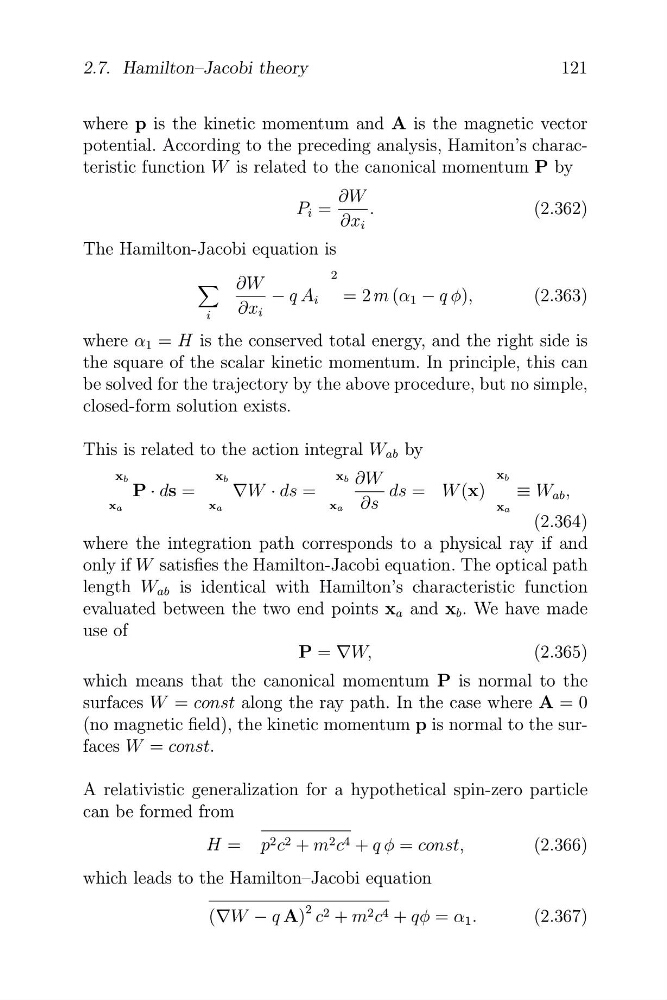
potential. According to the preceding analysis, Hamiton’s characteristic function W is related to the canonical momentum P by
∂W
P i =
.
(2.362)
∂x i
The Hamilton-Jacobi equation is
2
4 ∂W − q A i = 2 m (α 1 − q φ),
(2.363)
i
∂x i
where α 1 = H is the conserved total energy, and the right side is
the square of the scalar kinetic momentum. In principle, this can
be solved for the trajectory by the above procedure, but no simple,
closed-form solution exists.
This is related to the action integral W ab by
x b
x b
x b
x b
∂W
P · ds =
vW · ds =
ds = W (x)
≡ W ab ,
xa
xa
xa ∂s
xa
(2.364)
where the integration path corresponds to a physical ray if and
only if W satisfies the Hamilton-Jacobi equation. The optical path
length W ab is identical with Hamilton’s characteristic function
evaluated between the two end points x a and x b . We have made
use of
P = vW,
(2.365)
which means that the canonical momentum P is normal to the
surfaces W = const along the ray path. In the case where A = 0
(no magnetic field), the kinetic momentum p is normal to the surfaces W = const.
A relativistic generalization for a hypothetical spin-zero particle
can be formed from
H = p 2 c 2 + m 2 c 4 + q φ = const,
(2.366)
which leads to the Hamilton–Jacobi equation
2 2 + m 2
(vW − q A) c
c 4 + qφ = α 1 .
(2.367)
121
2.7. Hamilton–Jacobi theory
�
�
�
where p is the kinetic momentum and A is the magnetic vector
potential. According to the preceding analysis, Hamiton’s characteristic function W is related to the canonical momentum P by
∂W
P i =
.
(2.362)
∂x i
The Hamilton-Jacobi equation is
2
4 ∂W − q A i = 2 m (α 1 − q φ),
(2.363)
i
∂x i
where α 1 = H is the conserved total energy, and the right side is
the square of the scalar kinetic momentum. In principle, this can
be solved for the trajectory by the above procedure, but no simple,
closed-form solution exists.
This is related to the action integral W ab by
x b
x b
x b
x b
∂W
P · ds =
vW · ds =
ds = W (x)
≡ W ab ,
xa
xa
xa ∂s
xa
(2.364)
where the integration path corresponds to a physical ray if and
only if W satisfies the Hamilton-Jacobi equation. The optical path
length W ab is identical with Hamilton’s characteristic function
evaluated between the two end points x a and x b . We have made
use of
P = vW,
(2.365)
which means that the canonical momentum P is normal to the
surfaces W = const along the ray path. In the case where A = 0
(no magnetic field), the kinetic momentum p is normal to the surfaces W = const.
A relativistic generalization for a hypothetical spin-zero particle
can be formed from
H = p 2 c 2 + m 2 c 4 + q φ = const,
(2.366)
which leads to the Hamilton–Jacobi equation
2 2 + m 2
(vW − q A) c
c 4 + qφ = α 1 .
(2.367)
121
2.7. Hamilton–Jacobi theory