

113
2.7. Hamilton–Jacobi theory
This equation is called the Hamilton-Jacobi equation, and S is
called Hamilton’s principal function. We notice the significant fact
that this equation only contains the variables Q i and t.
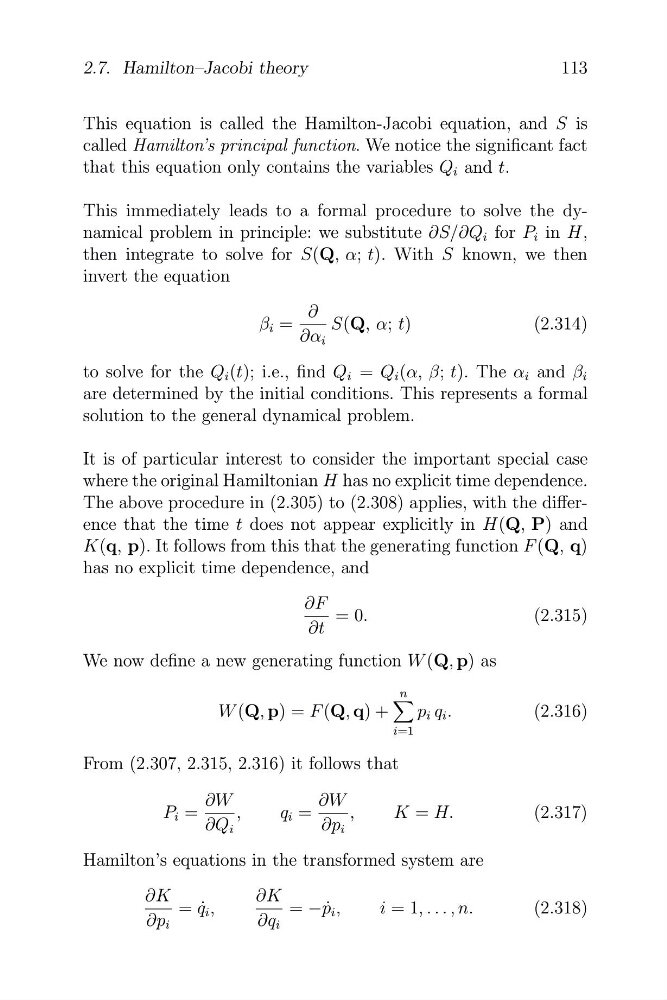
This immediately leads to a formal procedure to solve the dynamical problem in principle: we substitute ∂S/∂Q i for P i in H,
then integrate to solve for S(Q, α; t). With S known, we then
invert the equation
∂
β i =
S(Q, α; t)
(2.314)
∂α i
to solve for the Q i (t); i.e., find Q i = Q i (α, β; t). The α i and β i
are determined by the initial conditions. This represents a formal
solution to the general dynamical problem.
It is of particular interest to consider the important special case
where the original Hamiltonian H has no explicit time dependence.
The above procedure in (2.305) to (2.308) applies, with the difference that the time t does not appear explicitly in H(Q, P) and
K(q, p). It follows from this that the generating function F (Q, q)
has no explicit time dependence, and
∂F = 0.
(2.315)
∂t
We now define a new generating function W (Q, p) as
n
W (Q, p) = F (Q, q) +
4
p i q i .
(2.316)
i=1
From (2.307, 2.315, 2.316) it follows that
∂W
∂W
P i =
,
q i =
,
K = H.
(2.317)
∂Q i
∂p i
Hamilton’s equations in the transformed system are
∂K
∂K
= q˙ i ,
= − p ˙ i ,
i = 1, . . . , n.
(2.318)
∂p i
∂q i
2.7. Hamilton–Jacobi theory
This equation is called the Hamilton-Jacobi equation, and S is
called Hamilton’s principal function. We notice the significant fact
that this equation only contains the variables Q i and t.
This immediately leads to a formal procedure to solve the dynamical problem in principle: we substitute ∂S/∂Q i for P i in H,
then integrate to solve for S(Q, α; t). With S known, we then
invert the equation
∂
β i =
S(Q, α; t)
(2.314)
∂α i
to solve for the Q i (t); i.e., find Q i = Q i (α, β; t). The α i and β i
are determined by the initial conditions. This represents a formal
solution to the general dynamical problem.
It is of particular interest to consider the important special case
where the original Hamiltonian H has no explicit time dependence.
The above procedure in (2.305) to (2.308) applies, with the difference that the time t does not appear explicitly in H(Q, P) and
K(q, p). It follows from this that the generating function F (Q, q)
has no explicit time dependence, and
∂F = 0.
(2.315)
∂t
We now define a new generating function W (Q, p) as
n
W (Q, p) = F (Q, q) +
4
p i q i .
(2.316)
i=1
From (2.307, 2.315, 2.316) it follows that
∂W
∂W
P i =
,
q i =
,
K = H.
(2.317)
∂Q i
∂p i
Hamilton’s equations in the transformed system are
∂K
∂K
= q˙ i ,
= − p ˙ i ,
i = 1, . . . , n.
(2.318)
∂p i
∂q i