

�
� �
�
�
�
�
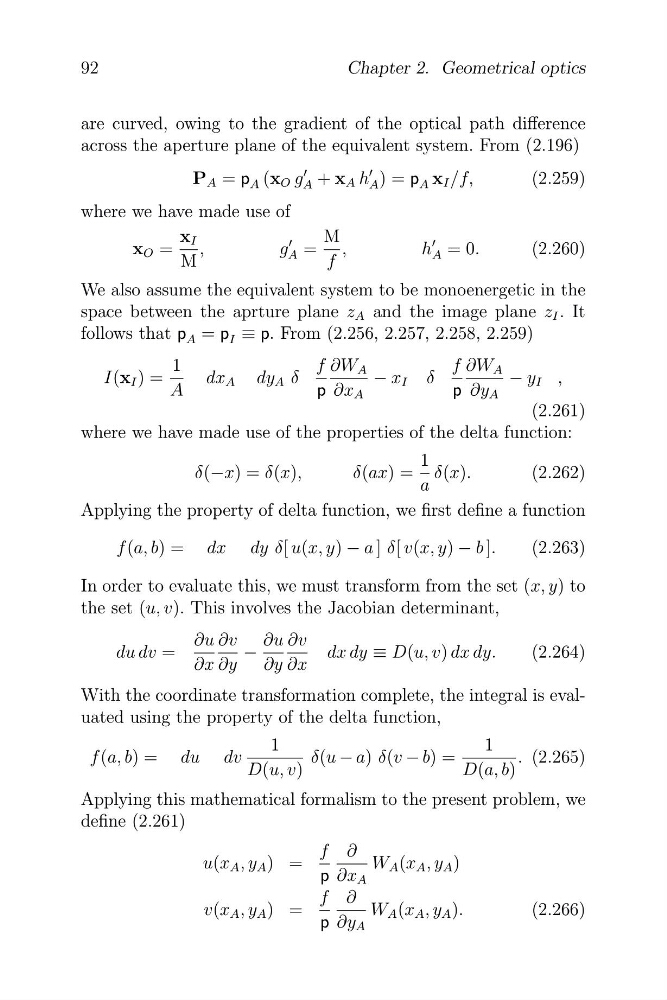
are curved, owing to the gradient of the optical path difference
across the aperture plane of the equivalent system. From (2.196)
P A = p A (x O g A + x A h A
� ) = p A x I /f,
(2.259)
where we have made use of
x I
M
�
h
�
x O = ,
g A = ,
A = 0.
(2.260)
M
f
We also assume the equivalent system to be monoenergetic in the
space between the aprture plane z A and the image plane z I . It
follows that p A = p I ≡ p. From (2.256, 2.257, 2.258, 2.259)
1
f ∂W A
f ∂W A
I(x I ) =
dx A dy A δ
− x I δ
− y I ,
A
p ∂x A
p ∂y A
(2.261)
where we have made use of the properties of the delta function:
1
δ(−x) = δ(x),
δ(ax) = δ(x).
(2.262)
a
Applying the property of delta function, we first define a function
f (a, b) = dx dy δ[ u(x, y) − a ] δ[ v(x, y) − b ].
(2.263)
In order to evaluate this, we must transform from the set (x, y) to
the set (u, v). This involves the Jacobian determinant,
∂u ∂v ∂u ∂v
du dv =
−
dx dy ≡ D(u, v) dx dy.
(2.264)
∂x ∂y ∂y ∂x
With the coordinate transformation complete, the integral is evaluated using the property of the delta function,
1
1
f (a, b) = du dv
δ(u − a) δ(v − b) =
. (2.265)
D(u, v)
D(a, b)
Applying this mathematical formalism to the present problem, we
define (2.261)
f ∂
u(x A , y A ) =
W A (x A , y A )
p ∂x A
f ∂
v(x A , y A ) =
W A (x A , y A ).
(2.266)
p ∂y A
92
Chapter 2. Geometrical optics
� �
�
�
�
�
are curved, owing to the gradient of the optical path difference
across the aperture plane of the equivalent system. From (2.196)
P A = p A (x O g A + x A h A
� ) = p A x I /f,
(2.259)
where we have made use of
x I
M
�
h
�
x O = ,
g A = ,
A = 0.
(2.260)
M
f
We also assume the equivalent system to be monoenergetic in the
space between the aprture plane z A and the image plane z I . It
follows that p A = p I ≡ p. From (2.256, 2.257, 2.258, 2.259)
1
f ∂W A
f ∂W A
I(x I ) =
dx A dy A δ
− x I δ
− y I ,
A
p ∂x A
p ∂y A
(2.261)
where we have made use of the properties of the delta function:
1
δ(−x) = δ(x),
δ(ax) = δ(x).
(2.262)
a
Applying the property of delta function, we first define a function
f (a, b) = dx dy δ[ u(x, y) − a ] δ[ v(x, y) − b ].
(2.263)
In order to evaluate this, we must transform from the set (x, y) to
the set (u, v). This involves the Jacobian determinant,
∂u ∂v ∂u ∂v
du dv =
−
dx dy ≡ D(u, v) dx dy.
(2.264)
∂x ∂y ∂y ∂x
With the coordinate transformation complete, the integral is evaluated using the property of the delta function,
1
1
f (a, b) = du dv
δ(u − a) δ(v − b) =
. (2.265)
D(u, v)
D(a, b)
Applying this mathematical formalism to the present problem, we
define (2.261)
f ∂
u(x A , y A ) =
W A (x A , y A )
p ∂x A
f ∂
v(x A , y A ) =
W A (x A , y A ).
(2.266)
p ∂y A
92
Chapter 2. Geometrical optics