

� �
91
2.5. Axial symmetry
lens in the ideal system.
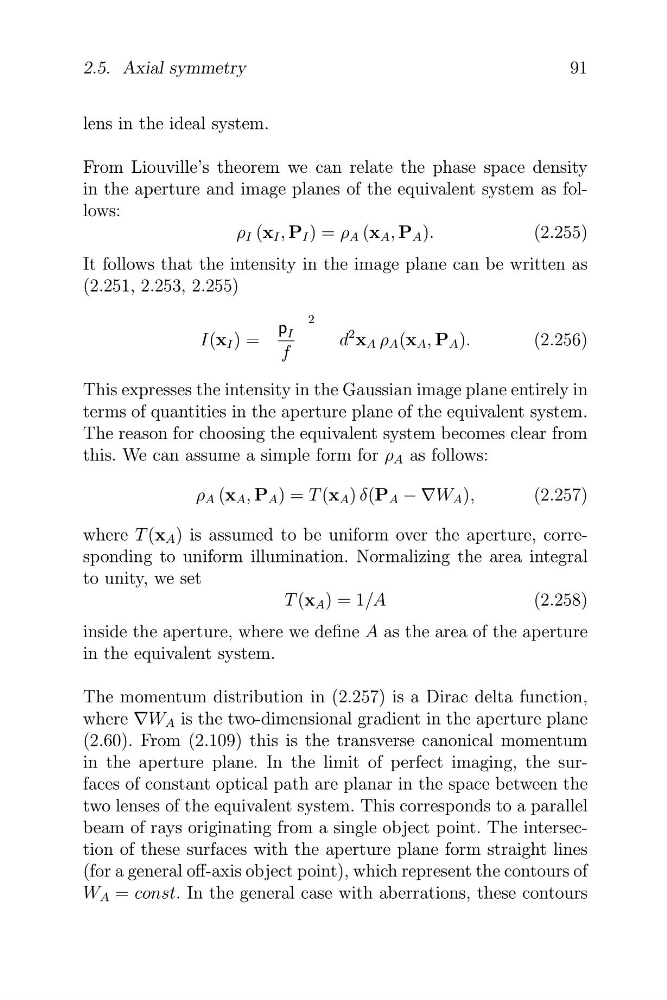
From Liouville’s theorem we can relate the phase space density
in the aperture and image planes of the equivalent system as follows:
ρ I (x I , P I ) = ρ A (x A , P A ).
(2.255)
It follows that the intensity in the image plane can be written as
(2.251, 2.253, 2.255)
2
p I
d
2
I(x I ) =
x A ρ A (x A , P A ).
(2.256)
f
This expresses the intensity in the Gaussian image plane entirely in
terms of quantities in the aperture plane of the equivalent system.
The reason for choosing the equivalent system becomes clear from
this. We can assume a simple form for ρ A as follows:
ρ A (x A , P A ) = T (x A ) δ(P A − vW A ),
(2.257)
where T (x A ) is assumed to be uniform over the aperture, corresponding to uniform illumination. Normalizing the area integral
to unity, we set
T (x A ) = 1/A
(2.258)
inside the aperture, where we define A as the area of the aperture
in the equivalent system.
The momentum distribution in (2.257) is a Dirac delta function,
where vW A is the two-dimensional gradient in the aperture plane
(2.60). From (2.109) this is the transverse canonical momentum
in the aperture plane. In the limit of perfect imaging, the surfaces of constant optical path are planar in the space between the
two lenses of the equivalent system. This corresponds to a parallel
beam of rays originating from a single object point. The intersection of these surfaces with the aperture plane form straight lines
(for a general off-axis object point), which represent the contours of
W A = const. In the general case with aberrations, these contours
91
2.5. Axial symmetry
lens in the ideal system.
From Liouville’s theorem we can relate the phase space density
in the aperture and image planes of the equivalent system as follows:
ρ I (x I , P I ) = ρ A (x A , P A ).
(2.255)
It follows that the intensity in the image plane can be written as
(2.251, 2.253, 2.255)
2
p I
d
2
I(x I ) =
x A ρ A (x A , P A ).
(2.256)
f
This expresses the intensity in the Gaussian image plane entirely in
terms of quantities in the aperture plane of the equivalent system.
The reason for choosing the equivalent system becomes clear from
this. We can assume a simple form for ρ A as follows:
ρ A (x A , P A ) = T (x A ) δ(P A − vW A ),
(2.257)
where T (x A ) is assumed to be uniform over the aperture, corresponding to uniform illumination. Normalizing the area integral
to unity, we set
T (x A ) = 1/A
(2.258)
inside the aperture, where we define A as the area of the aperture
in the equivalent system.
The momentum distribution in (2.257) is a Dirac delta function,
where vW A is the two-dimensional gradient in the aperture plane
(2.60). From (2.109) this is the transverse canonical momentum
in the aperture plane. In the limit of perfect imaging, the surfaces of constant optical path are planar in the space between the
two lenses of the equivalent system. This corresponds to a parallel
beam of rays originating from a single object point. The intersection of these surfaces with the aperture plane form straight lines
(for a general off-axis object point), which represent the contours of
W A = const. In the general case with aberrations, these contours