

Group III—Nitrides and Other Semiconductors for Terahertz Detector
201
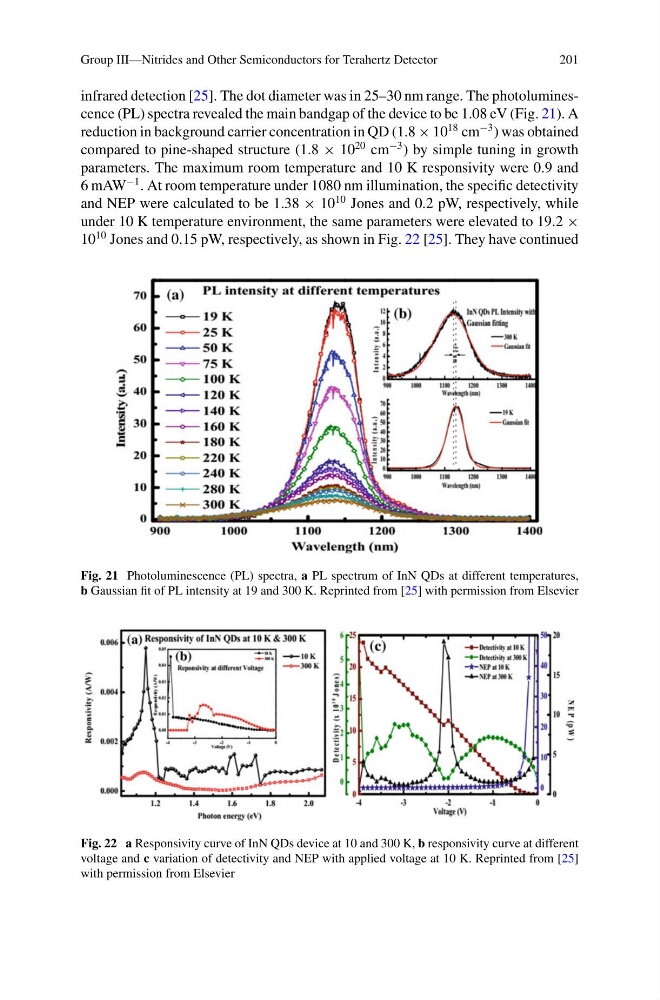
infrared detection [25]. The dot diameter was in 25–30 nm range. The photoluminescence (PL) spectra revealed the main bandgap of the device to be 1.08 eV (Fig. 21). A
reduction in background carrier concentration in QD (1.8 × 10
18 cm
−3 ) was obtained
compared to pine-shaped structure (1.8 × 10
20 cm
−3 ) by simple tuning in growth
parameters. The maximum room temperature and 10 K responsivity were 0.9 and
6 mAW
−1 . At room temperature under 1080 nm illumination, the specific detectivity
and NEP were calculated to be 1.38 × 10
10 Jones and 0.2 pW, respectively, while
under 10 K temperature environment, the same parameters were elevated to 19.2 ×
10
10 Jones and 0.15 pW, respectively, as shown in Fig. 22 [25]. They have continued
Fig. 21 Photoluminescence (PL) spectra, a PL spectrum of InN QDs at different temperatures,
b Gaussian fit of PL intensity at 19 and 300 K. Reprinted from [25] with permission from Elsevier
Fig. 22 a Responsivity curve of InN QDs device at 10 and 300 K, b responsivity curve at different
voltage and c variation of detectivity and NEP with applied voltage at 10 K. Reprinted from [25]
with permission from Elsevier
201
infrared detection [25]. The dot diameter was in 25–30 nm range. The photoluminescence (PL) spectra revealed the main bandgap of the device to be 1.08 eV (Fig. 21). A
reduction in background carrier concentration in QD (1.8 × 10
18 cm
−3 ) was obtained
compared to pine-shaped structure (1.8 × 10
20 cm
−3 ) by simple tuning in growth
parameters. The maximum room temperature and 10 K responsivity were 0.9 and
6 mAW
−1 . At room temperature under 1080 nm illumination, the specific detectivity
and NEP were calculated to be 1.38 × 10
10 Jones and 0.2 pW, respectively, while
under 10 K temperature environment, the same parameters were elevated to 19.2 ×
10
10 Jones and 0.15 pW, respectively, as shown in Fig. 22 [25]. They have continued
Fig. 21 Photoluminescence (PL) spectra, a PL spectrum of InN QDs at different temperatures,
b Gaussian fit of PL intensity at 19 and 300 K. Reprinted from [25] with permission from Elsevier
Fig. 22 a Responsivity curve of InN QDs device at 10 and 300 K, b responsivity curve at different
voltage and c variation of detectivity and NEP with applied voltage at 10 K. Reprinted from [25]
with permission from Elsevier