

202
B. Choudhuri and A. Mondal
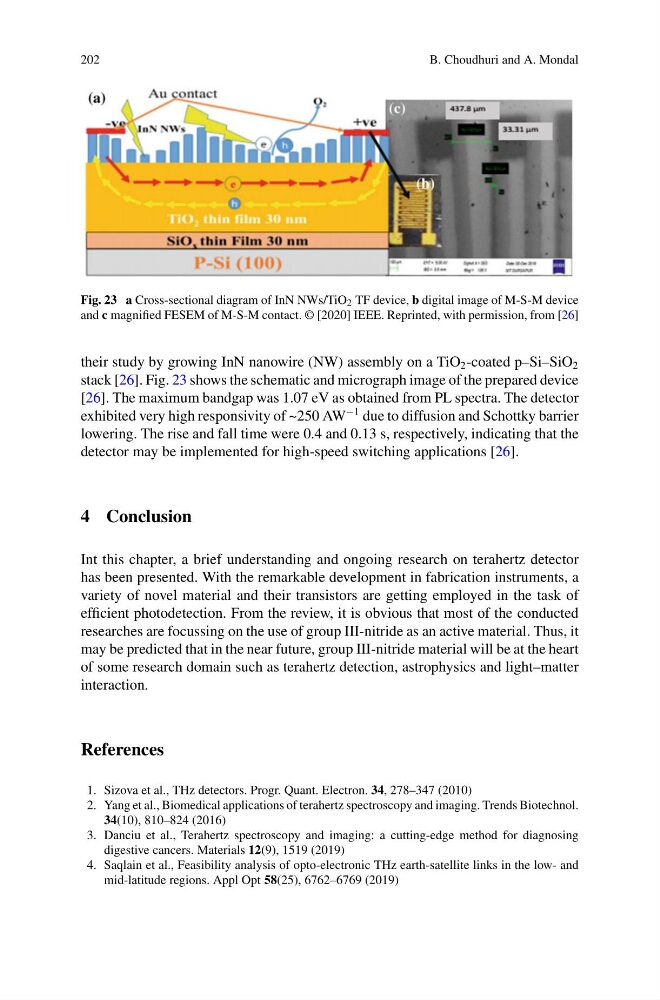
Fig. 23 a Cross-sectional diagram of InN NWs/TiO 2 TF device, b digital image of M-S-M device
and c magnified FESEM of M-S-M contact. © [2020] IEEE. Reprinted, with permission, from [26]
their study by growing InN nanowire (NW) assembly on a TiO 2 -coated p–Si–SiO 2
stack [26]. Fig. 23 shows the schematic and micrograph image of the prepared device
[26]. The maximum bandgap was 1.07 eV as obtained from PL spectra. The detector
exhibited very high responsivity of ~250 AW
−1 due to diffusion and Schottky barrier
lowering. The rise and fall time were 0.4 and 0.13 s, respectively, indicating that the
detector may be implemented for high-speed switching applications [26].
4 Conclusion
Int this chapter, a brief understanding and ongoing research on terahertz detector
has been presented. With the remarkable development in fabrication instruments, a
variety of novel material and their transistors are getting employed in the task of
efficient photodetection. From the review, it is obvious that most of the conducted
researches are focussing on the use of group III-nitride as an active material. Thus, it
may be predicted that in the near future, group III-nitride material will be at the heart
of some research domain such as terahertz detection, astrophysics and light–matter
interaction.
References
1. Sizova et al., THz detectors. Progr. Quant. Electron. 34, 278–347 (2010)
2. Yang et al., Biomedical applications of terahertz spectroscopy and imaging. Trends Biotechnol.
34(10), 810–824 (2016)
3. Danciu et al., Terahertz spectroscopy and imaging: a cutting-edge method for diagnosing
digestive cancers. Materials 12(9), 1519 (2019)
4. Saqlain et al., Feasibility analysis of opto-electronic THz earth-satellite links in the low- and
mid-latitude regions. Appl Opt 58(25), 6762–6769 (2019)
B. Choudhuri and A. Mondal
Fig. 23 a Cross-sectional diagram of InN NWs/TiO 2 TF device, b digital image of M-S-M device
and c magnified FESEM of M-S-M contact. © [2020] IEEE. Reprinted, with permission, from [26]
their study by growing InN nanowire (NW) assembly on a TiO 2 -coated p–Si–SiO 2
stack [26]. Fig. 23 shows the schematic and micrograph image of the prepared device
[26]. The maximum bandgap was 1.07 eV as obtained from PL spectra. The detector
exhibited very high responsivity of ~250 AW
−1 due to diffusion and Schottky barrier
lowering. The rise and fall time were 0.4 and 0.13 s, respectively, indicating that the
detector may be implemented for high-speed switching applications [26].
4 Conclusion
Int this chapter, a brief understanding and ongoing research on terahertz detector
has been presented. With the remarkable development in fabrication instruments, a
variety of novel material and their transistors are getting employed in the task of
efficient photodetection. From the review, it is obvious that most of the conducted
researches are focussing on the use of group III-nitride as an active material. Thus, it
may be predicted that in the near future, group III-nitride material will be at the heart
of some research domain such as terahertz detection, astrophysics and light–matter
interaction.
References
1. Sizova et al., THz detectors. Progr. Quant. Electron. 34, 278–347 (2010)
2. Yang et al., Biomedical applications of terahertz spectroscopy and imaging. Trends Biotechnol.
34(10), 810–824 (2016)
3. Danciu et al., Terahertz spectroscopy and imaging: a cutting-edge method for diagnosing
digestive cancers. Materials 12(9), 1519 (2019)
4. Saqlain et al., Feasibility analysis of opto-electronic THz earth-satellite links in the low- and
mid-latitude regions. Appl Opt 58(25), 6762–6769 (2019)