

Group III—Nitrides and Other Semiconductors for Terahertz Detector
193
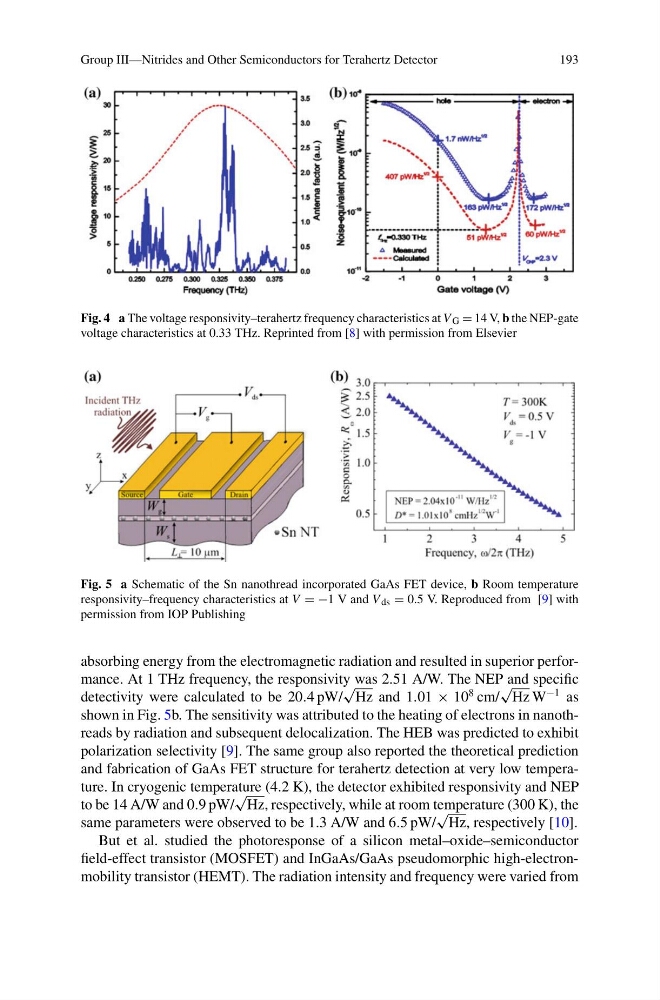
Fig. 4 a The voltage responsivity–terahertz frequency characteristics at V G = 14 V, b the NEP-gate
voltage characteristics at 0.33 THz. Reprinted from [8] with permission from Elsevier
Fig. 5 a Schematic of the Sn nanothread incorporated GaAs FET device, b Room temperature
responsivity–frequency characteristics at V = −1 V and V ds = 0.5 V. Reproduced from [9] with
permission from IOP Publishing
absorbing energy from the electromagnetic radiation and resulted in superior performance. At 1 THz frequency, the responsivity was 2.51 A/W. The NEP and specific
detectivity were calculated to be 20.4 pW/
√
Hz and 1.01 × 10
8 cm/
√
Hz W
−1 as
shown in Fig. 5b. The sensitivity was attributed to the heating of electrons in nanothreads by radiation and subsequent delocalization. The HEB was predicted to exhibit
polarization selectivity [9]. The same group also reported the theoretical prediction
and fabrication of GaAs FET structure for terahertz detection at very low temperature. In cryogenic temperature (4.2 K), the detector exhibited responsivity and NEP
to be 14 A/W and 0.9 pW/
√
Hz, respectively, while at room temperature (300 K), the
same parameters were observed to be 1.3 A/W and 6.5 pW/
√
Hz, respectively [10].
But et al. studied the photoresponse of a silicon metal–oxide–semiconductor
field-effect transistor (MOSFET) and InGaAs/GaAs pseudomorphic high-electronmobility transistor (HEMT). The radiation intensity and frequency were varied from
193
Fig. 4 a The voltage responsivity–terahertz frequency characteristics at V G = 14 V, b the NEP-gate
voltage characteristics at 0.33 THz. Reprinted from [8] with permission from Elsevier
Fig. 5 a Schematic of the Sn nanothread incorporated GaAs FET device, b Room temperature
responsivity–frequency characteristics at V = −1 V and V ds = 0.5 V. Reproduced from [9] with
permission from IOP Publishing
absorbing energy from the electromagnetic radiation and resulted in superior performance. At 1 THz frequency, the responsivity was 2.51 A/W. The NEP and specific
detectivity were calculated to be 20.4 pW/
√
Hz and 1.01 × 10
8 cm/
√
Hz W
−1 as
shown in Fig. 5b. The sensitivity was attributed to the heating of electrons in nanothreads by radiation and subsequent delocalization. The HEB was predicted to exhibit
polarization selectivity [9]. The same group also reported the theoretical prediction
and fabrication of GaAs FET structure for terahertz detection at very low temperature. In cryogenic temperature (4.2 K), the detector exhibited responsivity and NEP
to be 14 A/W and 0.9 pW/
√
Hz, respectively, while at room temperature (300 K), the
same parameters were observed to be 1.3 A/W and 6.5 pW/
√
Hz, respectively [10].
But et al. studied the photoresponse of a silicon metal–oxide–semiconductor
field-effect transistor (MOSFET) and InGaAs/GaAs pseudomorphic high-electronmobility transistor (HEMT). The radiation intensity and frequency were varied from