

184
R. N. Kini and C. P. Vaisakh
surface field and hence the THz emission in GaSbBi. However, the bandgap bowing
in GaSbBi and p-doping in GaAsBi seems to be of lesser influence in THz emission
amplitude. However, the degradation of crystal quality will reduce the transport
quality and the emission amplitude in any semiconductor system. It is exceptionally
challenging to create good-quality alloys with high Bi content. But, if we succeed in
that endeavor, it would be interesting to learn the THz emission phenomenon from
high Bi content alloys with excellent crystal quality. The knowledge of THz emission
dynamics in bismide alloys is still minimal. Further studies, including excitation
spectra dependence, must be done on bismide systems of a wide composition range
if we are to have a broader understanding of the subject.
9.5 Application in THz Spectroscopy
The THz emission from the GaSbBi and GaAsBi films is spectrally broad. The useful tail of the emission extends up to ~4.5 THz. The detected bandwidth could be
limited because of the low sensitivity of the PCA detector at higher THz frequencies.
We had compared the performance of the GaAsBi emitter and a commercially available iPCA in a THz-TDS system. The emission amplitude from GaAsBi or GaSbBi
surface is several orders of magnitude lower compared to the iPCA, but its spectral
reach surpasses that of a commercially available iPCA. We had used GaSbBi emitter
to study the THz response of β BBO crystal and demonstrated that compared to
a commercially available interdigitated PCA (iPCA), the frequency limit in which
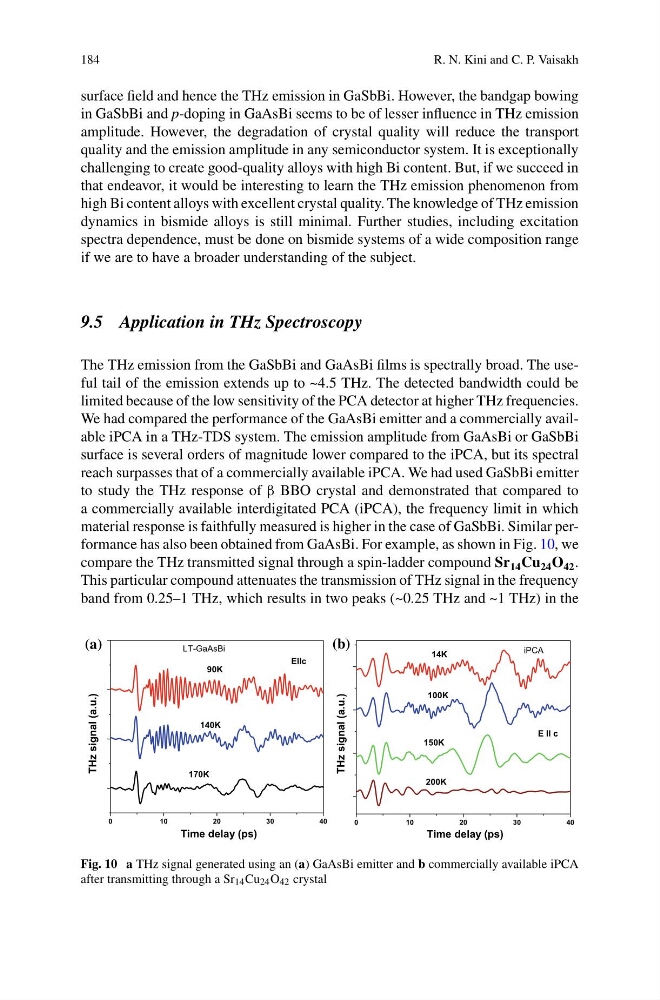
material response is faithfully measured is higher in the case of GaSbBi. Similar performance has also been obtained from GaAsBi. For example, as shown in Fig. 10, we
compare the THz transmitted signal through a spin-ladder compound Sr 14 Cu 24 O 42 .
This particular compound attenuates the transmission of THz signal in the frequency
band from 0.25–1 THz, which results in two peaks (~0.25 THz and ~1 THz) in the
0
1 0
2 0
3 0
4 0
THz signal (a.u.)
Time delay (ps)
90K
140K
170K
Ellc
(a)
LT-GaAsBi
0
1 0
2 0
3 0
4 0
THz signal (a.u.)
Time delay (ps)
14K
100K
150K
200K
E ll c
(b)
iPCA
Fig. 10 a THz signal generated using an (a) GaAsBi emitter and b commercially available iPCA
after transmitting through a Sr 14 Cu 24 O 42 crystal
R. N. Kini and C. P. Vaisakh
surface field and hence the THz emission in GaSbBi. However, the bandgap bowing
in GaSbBi and p-doping in GaAsBi seems to be of lesser influence in THz emission
amplitude. However, the degradation of crystal quality will reduce the transport
quality and the emission amplitude in any semiconductor system. It is exceptionally
challenging to create good-quality alloys with high Bi content. But, if we succeed in
that endeavor, it would be interesting to learn the THz emission phenomenon from
high Bi content alloys with excellent crystal quality. The knowledge of THz emission
dynamics in bismide alloys is still minimal. Further studies, including excitation
spectra dependence, must be done on bismide systems of a wide composition range
if we are to have a broader understanding of the subject.
9.5 Application in THz Spectroscopy
The THz emission from the GaSbBi and GaAsBi films is spectrally broad. The useful tail of the emission extends up to ~4.5 THz. The detected bandwidth could be
limited because of the low sensitivity of the PCA detector at higher THz frequencies.
We had compared the performance of the GaAsBi emitter and a commercially available iPCA in a THz-TDS system. The emission amplitude from GaAsBi or GaSbBi
surface is several orders of magnitude lower compared to the iPCA, but its spectral
reach surpasses that of a commercially available iPCA. We had used GaSbBi emitter
to study the THz response of β BBO crystal and demonstrated that compared to
a commercially available interdigitated PCA (iPCA), the frequency limit in which
material response is faithfully measured is higher in the case of GaSbBi. Similar performance has also been obtained from GaAsBi. For example, as shown in Fig. 10, we
compare the THz transmitted signal through a spin-ladder compound Sr 14 Cu 24 O 42 .
This particular compound attenuates the transmission of THz signal in the frequency
band from 0.25–1 THz, which results in two peaks (~0.25 THz and ~1 THz) in the
0
1 0
2 0
3 0
4 0
THz signal (a.u.)
Time delay (ps)
90K
140K
170K
Ellc
(a)
LT-GaAsBi
0
1 0
2 0
3 0
4 0
THz signal (a.u.)
Time delay (ps)
14K
100K
150K
200K
E ll c
(b)
iPCA
Fig. 10 a THz signal generated using an (a) GaAsBi emitter and b commercially available iPCA
after transmitting through a Sr 14 Cu 24 O 42 crystal