

182
R. N. Kini and C. P. Vaisakh
E Γ −X ≈ 0.31eV). Excitation with well above bandgap radiation readily scatters the
carriers to low mobility satellite valleys reducing the photocurrents and THz emission
[7].
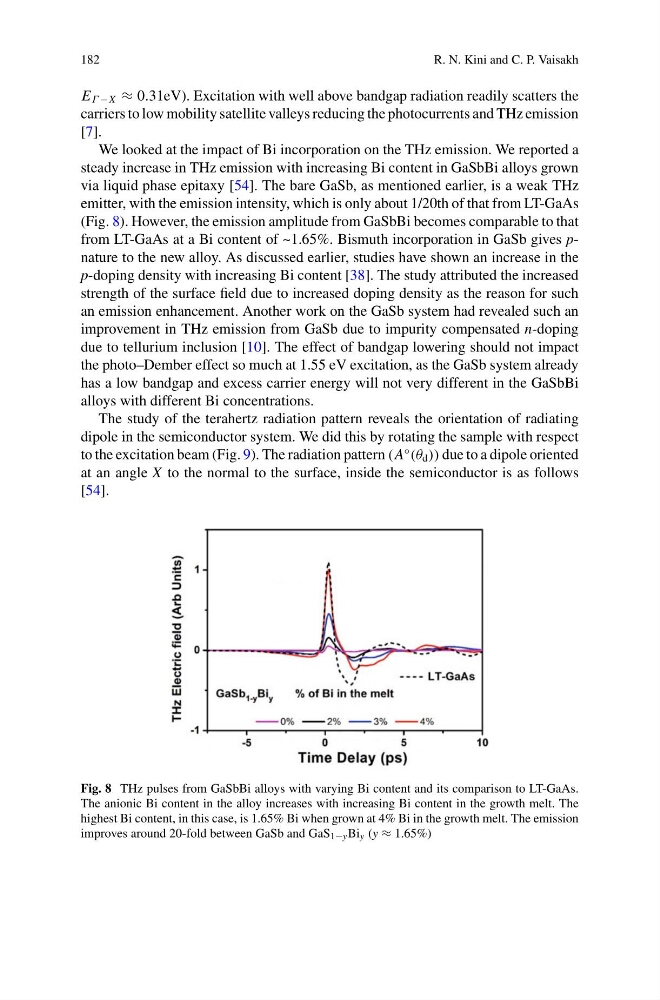
We looked at the impact of Bi incorporation on the THz emission. We reported a
steady increase in THz emission with increasing Bi content in GaSbBi alloys grown
via liquid phase epitaxy [54]. The bare GaSb, as mentioned earlier, is a weak THz
emitter, with the emission intensity, which is only about 1/20th of that from LT-GaAs
(Fig. 8). However, the emission amplitude from GaSbBi becomes comparable to that
from LT-GaAs at a Bi content of ~1.65%. Bismuth incorporation in GaSb gives pnature to the new alloy. As discussed earlier, studies have shown an increase in the
p-doping density with increasing Bi content [38]. The study attributed the increased
strength of the surface field due to increased doping density as the reason for such
an emission enhancement. Another work on the GaSb system had revealed such an
improvement in THz emission from GaSb due to impurity compensated n-doping
due to tellurium inclusion [10]. The effect of bandgap lowering should not impact
the photo–Dember effect so much at 1.55 eV excitation, as the GaSb system already
has a low bandgap and excess carrier energy will not very different in the GaSbBi
alloys with different Bi concentrations.
The study of the terahertz radiation pattern reveals the orientation of radiating
dipole in the semiconductor system. We did this by rotating the sample with respect
to the excitation beam (Fig. 9). The radiation pattern (A
◦
(θ d )) due to a dipole oriented
at an angle X to the normal to the surface, inside the semiconductor is as follows
[54].
Fig. 8 THz pulses from GaSbBi alloys with varying Bi content and its comparison to LT-GaAs.
The anionic Bi content in the alloy increases with increasing Bi content in the growth melt. The
highest Bi content, in this case, is 1.65% Bi when grown at 4% Bi in the growth melt. The emission
improves around 20-fold between GaSb and GaS 1−y Bi y (y ≈ 1.65%)
R. N. Kini and C. P. Vaisakh
E Γ −X ≈ 0.31eV). Excitation with well above bandgap radiation readily scatters the
carriers to low mobility satellite valleys reducing the photocurrents and THz emission
[7].
We looked at the impact of Bi incorporation on the THz emission. We reported a
steady increase in THz emission with increasing Bi content in GaSbBi alloys grown
via liquid phase epitaxy [54]. The bare GaSb, as mentioned earlier, is a weak THz
emitter, with the emission intensity, which is only about 1/20th of that from LT-GaAs
(Fig. 8). However, the emission amplitude from GaSbBi becomes comparable to that
from LT-GaAs at a Bi content of ~1.65%. Bismuth incorporation in GaSb gives pnature to the new alloy. As discussed earlier, studies have shown an increase in the
p-doping density with increasing Bi content [38]. The study attributed the increased
strength of the surface field due to increased doping density as the reason for such
an emission enhancement. Another work on the GaSb system had revealed such an
improvement in THz emission from GaSb due to impurity compensated n-doping
due to tellurium inclusion [10]. The effect of bandgap lowering should not impact
the photo–Dember effect so much at 1.55 eV excitation, as the GaSb system already
has a low bandgap and excess carrier energy will not very different in the GaSbBi
alloys with different Bi concentrations.
The study of the terahertz radiation pattern reveals the orientation of radiating
dipole in the semiconductor system. We did this by rotating the sample with respect
to the excitation beam (Fig. 9). The radiation pattern (A
◦
(θ d )) due to a dipole oriented
at an angle X to the normal to the surface, inside the semiconductor is as follows
[54].
Fig. 8 THz pulses from GaSbBi alloys with varying Bi content and its comparison to LT-GaAs.
The anionic Bi content in the alloy increases with increasing Bi content in the growth melt. The
highest Bi content, in this case, is 1.65% Bi when grown at 4% Bi in the growth melt. The emission
improves around 20-fold between GaSb and GaS 1−y Bi y (y ≈ 1.65%)