

Terahertz Emission Mechanisms in III–V Semiconductors …
181
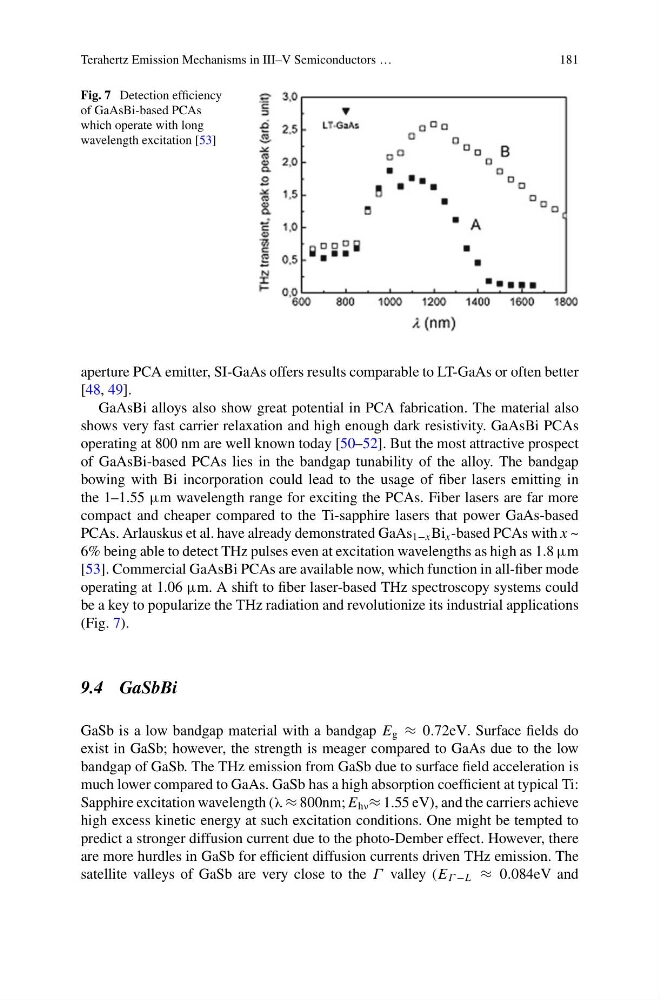
Fig. 7 Detection efficiency
of GaAsBi-based PCAs
which operate with long
wavelength excitation [53]
aperture PCA emitter, SI-GaAs offers results comparable to LT-GaAs or often better
[48, 49].
GaAsBi alloys also show great potential in PCA fabrication. The material also
shows very fast carrier relaxation and high enough dark resistivity. GaAsBi PCAs
operating at 800 nm are well known today [50–52]. But the most attractive prospect
of GaAsBi-based PCAs lies in the bandgap tunability of the alloy. The bandgap
bowing with Bi incorporation could lead to the usage of fiber lasers emitting in
the 1–1.55 μm wavelength range for exciting the PCAs. Fiber lasers are far more
compact and cheaper compared to the Ti-sapphire lasers that power GaAs-based
PCAs. Arlauskus et al. have already demonstrated GaAs 1−x Bi x -based PCAs with x ~
6% being able to detect THz pulses even at excitation wavelengths as high as 1.8 μm
[53]. Commercial GaAsBi PCAs are available now, which function in all-fiber mode
operating at 1.06 μm. A shift to fiber laser-based THz spectroscopy systems could
be a key to popularize the THz radiation and revolutionize its industrial applications
(Fig. 7).
9.4 GaSbBi
GaSb is a low bandgap material with a bandgap E g ≈ 0.72eV. Surface fields do
exist in GaSb; however, the strength is meager compared to GaAs due to the low
bandgap of GaSb. The THz emission from GaSb due to surface field acceleration is
much lower compared to GaAs. GaSb has a high absorption coefficient at typical Ti:
Sapphire excitation wavelength (λ ≈ 800nm; E hν ≈ 1.55 eV), and the carriers achieve
high excess kinetic energy at such excitation conditions. One might be tempted to
predict a stronger diffusion current due to the photo-Dember effect. However, there
are more hurdles in GaSb for efficient diffusion currents driven THz emission. The
satellite valleys of GaSb are very close to the Γ valley (E Γ −L ≈ 0.084eV and
181
Fig. 7 Detection efficiency
of GaAsBi-based PCAs
which operate with long
wavelength excitation [53]
aperture PCA emitter, SI-GaAs offers results comparable to LT-GaAs or often better
[48, 49].
GaAsBi alloys also show great potential in PCA fabrication. The material also
shows very fast carrier relaxation and high enough dark resistivity. GaAsBi PCAs
operating at 800 nm are well known today [50–52]. But the most attractive prospect
of GaAsBi-based PCAs lies in the bandgap tunability of the alloy. The bandgap
bowing with Bi incorporation could lead to the usage of fiber lasers emitting in
the 1–1.55 μm wavelength range for exciting the PCAs. Fiber lasers are far more
compact and cheaper compared to the Ti-sapphire lasers that power GaAs-based
PCAs. Arlauskus et al. have already demonstrated GaAs 1−x Bi x -based PCAs with x ~
6% being able to detect THz pulses even at excitation wavelengths as high as 1.8 μm
[53]. Commercial GaAsBi PCAs are available now, which function in all-fiber mode
operating at 1.06 μm. A shift to fiber laser-based THz spectroscopy systems could
be a key to popularize the THz radiation and revolutionize its industrial applications
(Fig. 7).
9.4 GaSbBi
GaSb is a low bandgap material with a bandgap E g ≈ 0.72eV. Surface fields do
exist in GaSb; however, the strength is meager compared to GaAs due to the low
bandgap of GaSb. The THz emission from GaSb due to surface field acceleration is
much lower compared to GaAs. GaSb has a high absorption coefficient at typical Ti:
Sapphire excitation wavelength (λ ≈ 800nm; E hν ≈ 1.55 eV), and the carriers achieve
high excess kinetic energy at such excitation conditions. One might be tempted to
predict a stronger diffusion current due to the photo-Dember effect. However, there
are more hurdles in GaSb for efficient diffusion currents driven THz emission. The
satellite valleys of GaSb are very close to the Γ valley (E Γ −L ≈ 0.084eV and