

180
R. N. Kini and C. P. Vaisakh
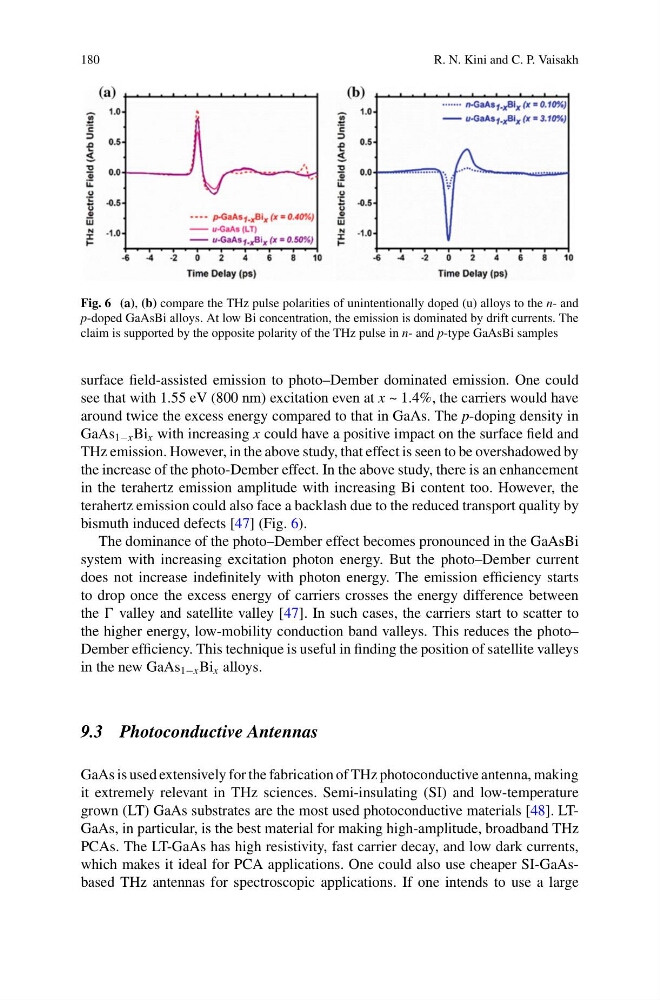
Fig. 6 (a), (b) compare the THz pulse polarities of unintentionally doped (u) alloys to the n- and
p-doped GaAsBi alloys. At low Bi concentration, the emission is dominated by drift currents. The
claim is supported by the opposite polarity of the THz pulse in n- and p-type GaAsBi samples
surface field-assisted emission to photo–Dember dominated emission. One could
see that with 1.55 eV (800 nm) excitation even at x ~ 1.4%, the carriers would have
around twice the excess energy compared to that in GaAs. The p-doping density in
GaAs 1−x Bi x with increasing x could have a positive impact on the surface field and
THz emission. However, in the above study, that effect is seen to be overshadowed by
the increase of the photo-Dember effect. In the above study, there is an enhancement
in the terahertz emission amplitude with increasing Bi content too. However, the
terahertz emission could also face a backlash due to the reduced transport quality by
bismuth induced defects [47] (Fig. 6).
The dominance of the photo–Dember effect becomes pronounced in the GaAsBi
system with increasing excitation photon energy. But the photo–Dember current
does not increase indefinitely with photon energy. The emission efficiency starts
to drop once the excess energy of carriers crosses the energy difference between
the valley and satellite valley [47]. In such cases, the carriers start to scatter to
the higher energy, low-mobility conduction band valleys. This reduces the photo–
Dember efficiency. This technique is useful in finding the position of satellite valleys
in the new GaAs 1−x Bi x alloys.
9.3 Photoconductive Antennas
GaAs is used extensively for the fabrication of THz photoconductive antenna, making
it extremely relevant in THz sciences. Semi-insulating (SI) and low-temperature
grown (LT) GaAs substrates are the most used photoconductive materials [48]. LTGaAs, in particular, is the best material for making high-amplitude, broadband THz
PCAs. The LT-GaAs has high resistivity, fast carrier decay, and low dark currents,
which makes it ideal for PCA applications. One could also use cheaper SI-GaAsbased THz antennas for spectroscopic applications. If one intends to use a large
R. N. Kini and C. P. Vaisakh
Fig. 6 (a), (b) compare the THz pulse polarities of unintentionally doped (u) alloys to the n- and
p-doped GaAsBi alloys. At low Bi concentration, the emission is dominated by drift currents. The
claim is supported by the opposite polarity of the THz pulse in n- and p-type GaAsBi samples
surface field-assisted emission to photo–Dember dominated emission. One could
see that with 1.55 eV (800 nm) excitation even at x ~ 1.4%, the carriers would have
around twice the excess energy compared to that in GaAs. The p-doping density in
GaAs 1−x Bi x with increasing x could have a positive impact on the surface field and
THz emission. However, in the above study, that effect is seen to be overshadowed by
the increase of the photo-Dember effect. In the above study, there is an enhancement
in the terahertz emission amplitude with increasing Bi content too. However, the
terahertz emission could also face a backlash due to the reduced transport quality by
bismuth induced defects [47] (Fig. 6).
The dominance of the photo–Dember effect becomes pronounced in the GaAsBi
system with increasing excitation photon energy. But the photo–Dember current
does not increase indefinitely with photon energy. The emission efficiency starts
to drop once the excess energy of carriers crosses the energy difference between
the valley and satellite valley [47]. In such cases, the carriers start to scatter to
the higher energy, low-mobility conduction band valleys. This reduces the photo–
Dember efficiency. This technique is useful in finding the position of satellite valleys
in the new GaAs 1−x Bi x alloys.
9.3 Photoconductive Antennas
GaAs is used extensively for the fabrication of THz photoconductive antenna, making
it extremely relevant in THz sciences. Semi-insulating (SI) and low-temperature
grown (LT) GaAs substrates are the most used photoconductive materials [48]. LTGaAs, in particular, is the best material for making high-amplitude, broadband THz
PCAs. The LT-GaAs has high resistivity, fast carrier decay, and low dark currents,
which makes it ideal for PCA applications. One could also use cheaper SI-GaAsbased THz antennas for spectroscopic applications. If one intends to use a large