

Terahertz Emission Mechanisms in III–V Semiconductors …
179
for creating diffusion current. Hence, decreasing the bandgap by incorporating more
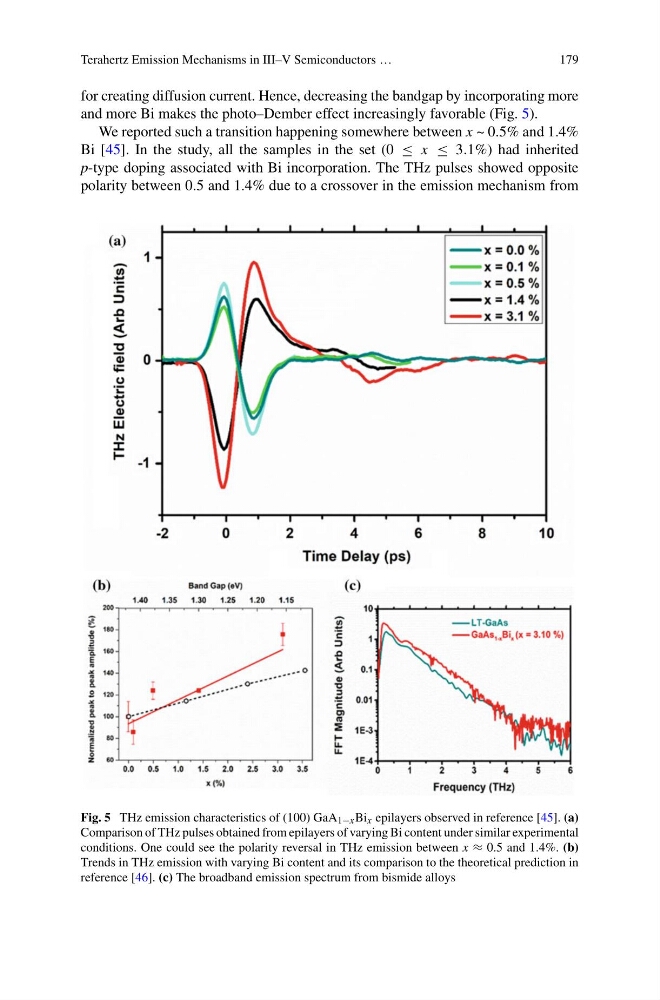
and more Bi makes the photo–Dember effect increasingly favorable (Fig. 5).
We reported such a transition happening somewhere between x ~ 0.5% and 1.4%
Bi [45]. In the study, all the samples in the set (0 ≤ x ≤ 3.1%) had inherited
p-type doping associated with Bi incorporation. The THz pulses showed opposite
polarity between 0.5 and 1.4% due to a crossover in the emission mechanism from
Fig. 5 THz emission characteristics of (100) GaA 1−x Bi x epilayers observed in reference [45]. (a)
Comparison of THz pulses obtained from epilayers of varying Bi content under similar experimental
conditions. One could see the polarity reversal in THz emission between x ≈ 0.5 and 1.4%. (b)
Trends in THz emission with varying Bi content and its comparison to the theoretical prediction in
reference [46]. (c) The broadband emission spectrum from bismide alloys
179
for creating diffusion current. Hence, decreasing the bandgap by incorporating more
and more Bi makes the photo–Dember effect increasingly favorable (Fig. 5).
We reported such a transition happening somewhere between x ~ 0.5% and 1.4%
Bi [45]. In the study, all the samples in the set (0 ≤ x ≤ 3.1%) had inherited
p-type doping associated with Bi incorporation. The THz pulses showed opposite
polarity between 0.5 and 1.4% due to a crossover in the emission mechanism from
Fig. 5 THz emission characteristics of (100) GaA 1−x Bi x epilayers observed in reference [45]. (a)
Comparison of THz pulses obtained from epilayers of varying Bi content under similar experimental
conditions. One could see the polarity reversal in THz emission between x ≈ 0.5 and 1.4%. (b)
Trends in THz emission with varying Bi content and its comparison to the theoretical prediction in
reference [46]. (c) The broadband emission spectrum from bismide alloys