

178
R. N. Kini and C. P. Vaisakh
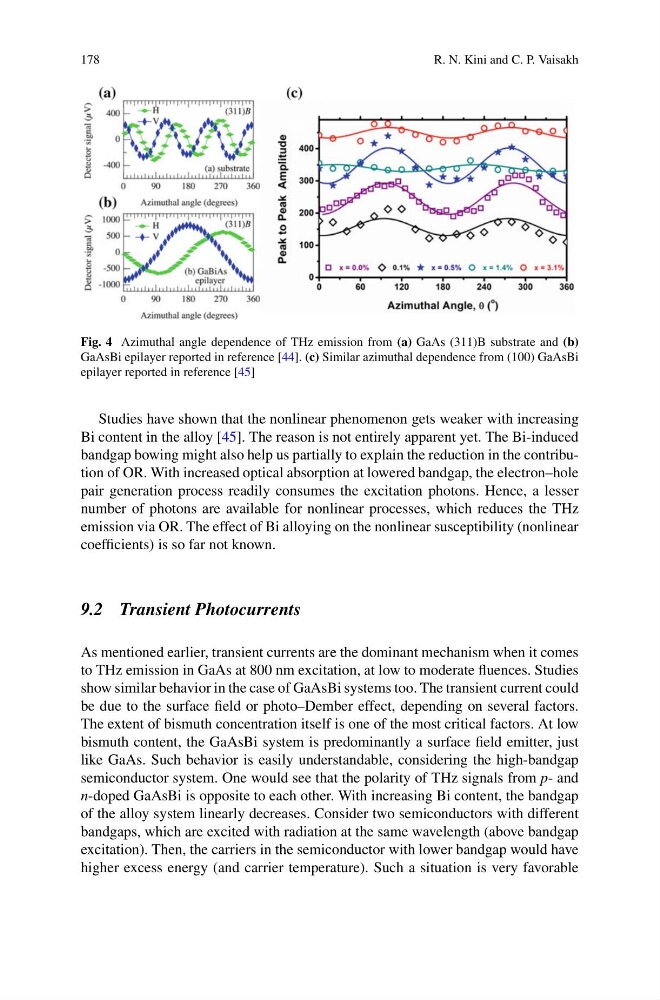
Fig. 4 Azimuthal angle dependence of THz emission from (a) GaAs (311)B substrate and (b)
GaAsBi epilayer reported in reference [44]. (c) Similar azimuthal dependence from (100) GaAsBi
epilayer reported in reference [45]
Studies have shown that the nonlinear phenomenon gets weaker with increasing
Bi content in the alloy [45]. The reason is not entirely apparent yet. The Bi-induced
bandgap bowing might also help us partially to explain the reduction in the contribution of OR. With increased optical absorption at lowered bandgap, the electron–hole
pair generation process readily consumes the excitation photons. Hence, a lesser
number of photons are available for nonlinear processes, which reduces the THz
emission via OR. The effect of Bi alloying on the nonlinear susceptibility (nonlinear
coefficients) is so far not known.
9.2 Transient Photocurrents
As mentioned earlier, transient currents are the dominant mechanism when it comes
to THz emission in GaAs at 800 nm excitation, at low to moderate fluences. Studies
show similar behavior in the case of GaAsBi systems too. The transient current could
be due to the surface field or photo–Dember effect, depending on several factors.
The extent of bismuth concentration itself is one of the most critical factors. At low
bismuth content, the GaAsBi system is predominantly a surface field emitter, just
like GaAs. Such behavior is easily understandable, considering the high-bandgap
semiconductor system. One would see that the polarity of THz signals from p- and
n-doped GaAsBi is opposite to each other. With increasing Bi content, the bandgap
of the alloy system linearly decreases. Consider two semiconductors with different
bandgaps, which are excited with radiation at the same wavelength (above bandgap
excitation). Then, the carriers in the semiconductor with lower bandgap would have
higher excess energy (and carrier temperature). Such a situation is very favorable
R. N. Kini and C. P. Vaisakh
Fig. 4 Azimuthal angle dependence of THz emission from (a) GaAs (311)B substrate and (b)
GaAsBi epilayer reported in reference [44]. (c) Similar azimuthal dependence from (100) GaAsBi
epilayer reported in reference [45]
Studies have shown that the nonlinear phenomenon gets weaker with increasing
Bi content in the alloy [45]. The reason is not entirely apparent yet. The Bi-induced
bandgap bowing might also help us partially to explain the reduction in the contribution of OR. With increased optical absorption at lowered bandgap, the electron–hole
pair generation process readily consumes the excitation photons. Hence, a lesser
number of photons are available for nonlinear processes, which reduces the THz
emission via OR. The effect of Bi alloying on the nonlinear susceptibility (nonlinear
coefficients) is so far not known.
9.2 Transient Photocurrents
As mentioned earlier, transient currents are the dominant mechanism when it comes
to THz emission in GaAs at 800 nm excitation, at low to moderate fluences. Studies
show similar behavior in the case of GaAsBi systems too. The transient current could
be due to the surface field or photo–Dember effect, depending on several factors.
The extent of bismuth concentration itself is one of the most critical factors. At low
bismuth content, the GaAsBi system is predominantly a surface field emitter, just
like GaAs. Such behavior is easily understandable, considering the high-bandgap
semiconductor system. One would see that the polarity of THz signals from p- and
n-doped GaAsBi is opposite to each other. With increasing Bi content, the bandgap
of the alloy system linearly decreases. Consider two semiconductors with different
bandgaps, which are excited with radiation at the same wavelength (above bandgap
excitation). Then, the carriers in the semiconductor with lower bandgap would have
higher excess energy (and carrier temperature). Such a situation is very favorable