

152
A. Saha
is known as Fabry–Perot reflections which happens due to multiple reflections within
the sample. For optically thick sample, this term may be neglected, but while characterizing thin films, this term becomes important [43]. Now, if there is sufficient
separation in time among the multiple reflections, and only the wave transmitted
directly is sampled during the time-domain measurement, then the sample is considered to be optically thick [34]. Again, the sample can also be considered as optically
thick when the sample material loss is high enough (i.e. the exponential term in Eq. 3
1). In that case, the amplitude of the multiple reflected waves is very small and
may be neglected.
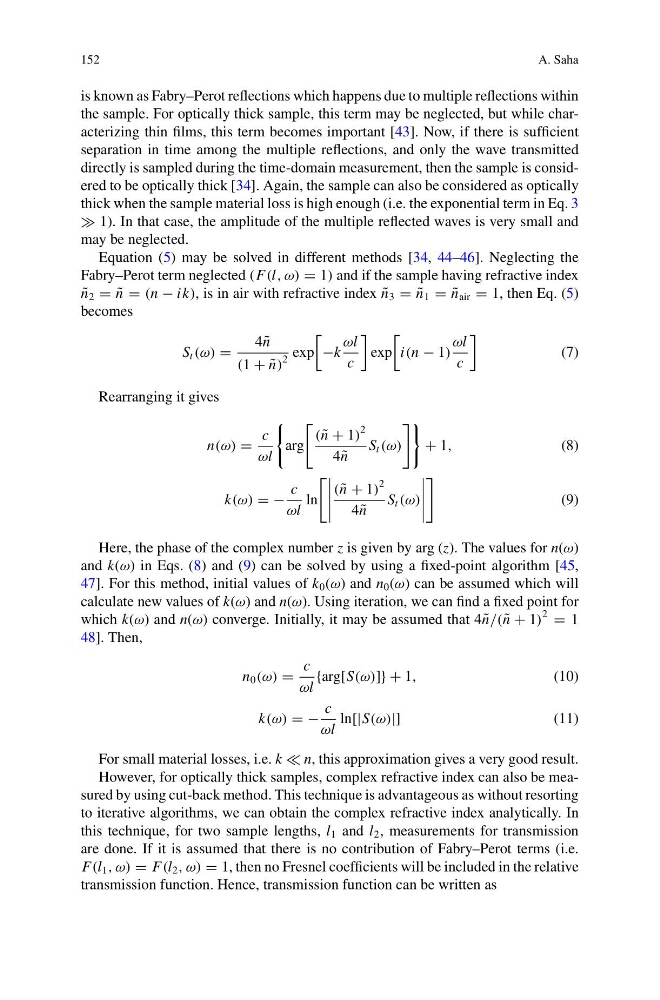
Equation (5) may be solved in different methods [34, 44–46]. Neglecting the
Fabry–Perot term neglected (F(l, ω) = 1) and if the sample having refractive index
˜
n 2 = ˜
n = (n − ik), is in air with refractive index ˜
n 3 = ˜
n 1 = ˜
n air = 1, then Eq. (5)
becomes
S t (ω) =
4 ˜
n
(1 + ˜
n)
2
exp
−k
ωl
c
exp
i(n − 1)
ωl
c
(7)
Rearranging it gives
n(ω) =
c
ωl
arg
( ˜
n + 1)
2
4 ˜
n
S t (ω)
+ 1,
(8)
k(ω) = −
c
ωl
ln
( ˜
n + 1)
2
4 ˜
n
S t (ω)
(9)
Here, the phase of the complex number z is given by arg (z). The values for n(ω)
and k(ω) in Eqs. (8) and (9) can be solved by using a fixed-point algorithm [45,
47]. For this method, initial values of k 0 (ω) and n 0 (ω) can be assumed which will
calculate new values of k(ω) and n(ω). Using iteration, we can find a fixed point for
which k(ω) and n(ω) converge. Initially, it may be assumed that 4 ˜
n/( ˜
n + 1)
2 = 1
48]. Then,
n 0 (ω) =
c
ωl
{arg[S(ω)]} + 1,
(10)
k(ω) = −
c
ωl
ln[|S(ω)|]
(11)
For small material losses, i.e. k n, this approximation gives a very good result.
However, for optically thick samples, complex refractive index can also be measured by using cut-back method. This technique is advantageous as without resorting
to iterative algorithms, we can obtain the complex refractive index analytically. In
this technique, for two sample lengths, l 1 and l 2 , measurements for transmission
are done. If it is assumed that there is no contribution of Fabry–Perot terms (i.e.
F(l 1 , ω) = F(l 2 , ω) = 1, then no Fresnel coefficients will be included in the relative
transmission function. Hence, transmission function can be written as
A. Saha
is known as Fabry–Perot reflections which happens due to multiple reflections within
the sample. For optically thick sample, this term may be neglected, but while characterizing thin films, this term becomes important [43]. Now, if there is sufficient
separation in time among the multiple reflections, and only the wave transmitted
directly is sampled during the time-domain measurement, then the sample is considered to be optically thick [34]. Again, the sample can also be considered as optically
thick when the sample material loss is high enough (i.e. the exponential term in Eq. 3
1). In that case, the amplitude of the multiple reflected waves is very small and
may be neglected.
Equation (5) may be solved in different methods [34, 44–46]. Neglecting the
Fabry–Perot term neglected (F(l, ω) = 1) and if the sample having refractive index
˜
n 2 = ˜
n = (n − ik), is in air with refractive index ˜
n 3 = ˜
n 1 = ˜
n air = 1, then Eq. (5)
becomes
S t (ω) =
4 ˜
n
(1 + ˜
n)
2
exp
−k
ωl
c
exp
i(n − 1)
ωl
c
(7)
Rearranging it gives
n(ω) =
c
ωl
arg
( ˜
n + 1)
2
4 ˜
n
S t (ω)
+ 1,
(8)
k(ω) = −
c
ωl
ln
( ˜
n + 1)
2
4 ˜
n
S t (ω)
(9)
Here, the phase of the complex number z is given by arg (z). The values for n(ω)
and k(ω) in Eqs. (8) and (9) can be solved by using a fixed-point algorithm [45,
47]. For this method, initial values of k 0 (ω) and n 0 (ω) can be assumed which will
calculate new values of k(ω) and n(ω). Using iteration, we can find a fixed point for
which k(ω) and n(ω) converge. Initially, it may be assumed that 4 ˜
n/( ˜
n + 1)
2 = 1
48]. Then,
n 0 (ω) =
c
ωl
{arg[S(ω)]} + 1,
(10)
k(ω) = −
c
ωl
ln[|S(ω)|]
(11)
For small material losses, i.e. k n, this approximation gives a very good result.
However, for optically thick samples, complex refractive index can also be measured by using cut-back method. This technique is advantageous as without resorting
to iterative algorithms, we can obtain the complex refractive index analytically. In
this technique, for two sample lengths, l 1 and l 2 , measurements for transmission
are done. If it is assumed that there is no contribution of Fabry–Perot terms (i.e.
F(l 1 , ω) = F(l 2 , ω) = 1, then no Fresnel coefficients will be included in the relative
transmission function. Hence, transmission function can be written as