

Advances in Terahertz Imaging
151
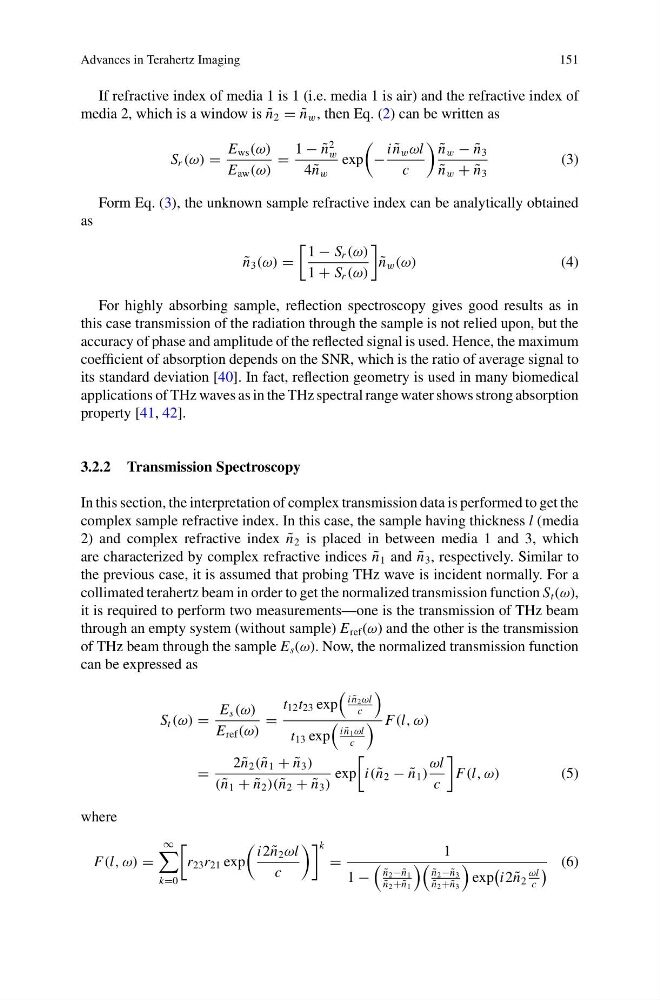
If refractive index of media 1 is 1 (i.e. media 1 is air) and the refractive index of
media 2, which is a window is ˜
n 2 = ˜
n w , then Eq. (2) can be written as
S r (ω) =
E ws (ω)
E aw (ω)
=
1 − ˜
n
2
w
4 ˜
n w
exp
−
i ˜
n w ωl
c
˜
n w − ˜
n 3
˜
n w + ˜
n 3
(3)
Form Eq. (3), the unknown sample refractive index can be analytically obtained
as
˜
n 3 (ω) =
1 − S r (ω)
1 + S r (ω)
˜
n w (ω)
(4)
For highly absorbing sample, reflection spectroscopy gives good results as in
this case transmission of the radiation through the sample is not relied upon, but the
accuracy of phase and amplitude of the reflected signal is used. Hence, the maximum
coefficient of absorption depends on the SNR, which is the ratio of average signal to
its standard deviation [40]. In fact, reflection geometry is used in many biomedical
applications of THz waves as in the THz spectral range water shows strong absorption
property [41, 42].
3.2.2 Transmission Spectroscopy
In this section, the interpretation of complex transmission data is performed to get the
complex sample refractive index. In this case, the sample having thickness l (media
2) and complex refractive index ˜
n 2 is placed in between media 1 and 3, which
are characterized by complex refractive indices ˜
n 1 and ˜
n 3 , respectively. Similar to
the previous case, it is assumed that probing THz wave is incident normally. For a
collimated terahertz beam in order to get the normalized transmission function S t (ω),
it is required to perform two measurements—one is the transmission of THz beam
through an empty system (without sample) E ref (ω) and the other is the transmission
of THz beam through the sample E s (ω). Now, the normalized transmission function
can be expressed as
S t (ω) =
E s (ω)
E ref (ω)
=
t 12 t 23 exp
i ˜
n 2 ωl
c
t 13 exp
i ˜
n 1 ωl
c
F(l, ω)
=
2 ˜
n 2 ( ˜
n 1 + ˜
n 3 )
( ˜
n 1 + ˜
n 2 )( ˜
n 2 + ˜
n 3 )
exp
i( ˜
n 2 − ˜
n 1 )
ωl
c
F(l, ω)
(5)
where
F(l, ω) =
∞
k=0
r 23 r 21 exp
i2 ˜
n 2 ωl
c
k
=
1
1 −
˜
n 2 − ˜
n 1
˜
n 2 + ˜
n 1
˜
n 2 − ˜
n 3
˜
n 2 + ˜
n 3
exp
i2 ˜
n 2
ωl
c
(6)
151
If refractive index of media 1 is 1 (i.e. media 1 is air) and the refractive index of
media 2, which is a window is ˜
n 2 = ˜
n w , then Eq. (2) can be written as
S r (ω) =
E ws (ω)
E aw (ω)
=
1 − ˜
n
2
w
4 ˜
n w
exp
−
i ˜
n w ωl
c
˜
n w − ˜
n 3
˜
n w + ˜
n 3
(3)
Form Eq. (3), the unknown sample refractive index can be analytically obtained
as
˜
n 3 (ω) =
1 − S r (ω)
1 + S r (ω)
˜
n w (ω)
(4)
For highly absorbing sample, reflection spectroscopy gives good results as in
this case transmission of the radiation through the sample is not relied upon, but the
accuracy of phase and amplitude of the reflected signal is used. Hence, the maximum
coefficient of absorption depends on the SNR, which is the ratio of average signal to
its standard deviation [40]. In fact, reflection geometry is used in many biomedical
applications of THz waves as in the THz spectral range water shows strong absorption
property [41, 42].
3.2.2 Transmission Spectroscopy
In this section, the interpretation of complex transmission data is performed to get the
complex sample refractive index. In this case, the sample having thickness l (media
2) and complex refractive index ˜
n 2 is placed in between media 1 and 3, which
are characterized by complex refractive indices ˜
n 1 and ˜
n 3 , respectively. Similar to
the previous case, it is assumed that probing THz wave is incident normally. For a
collimated terahertz beam in order to get the normalized transmission function S t (ω),
it is required to perform two measurements—one is the transmission of THz beam
through an empty system (without sample) E ref (ω) and the other is the transmission
of THz beam through the sample E s (ω). Now, the normalized transmission function
can be expressed as
S t (ω) =
E s (ω)
E ref (ω)
=
t 12 t 23 exp
i ˜
n 2 ωl
c
t 13 exp
i ˜
n 1 ωl
c
F(l, ω)
=
2 ˜
n 2 ( ˜
n 1 + ˜
n 3 )
( ˜
n 1 + ˜
n 2 )( ˜
n 2 + ˜
n 3 )
exp
i( ˜
n 2 − ˜
n 1 )
ωl
c
F(l, ω)
(5)
where
F(l, ω) =
∞
k=0
r 23 r 21 exp
i2 ˜
n 2 ωl
c
k
=
1
1 −
˜
n 2 − ˜
n 1
˜
n 2 + ˜
n 1
˜
n 2 − ˜
n 3
˜
n 2 + ˜
n 3
exp
i2 ˜
n 2
ωl
c
(6)