

Advances in Terahertz Imaging
153
S t (ω) =
E 2 (ω)
E 1 (ω)
=
t 12 t 23 exp
i ˜
nωl 2
c
t 12 t 23 exp
i ˜
nωl 1
c
= exp
i
˜
nω
c
(l 2 − l 1 )
= exp
−
kω
c
(l 2 − l 1 )
exp
i
nω
c
(l 2 − l 1 )
(12)
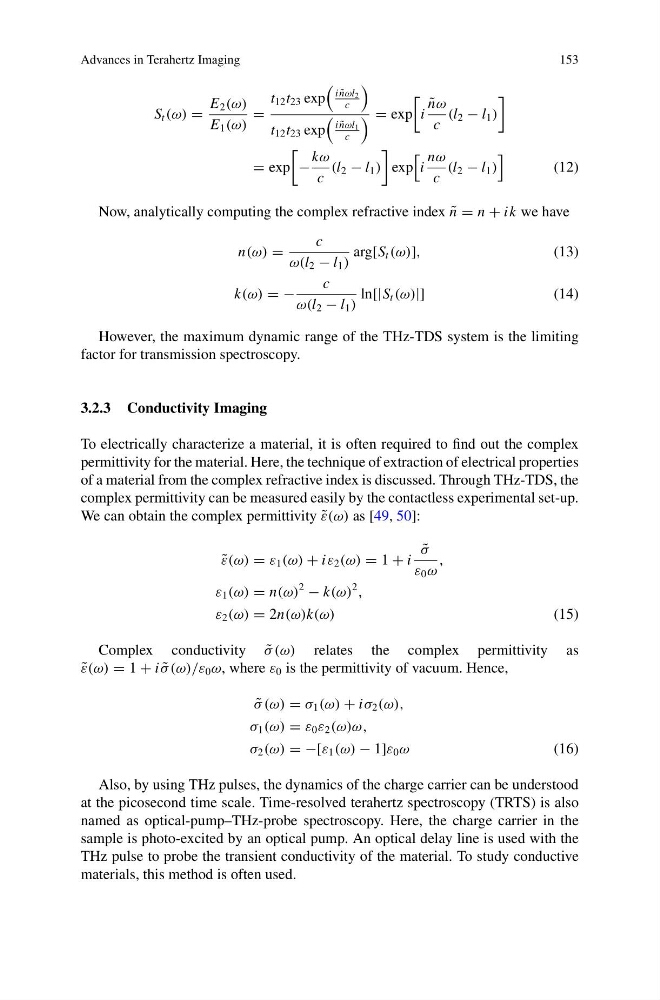
Now, analytically computing the complex refractive index ˜
n = n + ik we have
n(ω) =
c
ω(l 2 − l 1 )
arg[S t (ω)],
(13)
k(ω) = −
c
ω(l 2 − l 1 )
ln[|S t (ω)|]
(14)
However, the maximum dynamic range of the THz-TDS system is the limiting
factor for transmission spectroscopy.
3.2.3 Conductivity Imaging
To electrically characterize a material, it is often required to find out the complex
permittivity for the material. Here, the technique of extraction of electrical properties
of a material from the complex refractive index is discussed. Through THz-TDS, the
complex permittivity can be measured easily by the contactless experimental set-up.
We can obtain the complex permittivity ˜
ε(ω) as [49, 50]:
˜
ε(ω) = ε 1 (ω) + iε 2 (ω) = 1 + i
˜
σ
ε 0 ω
,
ε 1 (ω) = n(ω)
2
− k(ω)
2
,
ε 2 (ω) = 2n(ω)k(ω)
(15)
Complex conductivity ˜
σ (ω) relates the complex permittivity as
˜
ε(ω) = 1 + i ˜
σ (ω)/ε 0 ω, where ε 0 is the permittivity of vacuum. Hence,
˜
σ (ω) = σ 1 (ω) + iσ 2 (ω),
σ 1 (ω) = ε 0 ε 2 (ω)ω,
σ 2 (ω) = −[ε 1 (ω) − 1]ε 0 ω
(16)
Also, by using THz pulses, the dynamics of the charge carrier can be understood
at the picosecond time scale. Time-resolved terahertz spectroscopy (TRTS) is also
named as optical-pump–THz-probe spectroscopy. Here, the charge carrier in the
sample is photo-excited by an optical pump. An optical delay line is used with the
THz pulse to probe the transient conductivity of the material. To study conductive
materials, this method is often used.
153
S t (ω) =
E 2 (ω)
E 1 (ω)
=
t 12 t 23 exp
i ˜
nωl 2
c
t 12 t 23 exp
i ˜
nωl 1
c
= exp
i
˜
nω
c
(l 2 − l 1 )
= exp
−
kω
c
(l 2 − l 1 )
exp
i
nω
c
(l 2 − l 1 )
(12)
Now, analytically computing the complex refractive index ˜
n = n + ik we have
n(ω) =
c
ω(l 2 − l 1 )
arg[S t (ω)],
(13)
k(ω) = −
c
ω(l 2 − l 1 )
ln[|S t (ω)|]
(14)
However, the maximum dynamic range of the THz-TDS system is the limiting
factor for transmission spectroscopy.
3.2.3 Conductivity Imaging
To electrically characterize a material, it is often required to find out the complex
permittivity for the material. Here, the technique of extraction of electrical properties
of a material from the complex refractive index is discussed. Through THz-TDS, the
complex permittivity can be measured easily by the contactless experimental set-up.
We can obtain the complex permittivity ˜
ε(ω) as [49, 50]:
˜
ε(ω) = ε 1 (ω) + iε 2 (ω) = 1 + i
˜
σ
ε 0 ω
,
ε 1 (ω) = n(ω)
2
− k(ω)
2
,
ε 2 (ω) = 2n(ω)k(ω)
(15)
Complex conductivity ˜
σ (ω) relates the complex permittivity as
˜
ε(ω) = 1 + i ˜
σ (ω)/ε 0 ω, where ε 0 is the permittivity of vacuum. Hence,
˜
σ (ω) = σ 1 (ω) + iσ 2 (ω),
σ 1 (ω) = ε 0 ε 2 (ω)ω,
σ 2 (ω) = −[ε 1 (ω) − 1]ε 0 ω
(16)
Also, by using THz pulses, the dynamics of the charge carrier can be understood
at the picosecond time scale. Time-resolved terahertz spectroscopy (TRTS) is also
named as optical-pump–THz-probe spectroscopy. Here, the charge carrier in the
sample is photo-excited by an optical pump. An optical delay line is used with the
THz pulse to probe the transient conductivity of the material. To study conductive
materials, this method is often used.