

Heterostructure Devices for THz Signal Recognition
113
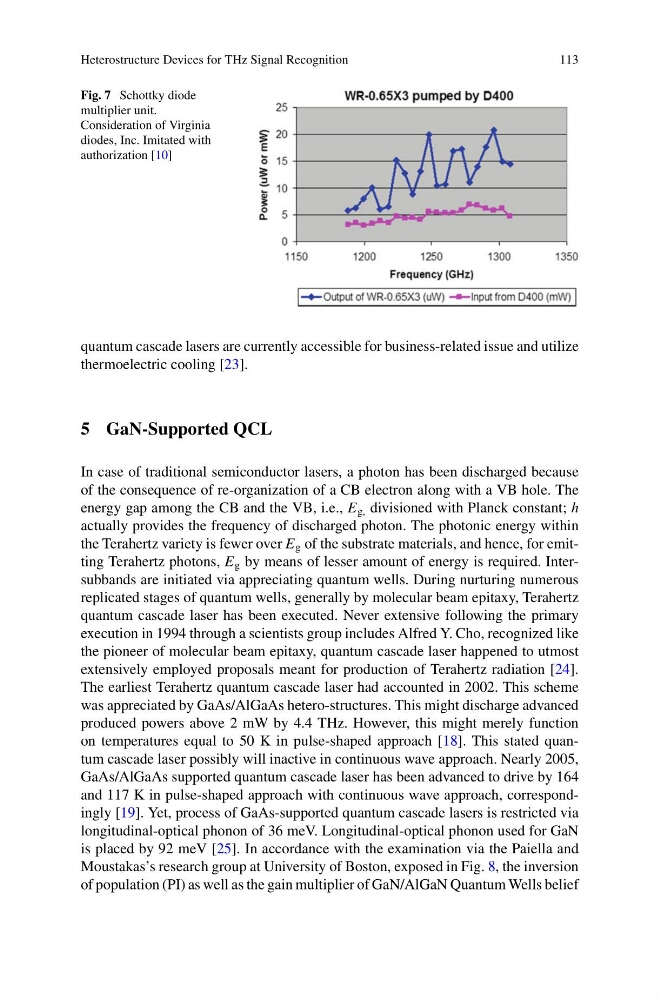
Fig. 7 Schottky diode
multiplier unit.
Consideration of Virginia
diodes, Inc. Imitated with
authorization [10]
quantum cascade lasers are currently accessible for business-related issue and utilize
thermoelectric cooling [23].
5 GaN-Supported QCL
In case of traditional semiconductor lasers, a photon has been discharged because
of the consequence of re-organization of a CB electron along with a VB hole. The
energy gap among the CB and the VB, i.e., E g, divisioned with Planck constant; h
actually provides the frequency of discharged photon. The photonic energy within
the Terahertz variety is fewer over E g of the substrate materials, and hence, for emitting Terahertz photons, E g by means of lesser amount of energy is required. Intersubbands are initiated via appreciating quantum wells. During nurturing numerous
replicated stages of quantum wells, generally by molecular beam epitaxy, Terahertz
quantum cascade laser has been executed. Never extensive following the primary
execution in 1994 through a scientists group includes Alfred Y. Cho, recognized like
the pioneer of molecular beam epitaxy, quantum cascade laser happened to utmost
extensively employed proposals meant for production of Terahertz radiation [24].
The earliest Terahertz quantum cascade laser had accounted in 2002. This scheme
was appreciated by GaAs/AlGaAs hetero-structures. This might discharge advanced
produced powers above 2 mW by 4.4 THz. However, this might merely function
on temperatures equal to 50 K in pulse-shaped approach [18]. This stated quantum cascade laser possibly will inactive in continuous wave approach. Nearly 2005,
GaAs/AlGaAs supported quantum cascade laser has been advanced to drive by 164
and 117 K in pulse-shaped approach with continuous wave approach, correspondingly [19]. Yet, process of GaAs-supported quantum cascade lasers is restricted via
longitudinal-optical phonon of 36 meV. Longitudinal-optical phonon used for GaN
is placed by 92 meV [25]. In accordance with the examination via the Paiella and
Moustakas’s research group at University of Boston, exposed in Fig. 8, the inversion
of population (PI) as well as the gain multiplier of GaN/AlGaN Quantum Wells belief
113
Fig. 7 Schottky diode
multiplier unit.
Consideration of Virginia
diodes, Inc. Imitated with
authorization [10]
quantum cascade lasers are currently accessible for business-related issue and utilize
thermoelectric cooling [23].
5 GaN-Supported QCL
In case of traditional semiconductor lasers, a photon has been discharged because
of the consequence of re-organization of a CB electron along with a VB hole. The
energy gap among the CB and the VB, i.e., E g, divisioned with Planck constant; h
actually provides the frequency of discharged photon. The photonic energy within
the Terahertz variety is fewer over E g of the substrate materials, and hence, for emitting Terahertz photons, E g by means of lesser amount of energy is required. Intersubbands are initiated via appreciating quantum wells. During nurturing numerous
replicated stages of quantum wells, generally by molecular beam epitaxy, Terahertz
quantum cascade laser has been executed. Never extensive following the primary
execution in 1994 through a scientists group includes Alfred Y. Cho, recognized like
the pioneer of molecular beam epitaxy, quantum cascade laser happened to utmost
extensively employed proposals meant for production of Terahertz radiation [24].
The earliest Terahertz quantum cascade laser had accounted in 2002. This scheme
was appreciated by GaAs/AlGaAs hetero-structures. This might discharge advanced
produced powers above 2 mW by 4.4 THz. However, this might merely function
on temperatures equal to 50 K in pulse-shaped approach [18]. This stated quantum cascade laser possibly will inactive in continuous wave approach. Nearly 2005,
GaAs/AlGaAs supported quantum cascade laser has been advanced to drive by 164
and 117 K in pulse-shaped approach with continuous wave approach, correspondingly [19]. Yet, process of GaAs-supported quantum cascade lasers is restricted via
longitudinal-optical phonon of 36 meV. Longitudinal-optical phonon used for GaN
is placed by 92 meV [25]. In accordance with the examination via the Paiella and
Moustakas’s research group at University of Boston, exposed in Fig. 8, the inversion
of population (PI) as well as the gain multiplier of GaN/AlGaN Quantum Wells belief