

114
A. Bhattacharyya et al.
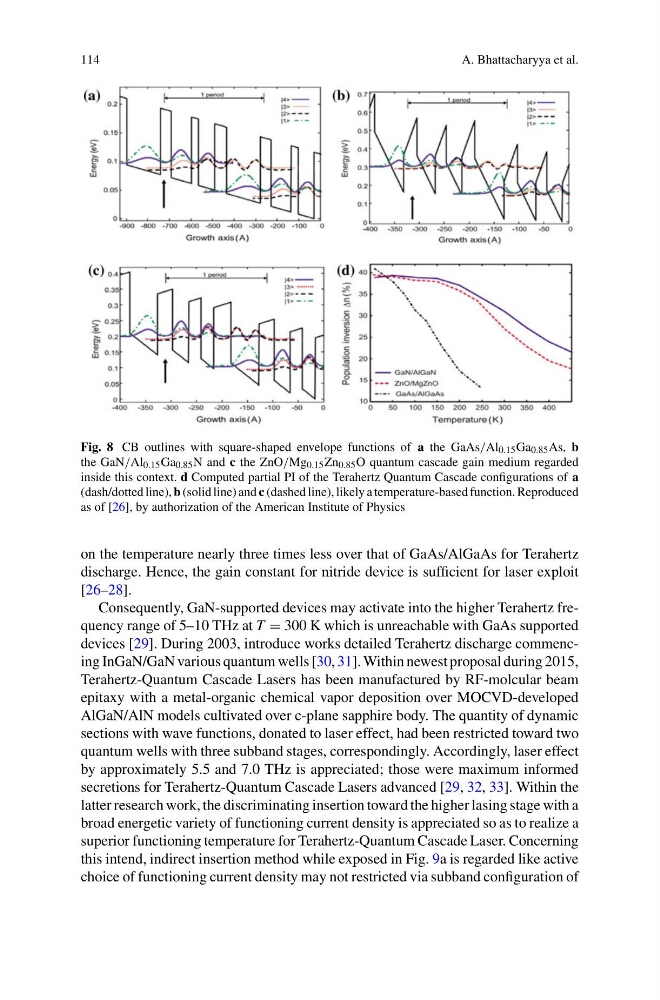
Fig. 8 CB outlines with square-shaped envelope functions of a the GaAs/Al 0.15 Ga 0.85 As, b
the GaN/Al 0.15 Ga 0.85 N and c the ZnO/Mg 0.15 Zn 0.85 O quantum cascade gain medium regarded
inside this context. d Computed partial PI of the Terahertz Quantum Cascade configurations of a
(dash/dotted line), b (solid line) and c (dashed line), likely a temperature-based function. Reproduced
as of [26], by authorization of the American Institute of Physics
on the temperature nearly three times less over that of GaAs/AlGaAs for Terahertz
discharge. Hence, the gain constant for nitride device is sufficient for laser exploit
[26–28].
Consequently, GaN-supported devices may activate into the higher Terahertz frequency range of 5–10 THz at T = 300 K which is unreachable with GaAs supported
devices [29]. During 2003, introduce works detailed Terahertz discharge commencing InGaN/GaN various quantum wells [30, 31]. Within newest proposal during 2015,
Terahertz-Quantum Cascade Lasers has been manufactured by RF-molcular beam
epitaxy with a metal-organic chemical vapor deposition over MOCVD-developed
AlGaN/AlN models cultivated over c-plane sapphire body. The quantity of dynamic
sections with wave functions, donated to laser effect, had been restricted toward two
quantum wells with three subband stages, correspondingly. Accordingly, laser effect
by approximately 5.5 and 7.0 THz is appreciated; those were maximum informed
secretions for Terahertz-Quantum Cascade Lasers advanced [29, 32, 33]. Within the
latter research work, the discriminating insertion toward the higher lasing stage with a
broad energetic variety of functioning current density is appreciated so as to realize a
superior functioning temperature for Terahertz-Quantum Cascade Laser. Concerning
this intend, indirect insertion method while exposed in Fig. 9a is regarded like active
choice of functioning current density may not restricted via subband configuration of
A. Bhattacharyya et al.
Fig. 8 CB outlines with square-shaped envelope functions of a the GaAs/Al 0.15 Ga 0.85 As, b
the GaN/Al 0.15 Ga 0.85 N and c the ZnO/Mg 0.15 Zn 0.85 O quantum cascade gain medium regarded
inside this context. d Computed partial PI of the Terahertz Quantum Cascade configurations of a
(dash/dotted line), b (solid line) and c (dashed line), likely a temperature-based function. Reproduced
as of [26], by authorization of the American Institute of Physics
on the temperature nearly three times less over that of GaAs/AlGaAs for Terahertz
discharge. Hence, the gain constant for nitride device is sufficient for laser exploit
[26–28].
Consequently, GaN-supported devices may activate into the higher Terahertz frequency range of 5–10 THz at T = 300 K which is unreachable with GaAs supported
devices [29]. During 2003, introduce works detailed Terahertz discharge commencing InGaN/GaN various quantum wells [30, 31]. Within newest proposal during 2015,
Terahertz-Quantum Cascade Lasers has been manufactured by RF-molcular beam
epitaxy with a metal-organic chemical vapor deposition over MOCVD-developed
AlGaN/AlN models cultivated over c-plane sapphire body. The quantity of dynamic
sections with wave functions, donated to laser effect, had been restricted toward two
quantum wells with three subband stages, correspondingly. Accordingly, laser effect
by approximately 5.5 and 7.0 THz is appreciated; those were maximum informed
secretions for Terahertz-Quantum Cascade Lasers advanced [29, 32, 33]. Within the
latter research work, the discriminating insertion toward the higher lasing stage with a
broad energetic variety of functioning current density is appreciated so as to realize a
superior functioning temperature for Terahertz-Quantum Cascade Laser. Concerning
this intend, indirect insertion method while exposed in Fig. 9a is regarded like active
choice of functioning current density may not restricted via subband configuration of