

112
A. Bhattacharyya et al.
4 Production and Recognition of Terahertz Radiation
Sources of electronic Terahertz activate by the short margin of the Terahertz variety
(commencing 300 GHz to ~1 THz). Around 300 GHz, GaAs and Si impact avalanche
transit time (IMPATT) diodes convey powers beyond 1 W. The yield of Gunn diode
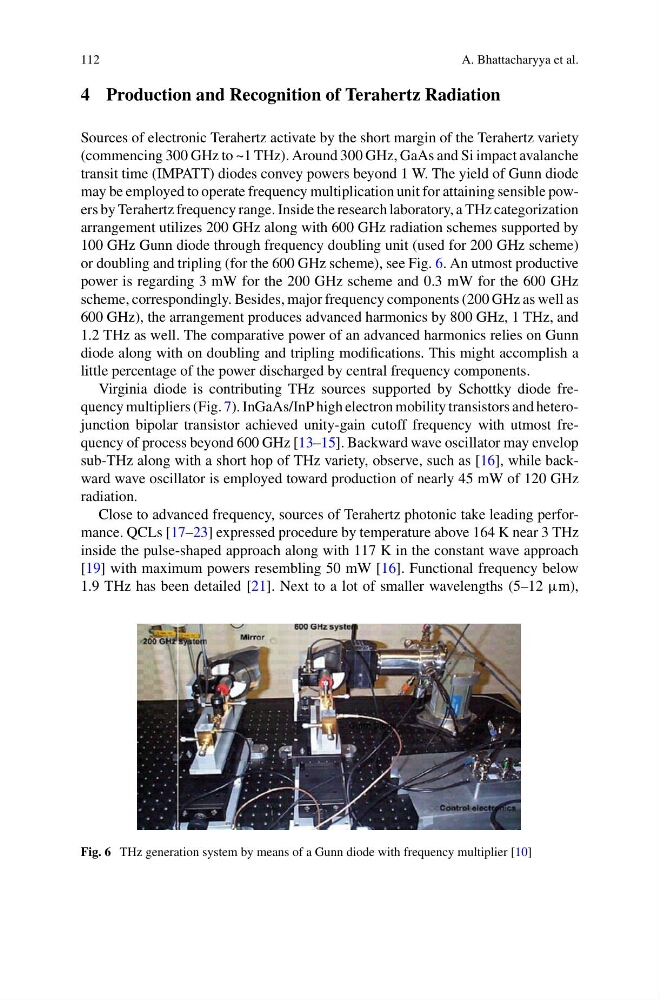
may be employed to operate frequency multiplication unit for attaining sensible powers by Terahertz frequency range. Inside the research laboratory, a THz categorization
arrangement utilizes 200 GHz along with 600 GHz radiation schemes supported by
100 GHz Gunn diode through frequency doubling unit (used for 200 GHz scheme)
or doubling and tripling (for the 600 GHz scheme), see Fig. 6. An utmost productive
power is regarding 3 mW for the 200 GHz scheme and 0.3 mW for the 600 GHz
scheme, correspondingly. Besides, major frequency components (200 GHz as well as
600 GHz), the arrangement produces advanced harmonics by 800 GHz, 1 THz, and
1.2 THz as well. The comparative power of an advanced harmonics relies on Gunn
diode along with on doubling and tripling modifications. This might accomplish a
little percentage of the power discharged by central frequency components.
Virginia diode is contributing THz sources supported by Schottky diode frequency multipliers (Fig. 7). InGaAs/InP high electron mobility transistors and heterojunction bipolar transistor achieved unity-gain cutoff frequency with utmost frequency of process beyond 600 GHz [13–15]. Backward wave oscillator may envelop
sub-THz along with a short hop of THz variety, observe, such as [16], while backward wave oscillator is employed toward production of nearly 45 mW of 120 GHz
radiation.
Close to advanced frequency, sources of Terahertz photonic take leading performance. QCLs [17–23] expressed procedure by temperature above 164 K near 3 THz
inside the pulse-shaped approach along with 117 K in the constant wave approach
[19] with maximum powers resembling 50 mW [16]. Functional frequency below
1.9 THz has been detailed [21]. Next to a lot of smaller wavelengths (5–12 µm),
Fig. 6 THz generation system by means of a Gunn diode with frequency multiplier [10]
A. Bhattacharyya et al.
4 Production and Recognition of Terahertz Radiation
Sources of electronic Terahertz activate by the short margin of the Terahertz variety
(commencing 300 GHz to ~1 THz). Around 300 GHz, GaAs and Si impact avalanche
transit time (IMPATT) diodes convey powers beyond 1 W. The yield of Gunn diode
may be employed to operate frequency multiplication unit for attaining sensible powers by Terahertz frequency range. Inside the research laboratory, a THz categorization
arrangement utilizes 200 GHz along with 600 GHz radiation schemes supported by
100 GHz Gunn diode through frequency doubling unit (used for 200 GHz scheme)
or doubling and tripling (for the 600 GHz scheme), see Fig. 6. An utmost productive
power is regarding 3 mW for the 200 GHz scheme and 0.3 mW for the 600 GHz
scheme, correspondingly. Besides, major frequency components (200 GHz as well as
600 GHz), the arrangement produces advanced harmonics by 800 GHz, 1 THz, and
1.2 THz as well. The comparative power of an advanced harmonics relies on Gunn
diode along with on doubling and tripling modifications. This might accomplish a
little percentage of the power discharged by central frequency components.
Virginia diode is contributing THz sources supported by Schottky diode frequency multipliers (Fig. 7). InGaAs/InP high electron mobility transistors and heterojunction bipolar transistor achieved unity-gain cutoff frequency with utmost frequency of process beyond 600 GHz [13–15]. Backward wave oscillator may envelop
sub-THz along with a short hop of THz variety, observe, such as [16], while backward wave oscillator is employed toward production of nearly 45 mW of 120 GHz
radiation.
Close to advanced frequency, sources of Terahertz photonic take leading performance. QCLs [17–23] expressed procedure by temperature above 164 K near 3 THz
inside the pulse-shaped approach along with 117 K in the constant wave approach
[19] with maximum powers resembling 50 mW [16]. Functional frequency below
1.9 THz has been detailed [21]. Next to a lot of smaller wavelengths (5–12 µm),
Fig. 6 THz generation system by means of a Gunn diode with frequency multiplier [10]