

management during a catastrophe. Since the reports of the IPCC are focusing on
change and risks the message must be alarming, or—depending on the susceptibility
of the individual awareness—even apocalyptic.
These examples may indicate how our communication and awareness can be
influenced by scientific information (IPCC 2014, 2018, 2019, and others).
6 Interplay of Scientific and Traditional Knowledge,
Religion and Spirituality, Economy and Politics,
Communication and the Media
Awareness and knowledge of the environment, including environmental risk, is the
result of observation and empirical studies plus communication and interpretation of
the data (Fig. 6).
The knowledge and awareness of the environment leads to consequences such as
risk analysis, risk management, coast protection, rules for agriculture, forestry,
fishery, aquaculture, and so on. Indeed many political decisions are influenced by
the memory of disasters.
Religious consequences might also be disclaimers, fatalism or an increase in
prayer or sacrificial offering. In former times, human sacrifice, cannibalism, or
headhunting was used as martial consequence partially to satisfy gods or in the
belief that this behaviour to avoid competition for food would be natural and normal.
Religions may answer the question of why God is creating a catastrophe,
punishing humans, and how humans could improve their relationship with God
and/or to nature. Since the self-conception of science is objectivity its basis is
rationality, and therefore neither emotionality nor morality. Normativity and supernatural causation might be an empirical object for different scientific disciplines, but
much less a conducting rational. Religion, on the contrary, is much more open for all
kinds of spirituality, emotionality, fear and hope as an important part of human’s
0
2,5
5,0
7,5
10,0
y = 8,702E-7x2 - 0,0012x + 7,326
R = 0,0426
1910
2009
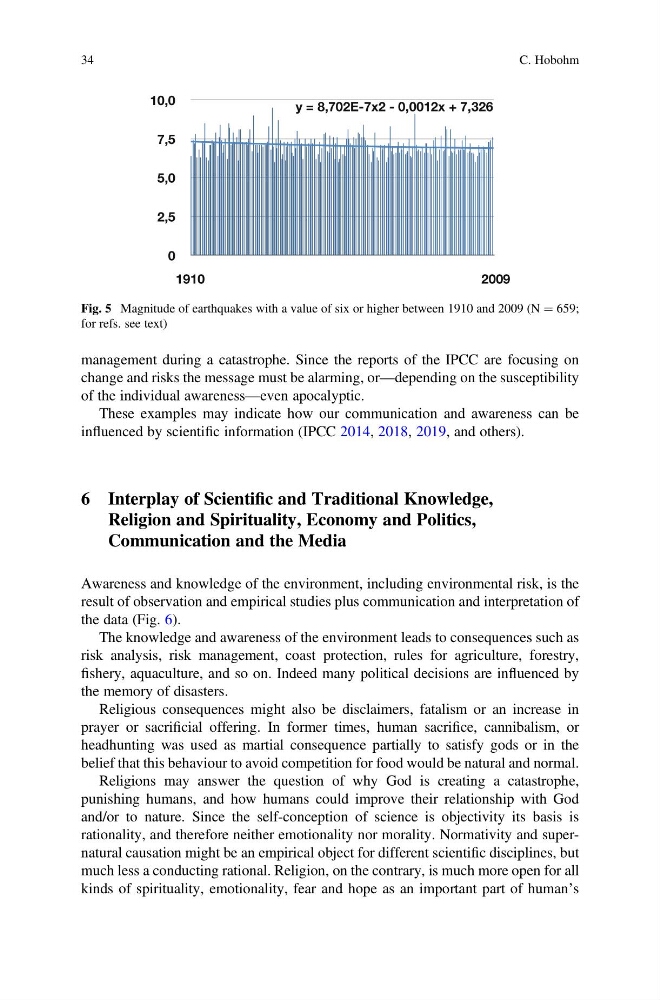
Fig. 5 Magnitude of earthquakes with a value of six or higher between 1910 and 2009 (N ¼ 659;
for refs. see text)
34
C. Hobohm
change and risks the message must be alarming, or—depending on the susceptibility
of the individual awareness—even apocalyptic.
These examples may indicate how our communication and awareness can be
influenced by scientific information (IPCC 2014, 2018, 2019, and others).
6 Interplay of Scientific and Traditional Knowledge,
Religion and Spirituality, Economy and Politics,
Communication and the Media
Awareness and knowledge of the environment, including environmental risk, is the
result of observation and empirical studies plus communication and interpretation of
the data (Fig. 6).
The knowledge and awareness of the environment leads to consequences such as
risk analysis, risk management, coast protection, rules for agriculture, forestry,
fishery, aquaculture, and so on. Indeed many political decisions are influenced by
the memory of disasters.
Religious consequences might also be disclaimers, fatalism or an increase in
prayer or sacrificial offering. In former times, human sacrifice, cannibalism, or
headhunting was used as martial consequence partially to satisfy gods or in the
belief that this behaviour to avoid competition for food would be natural and normal.
Religions may answer the question of why God is creating a catastrophe,
punishing humans, and how humans could improve their relationship with God
and/or to nature. Since the self-conception of science is objectivity its basis is
rationality, and therefore neither emotionality nor morality. Normativity and supernatural causation might be an empirical object for different scientific disciplines, but
much less a conducting rational. Religion, on the contrary, is much more open for all
kinds of spirituality, emotionality, fear and hope as an important part of human’s
0
2,5
5,0
7,5
10,0
y = 8,702E-7x2 - 0,0012x + 7,326
R = 0,0426
1910
2009
Fig. 5 Magnitude of earthquakes with a value of six or higher between 1910 and 2009 (N ¼ 659;
for refs. see text)
34
C. Hobohm