

countries. Furthermore, compared to other European countries Germany and UK
represent relatively high numbers.
If all apomictic taxa would be listed with the same intensity and awareness for all
countries, most likely the numbers and relations would strongly increase. In general,
it is questionable if apomictic taxa, microspecies or subspecies should be listed or
excluded from such lists. However, for the first version of Hypedata we took all
available information and did not exclude any taxon.
All databases and contributions with information about biodiversity have to be
updated regularly. And even if the knowledge is rapidly growing such a database can
never be perfect or complete. Nevertheless, we are convinced that it is meaningful to
use such lists with required prudence. However, because of supposed biases we did
not quantify all relationships.
Moreover, we already started to communicate with many scientists in the world to
get more information especially on invertebrates wherever we assumed to get
information which has not or only regionally been published. The personal communication already shows that we can expect much more local and hyperendemics for
example in Coleoptera (e.g. Carabidae) and molluscs (many gastropods) as well as in
amphibians where microendemic species e.g. of Micorhylids and Atelopus spp. are
widespread. In case of terrestrial snails, the number of species significantly increased
after communication with malacologists from islands and archipelagos. Due to the
first results of focussing on certain areas like habitat islands such as caves and
sources we can expect an increasing number of hyperendemic species also on the
mainland.
We also conclude that the restriction of a taxon to a single square kilometer or a
population of 50 individuals or less for many taxa like most groups of flying insects
is not an adequate category. Thus, depending on the taxonomic group a systematic
reflecting a large, normal or small range and a critical population size for all
taxonomic groups should be developed.
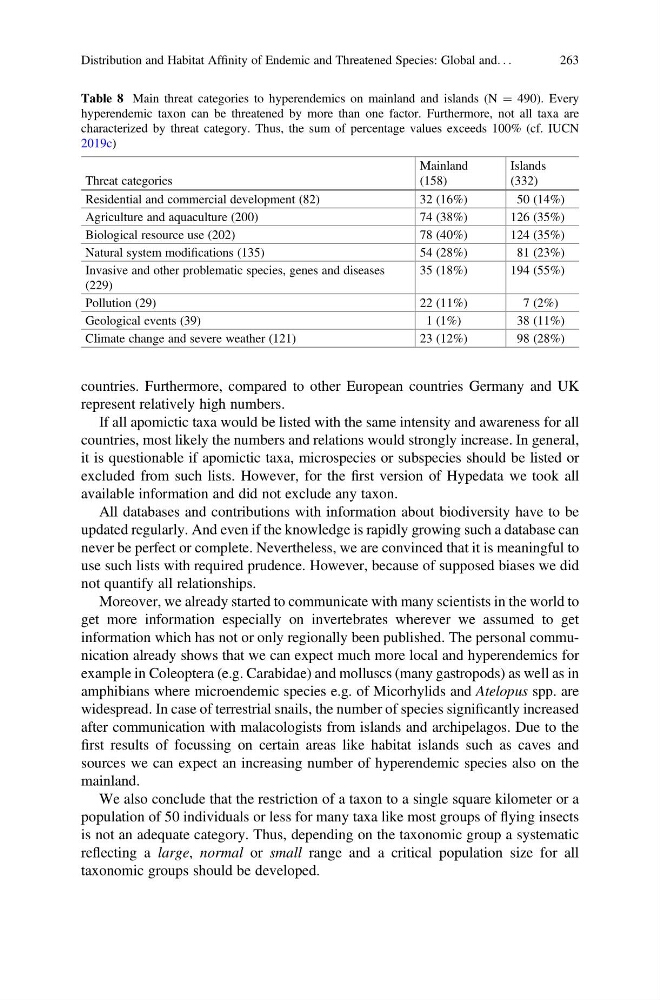
Table 8 Main threat categories to hyperendemics on mainland and islands (N ¼ 490). Every
hyperendemic taxon can be threatened by more than one factor. Furthermore, not all taxa are
characterized by threat category. Thus, the sum of percentage values exceeds 100% (cf. IUCN
2019c)
Threat categories
Mainland
(158)
Islands
(332)
Residential and commercial development (82)
32 (16%)
50 (14%)
Agriculture and aquaculture (200)
74 (38%)
126 (35%)
Biological resource use (202)
78 (40%)
124 (35%)
Natural system modifications (135)
54 (28%)
81 (23%)
Invasive and other problematic species, genes and diseases
(229)
35 (18%)
194 (55%)
Pollution (29)
22 (11%)
7 (2%)
Geological events (39)
1 (1%)
38 (11%)
Climate change and severe weather (121)
23 (12%)
98 (28%)
Distribution and Habitat Affinity of Endemic and Threatened Species: Global and. . .
263
represent relatively high numbers.
If all apomictic taxa would be listed with the same intensity and awareness for all
countries, most likely the numbers and relations would strongly increase. In general,
it is questionable if apomictic taxa, microspecies or subspecies should be listed or
excluded from such lists. However, for the first version of Hypedata we took all
available information and did not exclude any taxon.
All databases and contributions with information about biodiversity have to be
updated regularly. And even if the knowledge is rapidly growing such a database can
never be perfect or complete. Nevertheless, we are convinced that it is meaningful to
use such lists with required prudence. However, because of supposed biases we did
not quantify all relationships.
Moreover, we already started to communicate with many scientists in the world to
get more information especially on invertebrates wherever we assumed to get
information which has not or only regionally been published. The personal communication already shows that we can expect much more local and hyperendemics for
example in Coleoptera (e.g. Carabidae) and molluscs (many gastropods) as well as in
amphibians where microendemic species e.g. of Micorhylids and Atelopus spp. are
widespread. In case of terrestrial snails, the number of species significantly increased
after communication with malacologists from islands and archipelagos. Due to the
first results of focussing on certain areas like habitat islands such as caves and
sources we can expect an increasing number of hyperendemic species also on the
mainland.
We also conclude that the restriction of a taxon to a single square kilometer or a
population of 50 individuals or less for many taxa like most groups of flying insects
is not an adequate category. Thus, depending on the taxonomic group a systematic
reflecting a large, normal or small range and a critical population size for all
taxonomic groups should be developed.
Table 8 Main threat categories to hyperendemics on mainland and islands (N ¼ 490). Every
hyperendemic taxon can be threatened by more than one factor. Furthermore, not all taxa are
characterized by threat category. Thus, the sum of percentage values exceeds 100% (cf. IUCN
2019c)
Threat categories
Mainland
(158)
Islands
(332)
Residential and commercial development (82)
32 (16%)
50 (14%)
Agriculture and aquaculture (200)
74 (38%)
126 (35%)
Biological resource use (202)
78 (40%)
124 (35%)
Natural system modifications (135)
54 (28%)
81 (23%)
Invasive and other problematic species, genes and diseases
(229)
35 (18%)
194 (55%)
Pollution (29)
22 (11%)
7 (2%)
Geological events (39)
1 (1%)
38 (11%)
Climate change and severe weather (121)
23 (12%)
98 (28%)
Distribution and Habitat Affinity of Endemic and Threatened Species: Global and. . .
263