

88
W. Ota and T. Sato
occur within a dimer or larger polymer rather than a monomer. The NHOMO and
HOMO as well as the LUMO and NLUMO are pseudo-degenerate because of the
delocalized electronic states. These orbitals are approximately represented as
ψ NHO ≈
1
√
2
(φ HO (X 1 ) + φ HO (X 2 )),
(5.30)
ψ HO ≈
1
√
2
(φ HO (X 1 ) − φ HO (X 2 )),
(5.31)
ψ LU ≈
1
√
2
(φ LU (X 1 ) − φ LU (X 2 )),
(5.32)
ψ NLU ≈
1
√
2
(φ LU (X 1 ) + φ LU (X 2 )),
(5.33)
where φ HO/LU (X 1 / X 2 ) is the HOMO/LUMO of X 1 /X 2 consisting of the dimer.
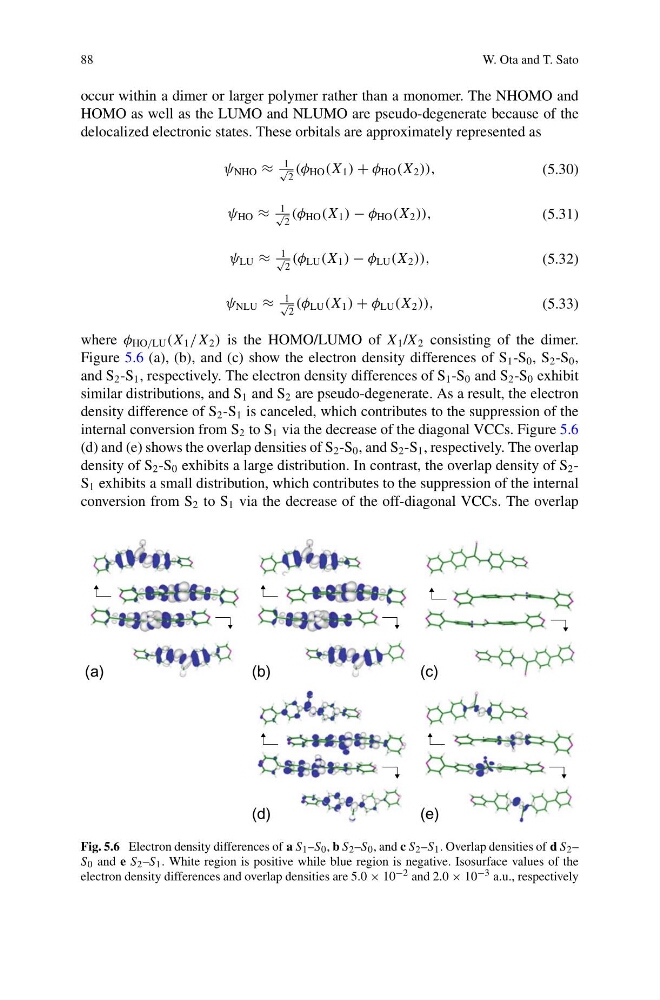
Figure 5.6 (a), (b), and (c) show the electron density differences of S 1 -S 0 , S 2 -S 0 ,
and S 2 -S 1 , respectively. The electron density differences of S 1 -S 0 and S 2 -S 0 exhibit
similar distributions, and S 1 and S 2 are pseudo-degenerate. As a result, the electron
density difference of S 2 -S 1 is canceled, which contributes to the suppression of the
internal conversion from S 2 to S 1 via the decrease of the diagonal VCCs. Figure 5.6
(d) and (e) shows the overlap densities of S 2 -S 0 , and S 2 -S 1 , respectively. The overlap
density of S 2 -S 0 exhibits a large distribution. In contrast, the overlap density of S 2 -
S 1 exhibits a small distribution, which contributes to the suppression of the internal
conversion from S 2 to S 1 via the decrease of the off-diagonal VCCs. The overlap
(a)
(d)
(b)
(c)
(e)
Fig. 5.6 Electron density differences of a S 1 –S 0 , b S 2 –S 0 , and c S 2 –S 1 . Overlap densities of d S 2 –
S 0 and e S 2 –S 1 . White region is positive while blue region is negative. Isosurface values of the
electron density differences and overlap densities are 5.0 × 10 −2 and 2.0 × 10 −3 a.u., respectively
W. Ota and T. Sato
occur within a dimer or larger polymer rather than a monomer. The NHOMO and
HOMO as well as the LUMO and NLUMO are pseudo-degenerate because of the
delocalized electronic states. These orbitals are approximately represented as
ψ NHO ≈
1
√
2
(φ HO (X 1 ) + φ HO (X 2 )),
(5.30)
ψ HO ≈
1
√
2
(φ HO (X 1 ) − φ HO (X 2 )),
(5.31)
ψ LU ≈
1
√
2
(φ LU (X 1 ) − φ LU (X 2 )),
(5.32)
ψ NLU ≈
1
√
2
(φ LU (X 1 ) + φ LU (X 2 )),
(5.33)
where φ HO/LU (X 1 / X 2 ) is the HOMO/LUMO of X 1 /X 2 consisting of the dimer.
Figure 5.6 (a), (b), and (c) show the electron density differences of S 1 -S 0 , S 2 -S 0 ,
and S 2 -S 1 , respectively. The electron density differences of S 1 -S 0 and S 2 -S 0 exhibit
similar distributions, and S 1 and S 2 are pseudo-degenerate. As a result, the electron
density difference of S 2 -S 1 is canceled, which contributes to the suppression of the
internal conversion from S 2 to S 1 via the decrease of the diagonal VCCs. Figure 5.6
(d) and (e) shows the overlap densities of S 2 -S 0 , and S 2 -S 1 , respectively. The overlap
density of S 2 -S 0 exhibits a large distribution. In contrast, the overlap density of S 2 -
S 1 exhibits a small distribution, which contributes to the suppression of the internal
conversion from S 2 to S 1 via the decrease of the off-diagonal VCCs. The overlap
(a)
(d)
(b)
(c)
(e)
Fig. 5.6 Electron density differences of a S 1 –S 0 , b S 2 –S 0 , and c S 2 –S 1 . Overlap densities of d S 2 –
S 0 and e S 2 –S 1 . White region is positive while blue region is negative. Isosurface values of the
electron density differences and overlap densities are 5.0 × 10 −2 and 2.0 × 10 −3 a.u., respectively