

5 Suppression of Internal Conversions from Pseudo-Degenerate …
89
0
2
4
6
8
10
0
1000
2000
3000
|V
α | / 10
-4
a.u.
Frequency / cm
-1
ω 109 =1698 cm
-1
Monomer: FC S 1
0
2
4
6
8
10
0
1000
2000
3000
|V
α | / 10
-4
a.u.
Frequency / cm
-1
ω 224 =1695 cm
-1
Dimer: FC S 2
(a)
(b)
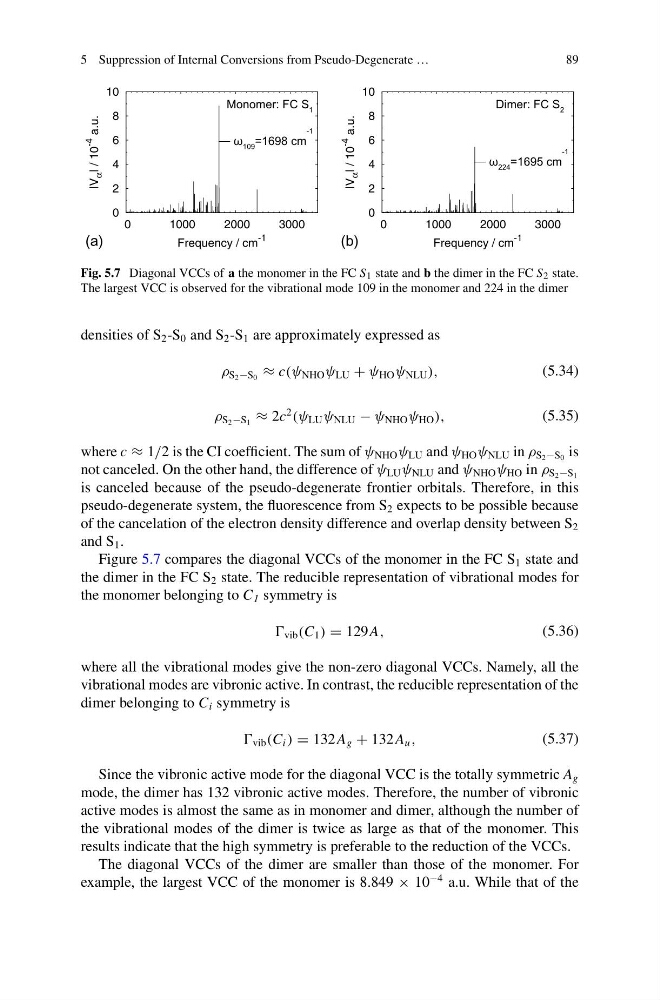
Fig. 5.7 Diagonal VCCs of a the monomer in the FC S 1 state and b the dimer in the FC S 2 state.
The largest VCC is observed for the vibrational mode 109 in the monomer and 224 in the dimer
densities of S 2 -S 0 and S 2 -S 1 are approximately expressed as
ρ S 2 −S 0 ≈ c(ψ NHO ψ LU + ψ HO ψ NLU ),
(5.34)
ρ S 2 −S 1 ≈ 2c
2
(ψ LU ψ NLU − ψ NHO ψ HO ),
(5.35)
where c ≈ 1/2 is the CI coefficient. The sum of ψ NHO ψ LU and ψ HO ψ NLU in ρ S 2 −S 0 is
not canceled. On the other hand, the difference of ψ LU ψ NLU and ψ NHO ψ HO in ρ S 2 −S 1
is canceled because of the pseudo-degenerate frontier orbitals. Therefore, in this
pseudo-degenerate system, the fluorescence from S 2 expects to be possible because
of the cancelation of the electron density difference and overlap density between S 2
and S 1 .
Figure 5.7 compares the diagonal VCCs of the monomer in the FC S 1 state and
the dimer in the FC S 2 state. The reducible representation of vibrational modes for
the monomer belonging to C 1 symmetry is
vib (C 1 ) = 129A,
(5.36)
where all the vibrational modes give the non-zero diagonal VCCs. Namely, all the
vibrational modes are vibronic active. In contrast, the reducible representation of the
dimer belonging to C i symmetry is
vib (C i ) = 132 A g + 132 A u ,
(5.37)
Since the vibronic active mode for the diagonal VCC is the totally symmetric A g
mode, the dimer has 132 vibronic active modes. Therefore, the number of vibronic
active modes is almost the same as in monomer and dimer, although the number of
the vibrational modes of the dimer is twice as large as that of the monomer. This
results indicate that the high symmetry is preferable to the reduction of the VCCs.
The diagonal VCCs of the dimer are smaller than those of the monomer. For
example, the largest VCC of the monomer is 8.849 × 10
−4 a.u. While that of the
89
0
2
4
6
8
10
0
1000
2000
3000
|V
α | / 10
-4
a.u.
Frequency / cm
-1
ω 109 =1698 cm
-1
Monomer: FC S 1
0
2
4
6
8
10
0
1000
2000
3000
|V
α | / 10
-4
a.u.
Frequency / cm
-1
ω 224 =1695 cm
-1
Dimer: FC S 2
(a)
(b)
Fig. 5.7 Diagonal VCCs of a the monomer in the FC S 1 state and b the dimer in the FC S 2 state.
The largest VCC is observed for the vibrational mode 109 in the monomer and 224 in the dimer
densities of S 2 -S 0 and S 2 -S 1 are approximately expressed as
ρ S 2 −S 0 ≈ c(ψ NHO ψ LU + ψ HO ψ NLU ),
(5.34)
ρ S 2 −S 1 ≈ 2c
2
(ψ LU ψ NLU − ψ NHO ψ HO ),
(5.35)
where c ≈ 1/2 is the CI coefficient. The sum of ψ NHO ψ LU and ψ HO ψ NLU in ρ S 2 −S 0 is
not canceled. On the other hand, the difference of ψ LU ψ NLU and ψ NHO ψ HO in ρ S 2 −S 1
is canceled because of the pseudo-degenerate frontier orbitals. Therefore, in this
pseudo-degenerate system, the fluorescence from S 2 expects to be possible because
of the cancelation of the electron density difference and overlap density between S 2
and S 1 .
Figure 5.7 compares the diagonal VCCs of the monomer in the FC S 1 state and
the dimer in the FC S 2 state. The reducible representation of vibrational modes for
the monomer belonging to C 1 symmetry is
vib (C 1 ) = 129A,
(5.36)
where all the vibrational modes give the non-zero diagonal VCCs. Namely, all the
vibrational modes are vibronic active. In contrast, the reducible representation of the
dimer belonging to C i symmetry is
vib (C i ) = 132 A g + 132 A u ,
(5.37)
Since the vibronic active mode for the diagonal VCC is the totally symmetric A g
mode, the dimer has 132 vibronic active modes. Therefore, the number of vibronic
active modes is almost the same as in monomer and dimer, although the number of
the vibrational modes of the dimer is twice as large as that of the monomer. This
results indicate that the high symmetry is preferable to the reduction of the VCCs.
The diagonal VCCs of the dimer are smaller than those of the monomer. For
example, the largest VCC of the monomer is 8.849 × 10
−4 a.u. While that of the