

86
W. Ota and T. Sato
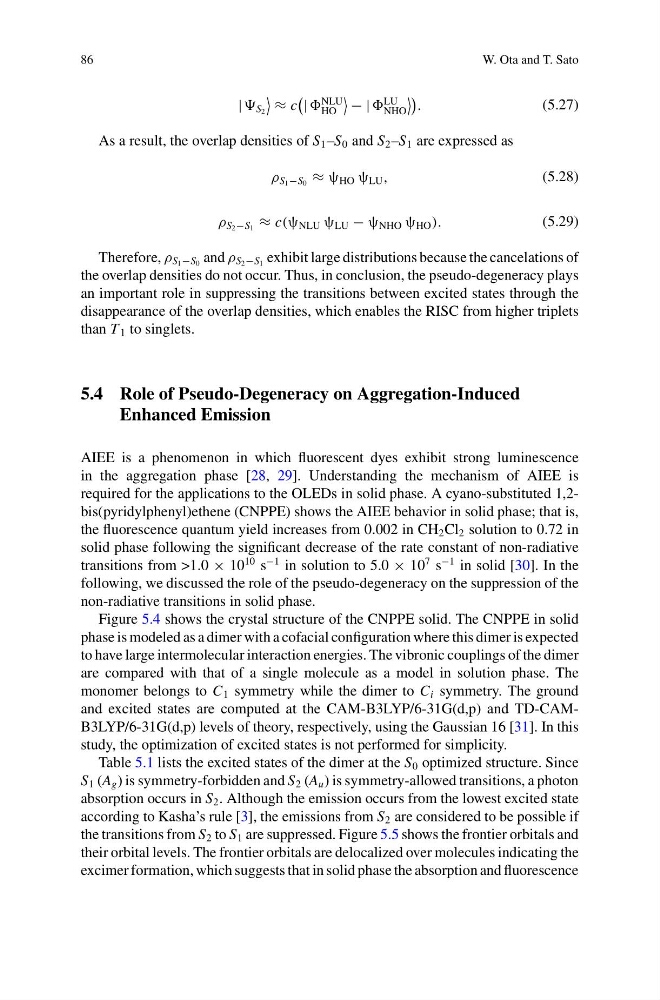
| S 2
≈ c
|
NLU
HO
− |
LU
NHO
.
(5.27)
As a result, the overlap densities of S 1 –S 0 and S 2 –S 1 are expressed as
ρ S 1 −S 0 ≈ ψ HO ψ LU ,
(5.28)
ρ S 2 −S 1 ≈ c(ψ NLU ψ LU − ψ NHO ψ HO ).
(5.29)
Therefore, ρ S 1 −S 0 and ρ S 2 −S 1 exhibit large distributions because the cancelations of
the overlap densities do not occur. Thus, in conclusion, the pseudo-degeneracy plays
an important role in suppressing the transitions between excited states through the
disappearance of the overlap densities, which enables the RISC from higher triplets
than T 1 to singlets.
5.4 Role of Pseudo-Degeneracy on Aggregation-Induced
Enhanced Emission
AIEE is a phenomenon in which fluorescent dyes exhibit strong luminescence
in the aggregation phase [28, 29]. Understanding the mechanism of AIEE is
required for the applications to the OLEDs in solid phase. A cyano-substituted 1,2bis(pyridylphenyl)ethene (CNPPE) shows the AIEE behavior in solid phase; that is,
the fluorescence quantum yield increases from 0.002 in CH 2 Cl 2 solution to 0.72 in
solid phase following the significant decrease of the rate constant of non-radiative
transitions from >1.0 × 10
10 s
−1 in solution to 5.0 × 10
7 s
−1 in solid [30]. In the
following, we discussed the role of the pseudo-degeneracy on the suppression of the
non-radiative transitions in solid phase.
Figure 5.4 shows the crystal structure of the CNPPE solid. The CNPPE in solid
phase is modeled as a dimer with a cofacial configuration where this dimer is expected
to have large intermolecular interaction energies. The vibronic couplings of the dimer
are compared with that of a single molecule as a model in solution phase. The
monomer belongs to C 1 symmetry while the dimer to C i symmetry. The ground
and excited states are computed at the CAM-B3LYP/6-31G(d,p) and TD-CAMB3LYP/6-31G(d,p) levels of theory, respectively, using the Gaussian 16 [31]. In this
study, the optimization of excited states is not performed for simplicity.
Table 5.1 lists the excited states of the dimer at the S 0 optimized structure. Since
S 1 (A g ) is symmetry-forbidden and S 2 (A u ) is symmetry-allowed transitions, a photon
absorption occurs in S 2 . Although the emission occurs from the lowest excited state
according to Kasha’s rule [3], the emissions from S 2 are considered to be possible if
the transitions from S 2 to S 1 are suppressed. Figure 5.5 shows the frontier orbitals and
their orbital levels. The frontier orbitals are delocalized over molecules indicating the
excimer formation, which suggests that in solid phase the absorption and fluorescence
W. Ota and T. Sato
| S 2
≈ c
|
NLU
HO
− |
LU
NHO
.
(5.27)
As a result, the overlap densities of S 1 –S 0 and S 2 –S 1 are expressed as
ρ S 1 −S 0 ≈ ψ HO ψ LU ,
(5.28)
ρ S 2 −S 1 ≈ c(ψ NLU ψ LU − ψ NHO ψ HO ).
(5.29)
Therefore, ρ S 1 −S 0 and ρ S 2 −S 1 exhibit large distributions because the cancelations of
the overlap densities do not occur. Thus, in conclusion, the pseudo-degeneracy plays
an important role in suppressing the transitions between excited states through the
disappearance of the overlap densities, which enables the RISC from higher triplets
than T 1 to singlets.
5.4 Role of Pseudo-Degeneracy on Aggregation-Induced
Enhanced Emission
AIEE is a phenomenon in which fluorescent dyes exhibit strong luminescence
in the aggregation phase [28, 29]. Understanding the mechanism of AIEE is
required for the applications to the OLEDs in solid phase. A cyano-substituted 1,2bis(pyridylphenyl)ethene (CNPPE) shows the AIEE behavior in solid phase; that is,
the fluorescence quantum yield increases from 0.002 in CH 2 Cl 2 solution to 0.72 in
solid phase following the significant decrease of the rate constant of non-radiative
transitions from >1.0 × 10
10 s
−1 in solution to 5.0 × 10
7 s
−1 in solid [30]. In the
following, we discussed the role of the pseudo-degeneracy on the suppression of the
non-radiative transitions in solid phase.
Figure 5.4 shows the crystal structure of the CNPPE solid. The CNPPE in solid
phase is modeled as a dimer with a cofacial configuration where this dimer is expected
to have large intermolecular interaction energies. The vibronic couplings of the dimer
are compared with that of a single molecule as a model in solution phase. The
monomer belongs to C 1 symmetry while the dimer to C i symmetry. The ground
and excited states are computed at the CAM-B3LYP/6-31G(d,p) and TD-CAMB3LYP/6-31G(d,p) levels of theory, respectively, using the Gaussian 16 [31]. In this
study, the optimization of excited states is not performed for simplicity.
Table 5.1 lists the excited states of the dimer at the S 0 optimized structure. Since
S 1 (A g ) is symmetry-forbidden and S 2 (A u ) is symmetry-allowed transitions, a photon
absorption occurs in S 2 . Although the emission occurs from the lowest excited state
according to Kasha’s rule [3], the emissions from S 2 are considered to be possible if
the transitions from S 2 to S 1 are suppressed. Figure 5.5 shows the frontier orbitals and
their orbital levels. The frontier orbitals are delocalized over molecules indicating the
excimer formation, which suggests that in solid phase the absorption and fluorescence