

84
W. Ota and T. Sato
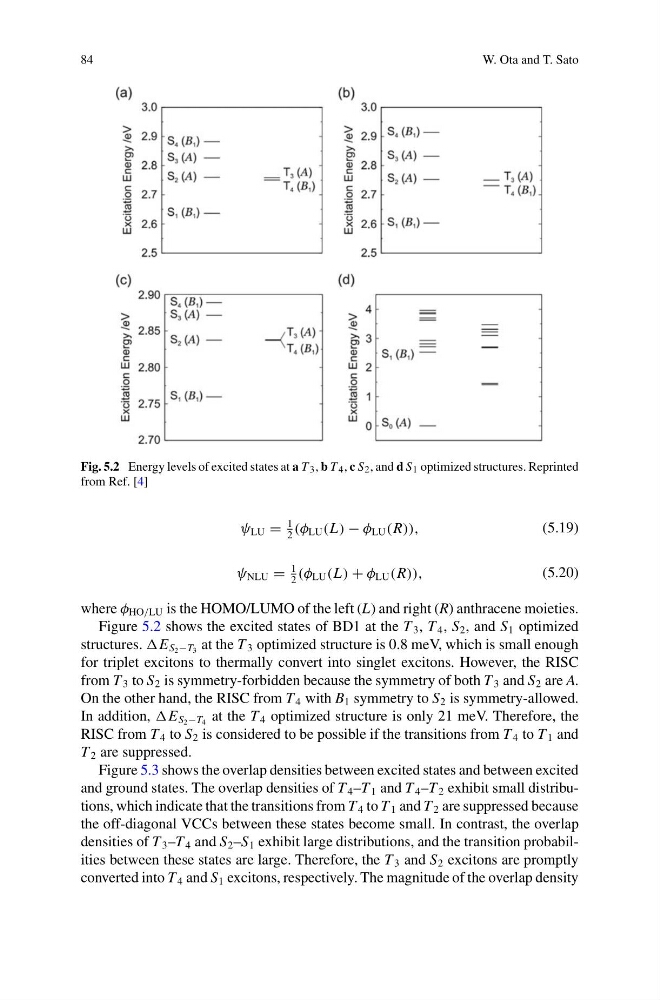
Fig. 5.2 Energy levels of excited states at a T 3 , b T 4 , c S 2 , and d S 1 optimized structures. Reprinted
from Ref. [4]
ψ LU =
1
2 (φ LU (L) − φ LU (R)),
(5.19)
ψ NLU =
1
2 (φ LU (L) + φ LU (R)),
(5.20)
where φ HO/LU is the HOMO/LUMO of the left (L) and right (R) anthracene moieties.
Figure 5.2 shows the excited states of BD1 at the T 3 , T 4 , S 2 , and S 1 optimized
structures. E S 2 −T 3 at the T 3 optimized structure is 0.8 meV, which is small enough
for triplet excitons to thermally convert into singlet excitons. However, the RISC
from T 3 to S 2 is symmetry-forbidden because the symmetry of both T 3 and S 2 are A.
On the other hand, the RISC from T 4 with B 1 symmetry to S 2 is symmetry-allowed.
In addition, E S 2 −T 4 at the T 4 optimized structure is only 21 meV. Therefore, the
RISC from T 4 to S 2 is considered to be possible if the transitions from T 4 to T 1 and
T 2 are suppressed.
Figure 5.3 shows the overlap densities between excited states and between excited
and ground states. The overlap densities of T 4 –T 1 and T 4 –T 2 exhibit small distributions, which indicate that the transitions from T 4 to T 1 and T 2 are suppressed because
the off-diagonal VCCs between these states become small. In contrast, the overlap
densities of T 3 –T 4 and S 2 –S 1 exhibit large distributions, and the transition probabilities between these states are large. Therefore, the T 3 and S 2 excitons are promptly
converted into T 4 and S 1 excitons, respectively. The magnitude of the overlap density
W. Ota and T. Sato
Fig. 5.2 Energy levels of excited states at a T 3 , b T 4 , c S 2 , and d S 1 optimized structures. Reprinted
from Ref. [4]
ψ LU =
1
2 (φ LU (L) − φ LU (R)),
(5.19)
ψ NLU =
1
2 (φ LU (L) + φ LU (R)),
(5.20)
where φ HO/LU is the HOMO/LUMO of the left (L) and right (R) anthracene moieties.
Figure 5.2 shows the excited states of BD1 at the T 3 , T 4 , S 2 , and S 1 optimized
structures. E S 2 −T 3 at the T 3 optimized structure is 0.8 meV, which is small enough
for triplet excitons to thermally convert into singlet excitons. However, the RISC
from T 3 to S 2 is symmetry-forbidden because the symmetry of both T 3 and S 2 are A.
On the other hand, the RISC from T 4 with B 1 symmetry to S 2 is symmetry-allowed.
In addition, E S 2 −T 4 at the T 4 optimized structure is only 21 meV. Therefore, the
RISC from T 4 to S 2 is considered to be possible if the transitions from T 4 to T 1 and
T 2 are suppressed.
Figure 5.3 shows the overlap densities between excited states and between excited
and ground states. The overlap densities of T 4 –T 1 and T 4 –T 2 exhibit small distributions, which indicate that the transitions from T 4 to T 1 and T 2 are suppressed because
the off-diagonal VCCs between these states become small. In contrast, the overlap
densities of T 3 –T 4 and S 2 –S 1 exhibit large distributions, and the transition probabilities between these states are large. Therefore, the T 3 and S 2 excitons are promptly
converted into T 4 and S 1 excitons, respectively. The magnitude of the overlap density