

5 Suppression of Internal Conversions from Pseudo-Degenerate …
83
5.3 Fluorescence Via Higher Triplets in Organic
Light-Emitting Diodes
The use of triplet excitons generated by electrical excitation is required for achieving
highly efficient OLEDs. Thermally activated delayed fluorescence (TADF) has gathered attention as a mechanism for the use of triplet excitons; that is, the reverse
intersystem crossing (RISC) from T 1 to S 1 is thermally activated by decreasing the
energy difference between T 1 and S 1 (E S 1 −T 1 ) using the HOMO-LUMO separation
[25, 26]. However, the OLED dopants using triplet excitons in spite of large E S 1 −T 1
has been reported. 1,4-bis(10-phenylanthracene-9-yl)benzene (BD1) is one of examples where E S 1 −T 1 are calculated to be more than 1.0 eV [27], which is extremely
large for T 1 excitons to thermally overcome. Therefore, the RISC from higher triples
than T 1 is expected. We propose a fluorescence via higher triplets (FvHT) as a mechanism for the use of high triplet excitons [4–6]. The excitons with long lifetime are
possible if radiative and non-radiative transitions from the high to low triplets are
sufficiently suppressed. In the following, we showed using BD1 that the suppression of the transitions between triplets is achieved by the cancelation of the overlap
densities between these states because of the pseudo-degenerate electronic states [5].
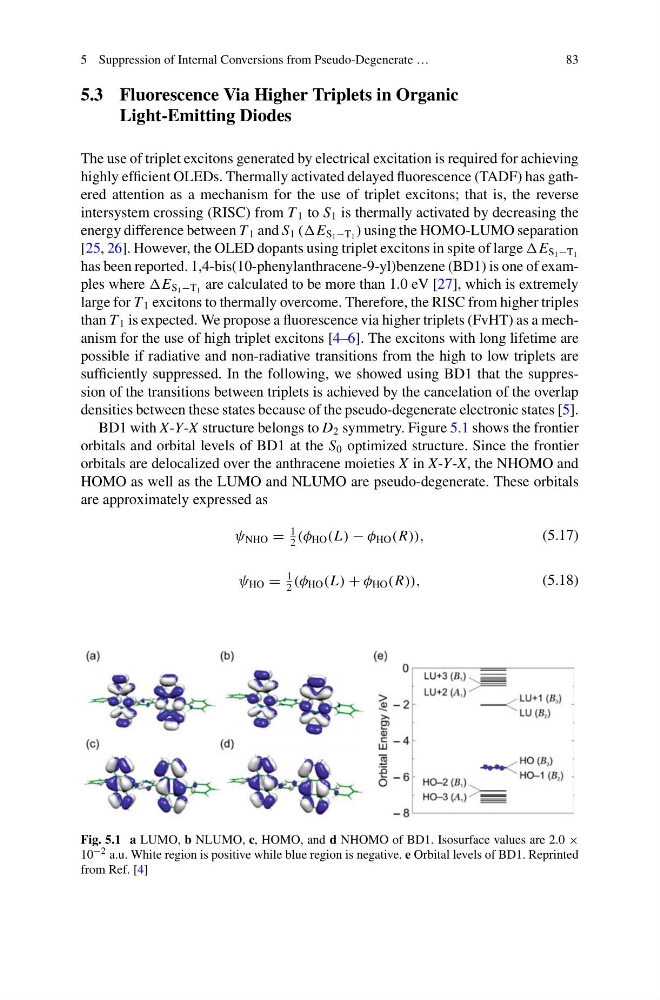
BD1 with X-Y-X structure belongs to D 2 symmetry. Figure 5.1 shows the frontier
orbitals and orbital levels of BD1 at the S 0 optimized structure. Since the frontier
orbitals are delocalized over the anthracene moieties X in X-Y-X, the NHOMO and
HOMO as well as the LUMO and NLUMO are pseudo-degenerate. These orbitals
are approximately expressed as
ψ NHO =
1
2 (φ HO (L) − φ HO (R)),
(5.17)
ψ HO =
1
2 (φ HO (L) + φ HO (R)),
(5.18)
Fig. 5.1 a LUMO, b NLUMO, c, HOMO, and d NHOMO of BD1. Isosurface values are 2.0 ×
10 −2 a.u. White region is positive while blue region is negative. e Orbital levels of BD1. Reprinted
from Ref. [4]
83
5.3 Fluorescence Via Higher Triplets in Organic
Light-Emitting Diodes
The use of triplet excitons generated by electrical excitation is required for achieving
highly efficient OLEDs. Thermally activated delayed fluorescence (TADF) has gathered attention as a mechanism for the use of triplet excitons; that is, the reverse
intersystem crossing (RISC) from T 1 to S 1 is thermally activated by decreasing the
energy difference between T 1 and S 1 (E S 1 −T 1 ) using the HOMO-LUMO separation
[25, 26]. However, the OLED dopants using triplet excitons in spite of large E S 1 −T 1
has been reported. 1,4-bis(10-phenylanthracene-9-yl)benzene (BD1) is one of examples where E S 1 −T 1 are calculated to be more than 1.0 eV [27], which is extremely
large for T 1 excitons to thermally overcome. Therefore, the RISC from higher triples
than T 1 is expected. We propose a fluorescence via higher triplets (FvHT) as a mechanism for the use of high triplet excitons [4–6]. The excitons with long lifetime are
possible if radiative and non-radiative transitions from the high to low triplets are
sufficiently suppressed. In the following, we showed using BD1 that the suppression of the transitions between triplets is achieved by the cancelation of the overlap
densities between these states because of the pseudo-degenerate electronic states [5].
BD1 with X-Y-X structure belongs to D 2 symmetry. Figure 5.1 shows the frontier
orbitals and orbital levels of BD1 at the S 0 optimized structure. Since the frontier
orbitals are delocalized over the anthracene moieties X in X-Y-X, the NHOMO and
HOMO as well as the LUMO and NLUMO are pseudo-degenerate. These orbitals
are approximately expressed as
ψ NHO =
1
2 (φ HO (L) − φ HO (R)),
(5.17)
ψ HO =
1
2 (φ HO (L) + φ HO (R)),
(5.18)
Fig. 5.1 a LUMO, b NLUMO, c, HOMO, and d NHOMO of BD1. Isosurface values are 2.0 ×
10 −2 a.u. White region is positive while blue region is negative. e Orbital levels of BD1. Reprinted
from Ref. [4]