

82
W. Ota and T. Sato
η n,α (x) = ρ nm (x) × v α (x),
(5.12)
η mn,α (x) = ρ mn (x) × v α (x).
(5.13)
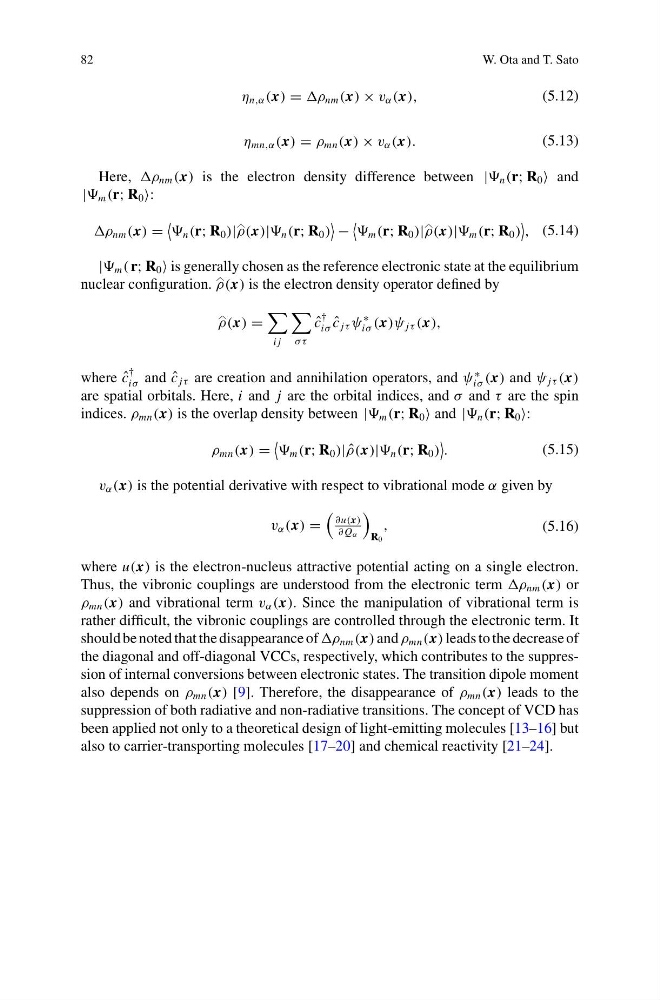
Here, ρ nm (x) is the electron density difference between | n (r; R 0 and
| m (r; R 0 :
ρ nm (x) =
n (r; R 0 )|ρ
(x)| n (r; R 0 )
−
m (r; R 0 )|ρ
(x)| m (r; R 0 )
, (5.14)
| m ( r; R 0 is generally chosen as the reference electronic state at the equilibrium
nuclear configuration. ρ
(x) is the electron density operator defined by
ρ
(x) =
i j
σ τ
ˆ
c
†
iσ ˆ
c jτ ψ
∗
iσ (x)ψ jτ (x),
where ˆ
c
†
iσ and ˆ
c jτ are creation and annihilation operators, and ψ
∗
iσ (x) and ψ jτ (x)
are spatial orbitals. Here, i and j are the orbital indices, and σ and τ are the spin
indices. ρ mn (x) is the overlap density between | m (r; R 0 and | n (r; R 0 :
ρ mn (x) =
m (r; R 0 )| ˆ
ρ(x)| n (r; R 0 )
.
(5.15)
v α (x) is the potential derivative with respect to vibrational mode α given by
v α (x) =
∂u(x)
∂ Q α
R 0
,
(5.16)
where u(x) is the electron-nucleus attractive potential acting on a single electron.
Thus, the vibronic couplings are understood from the electronic term ρ nm (x) or
ρ mn (x) and vibrational term v α (x). Since the manipulation of vibrational term is
rather difficult, the vibronic couplings are controlled through the electronic term. It
should be noted that the disappearance of ρ nm (x) and ρ mn (x) leads to the decrease of
the diagonal and off-diagonal VCCs, respectively, which contributes to the suppression of internal conversions between electronic states. The transition dipole moment
also depends on ρ mn (x) [9]. Therefore, the disappearance of ρ mn (x) leads to the
suppression of both radiative and non-radiative transitions. The concept of VCD has
been applied not only to a theoretical design of light-emitting molecules [13–16] but
also to carrier-transporting molecules [17–20] and chemical reactivity [21–24].
W. Ota and T. Sato
η n,α (x) = ρ nm (x) × v α (x),
(5.12)
η mn,α (x) = ρ mn (x) × v α (x).
(5.13)
Here, ρ nm (x) is the electron density difference between | n (r; R 0 and
| m (r; R 0 :
ρ nm (x) =
n (r; R 0 )|ρ
(x)| n (r; R 0 )
−
m (r; R 0 )|ρ
(x)| m (r; R 0 )
, (5.14)
| m ( r; R 0 is generally chosen as the reference electronic state at the equilibrium
nuclear configuration. ρ
(x) is the electron density operator defined by
ρ
(x) =
i j
σ τ
ˆ
c
†
iσ ˆ
c jτ ψ
∗
iσ (x)ψ jτ (x),
where ˆ
c
†
iσ and ˆ
c jτ are creation and annihilation operators, and ψ
∗
iσ (x) and ψ jτ (x)
are spatial orbitals. Here, i and j are the orbital indices, and σ and τ are the spin
indices. ρ mn (x) is the overlap density between | m (r; R 0 and | n (r; R 0 :
ρ mn (x) =
m (r; R 0 )| ˆ
ρ(x)| n (r; R 0 )
.
(5.15)
v α (x) is the potential derivative with respect to vibrational mode α given by
v α (x) =
∂u(x)
∂ Q α
R 0
,
(5.16)
where u(x) is the electron-nucleus attractive potential acting on a single electron.
Thus, the vibronic couplings are understood from the electronic term ρ nm (x) or
ρ mn (x) and vibrational term v α (x). Since the manipulation of vibrational term is
rather difficult, the vibronic couplings are controlled through the electronic term. It
should be noted that the disappearance of ρ nm (x) and ρ mn (x) leads to the decrease of
the diagonal and off-diagonal VCCs, respectively, which contributes to the suppression of internal conversions between electronic states. The transition dipole moment
also depends on ρ mn (x) [9]. Therefore, the disappearance of ρ mn (x) leads to the
suppression of both radiative and non-radiative transitions. The concept of VCD has
been applied not only to a theoretical design of light-emitting molecules [13–16] but
also to carrier-transporting molecules [17–20] and chemical reactivity [21–24].