

5 Suppression of Internal Conversions from Pseudo-Degenerate …
81
×
χ nj (Q)|Q α |χ mi (Q)
χ mi (Q)|Q β |χ nj (Q)
δ
E mi − E nj
.
(5.5)
It should be noted that this expression is different from the rate constant in
the Born–Oppenheimer (BO) representation [10, 11] in which the electronic states
depend on nuclear configuration R rather than fixed at R 0 .
Suppose that |χ mi (Q) is represented as the product of vibrational states of a
single mode
|χ mi (Q) =
γ
| n mi,γ
Q γ
,
(5.6)
then ignoring the Duschinsky effect the vibrational part is expressed as [9]
χ mi |Q α |χ nj
=
n mi,α |Q α |n nj,α
γ =α
n mi,γ |n nj,γ
,
(5.7)
where
n mi,α |Q α |n nj,α
=
2π
n nj,α + 1
n mi,α |n nj,α + 1
+
√
n nj,α
n mi,α |n nj,α − 1
(5.8)
and the Franck–Condon (FC) overlap integral is [12]
n mi,α |n nj,α
=
n mi,α !n nj,α !
2 n mi,α +n nj,α e
−
1
4 g
2
n,α
×
min[n mi,α ,n nj,α ]
l=0
(−1)
n mi,α −l 2
l
g
n mi,α +n nj,α −2l
n,α
l!
n mi,α − l
!
n nj,α − l
!
.
(5.9)
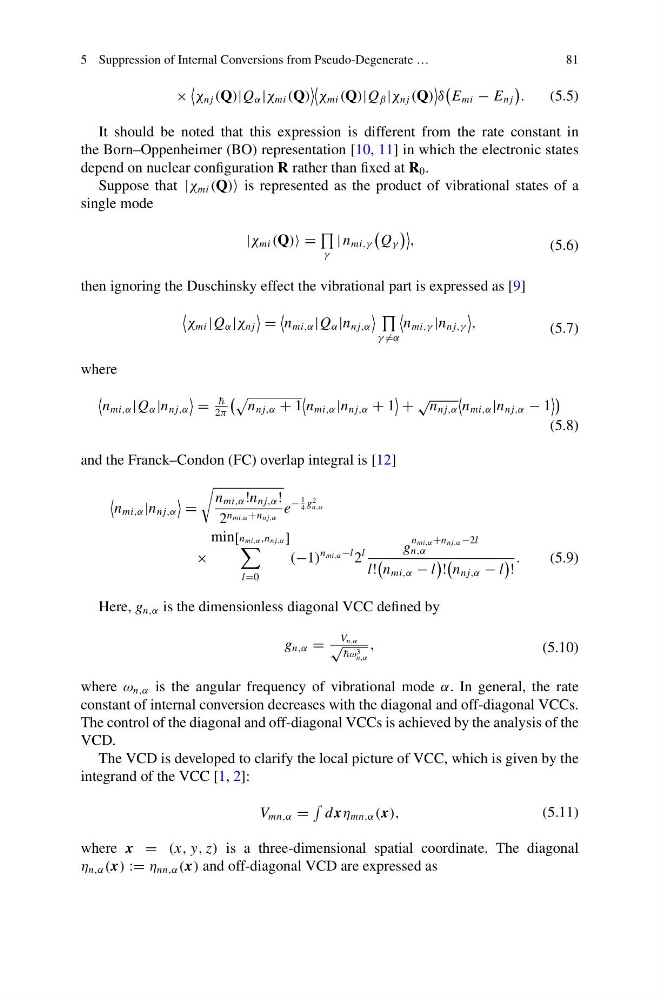
Here, g n,α is the dimensionless diagonal VCC defined by
g n,α =
V n,α
√ ω 3
n,α
,
(5.10)
where ω n,α is the angular frequency of vibrational mode α. In general, the rate
constant of internal conversion decreases with the diagonal and off-diagonal VCCs.
The control of the diagonal and off-diagonal VCCs is achieved by the analysis of the
VCD.
The VCD is developed to clarify the local picture of VCC, which is given by the
integrand of the VCC [1, 2]:
V mn,α =
d xη mn,α (x),
(5.11)
where x = (x, y, z) is a three-dimensional spatial coordinate. The diagonal
η n,α (x) := η nn,α (x) and off-diagonal VCD are expressed as
81
×
χ nj (Q)|Q α |χ mi (Q)
χ mi (Q)|Q β |χ nj (Q)
δ
E mi − E nj
.
(5.5)
It should be noted that this expression is different from the rate constant in
the Born–Oppenheimer (BO) representation [10, 11] in which the electronic states
depend on nuclear configuration R rather than fixed at R 0 .
Suppose that |χ mi (Q) is represented as the product of vibrational states of a
single mode
|χ mi (Q) =
γ
| n mi,γ
Q γ
,
(5.6)
then ignoring the Duschinsky effect the vibrational part is expressed as [9]
χ mi |Q α |χ nj
=
n mi,α |Q α |n nj,α
γ =α
n mi,γ |n nj,γ
,
(5.7)
where
n mi,α |Q α |n nj,α
=
2π
n nj,α + 1
n mi,α |n nj,α + 1
+
√
n nj,α
n mi,α |n nj,α − 1
(5.8)
and the Franck–Condon (FC) overlap integral is [12]
n mi,α |n nj,α
=
n mi,α !n nj,α !
2 n mi,α +n nj,α e
−
1
4 g
2
n,α
×
min[n mi,α ,n nj,α ]
l=0
(−1)
n mi,α −l 2
l
g
n mi,α +n nj,α −2l
n,α
l!
n mi,α − l
!
n nj,α − l
!
.
(5.9)
Here, g n,α is the dimensionless diagonal VCC defined by
g n,α =
V n,α
√ ω 3
n,α
,
(5.10)
where ω n,α is the angular frequency of vibrational mode α. In general, the rate
constant of internal conversion decreases with the diagonal and off-diagonal VCCs.
The control of the diagonal and off-diagonal VCCs is achieved by the analysis of the
VCD.
The VCD is developed to clarify the local picture of VCC, which is given by the
integrand of the VCC [1, 2]:
V mn,α =
d xη mn,α (x),
(5.11)
where x = (x, y, z) is a three-dimensional spatial coordinate. The diagonal
η n,α (x) := η nn,α (x) and off-diagonal VCD are expressed as