

80
W. Ota and T. Sato
electronic states can give the suppression of internal conversions between electronic
excited states against Kasha’s rule [3]. This is applicable to designing novel emitting
molecules for organic light-emitting diodes (OLEDs) in which the fluorescence via
higher triplets (FvHT) mechanism [4–6] operates and elucidating the origin of the
aggregation-induced enhanced emission (AIEE).
5.2 Internal Conversion and Vibronic Coupling Density
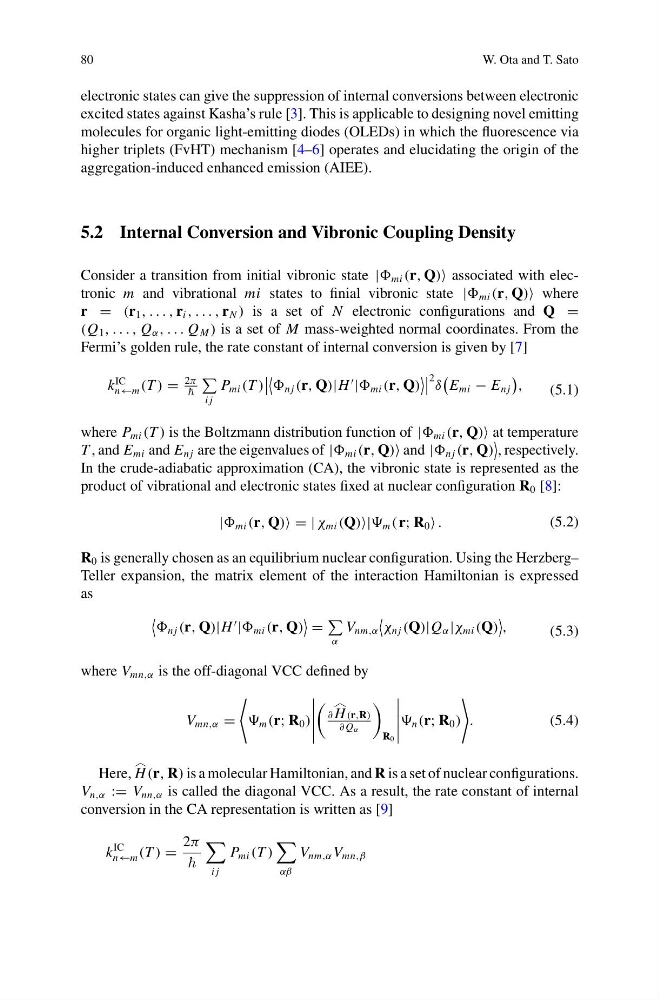
Consider a transition from initial vibronic state | mi (r, Q) associated with electronic m and vibrational mi states to finial vibronic state | mi (r, Q) where
r = (r 1 , . . . , r i , . . . , r N ) is a set of N electronic configurations and Q =
(Q 1 , . . . , Q α , . . . Q M ) is a set of M mass-weighted normal coordinates. From the
Fermi’s golden rule, the rate constant of internal conversion is given by [7]
k
IC
n←m (T ) =
2π
i j
P mi (T )
nj (r, Q)|H
| mi (r, Q)
2 δ
E mi − E nj
,
(5.1)
where P mi (T ) is the Boltzmann distribution function of | mi (r, Q) at temperature
T , and E mi and E nj are the eigenvalues of | mi (r, Q) and | nj (r, Q)
, respectively.
In the crude-adiabatic approximation (CA), the vibronic state is represented as the
product of vibrational and electronic states fixed at nuclear configuration R 0 [8]:
| mi (r, Q) = |χ mi (Q)| m ( r; R 0 .
(5.2)
R 0 is generally chosen as an equilibrium nuclear configuration. Using the Herzberg–
Teller expansion, the matrix element of the interaction Hamiltonian is expressed
as
nj (r, Q)|H
| mi (r, Q)
=
α
V nm,α
χ nj (Q)|Q α |χ mi (Q)
,
(5.3)
where V mn,α is the off-diagonal VCC defined by
V mn,α =
m (r; R 0 )
∂ H
(r,R)
∂ Q α
R 0
n (r; R 0 )
.
(5.4)
Here, H
(r, R) is a molecular Hamiltonian, and R is a set of nuclear configurations.
V n,α := V nn,α is called the diagonal VCC. As a result, the rate constant of internal
conversion in the CA representation is written as [9]
k
IC
n←m (T ) =
2π
i j
P mi (T )
αβ
V nm,α V mn,β
W. Ota and T. Sato
electronic states can give the suppression of internal conversions between electronic
excited states against Kasha’s rule [3]. This is applicable to designing novel emitting
molecules for organic light-emitting diodes (OLEDs) in which the fluorescence via
higher triplets (FvHT) mechanism [4–6] operates and elucidating the origin of the
aggregation-induced enhanced emission (AIEE).
5.2 Internal Conversion and Vibronic Coupling Density
Consider a transition from initial vibronic state | mi (r, Q) associated with electronic m and vibrational mi states to finial vibronic state | mi (r, Q) where
r = (r 1 , . . . , r i , . . . , r N ) is a set of N electronic configurations and Q =
(Q 1 , . . . , Q α , . . . Q M ) is a set of M mass-weighted normal coordinates. From the
Fermi’s golden rule, the rate constant of internal conversion is given by [7]
k
IC
n←m (T ) =
2π
i j
P mi (T )
nj (r, Q)|H
| mi (r, Q)
2 δ
E mi − E nj
,
(5.1)
where P mi (T ) is the Boltzmann distribution function of | mi (r, Q) at temperature
T , and E mi and E nj are the eigenvalues of | mi (r, Q) and | nj (r, Q)
, respectively.
In the crude-adiabatic approximation (CA), the vibronic state is represented as the
product of vibrational and electronic states fixed at nuclear configuration R 0 [8]:
| mi (r, Q) = |χ mi (Q)| m ( r; R 0 .
(5.2)
R 0 is generally chosen as an equilibrium nuclear configuration. Using the Herzberg–
Teller expansion, the matrix element of the interaction Hamiltonian is expressed
as
nj (r, Q)|H
| mi (r, Q)
=
α
V nm,α
χ nj (Q)|Q α |χ mi (Q)
,
(5.3)
where V mn,α is the off-diagonal VCC defined by
V mn,α =
m (r; R 0 )
∂ H
(r,R)
∂ Q α
R 0
n (r; R 0 )
.
(5.4)
Here, H
(r, R) is a molecular Hamiltonian, and R is a set of nuclear configurations.
V n,α := V nn,α is called the diagonal VCC. As a result, the rate constant of internal
conversion in the CA representation is written as [9]
k
IC
n←m (T ) =
2π
i j
P mi (T )
αβ
V nm,α V mn,β