

4 Stepwise Two-Photon Photochromism
69
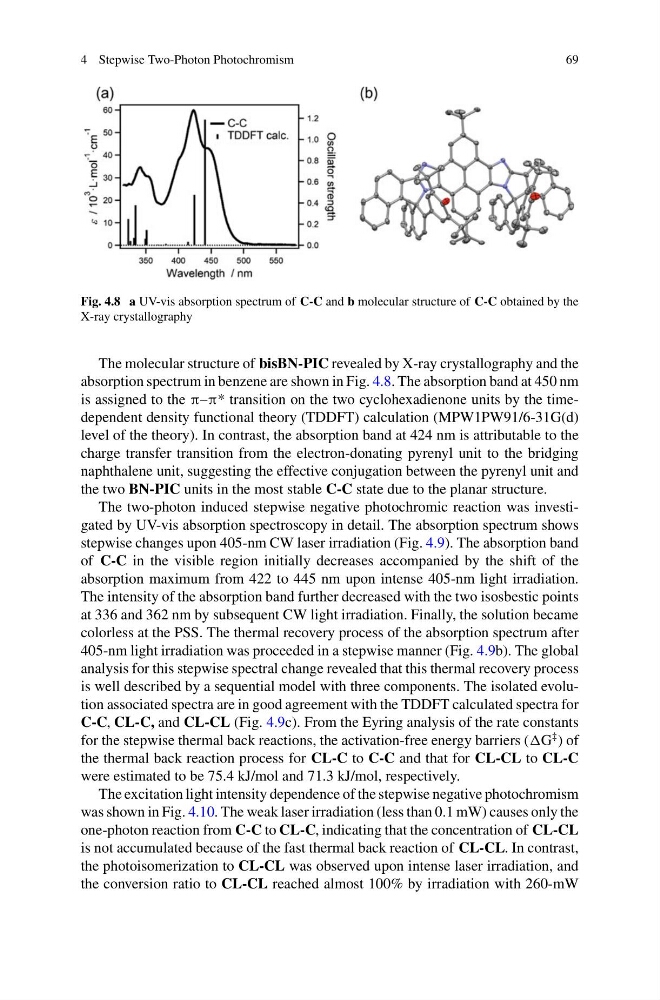
Fig. 4.8 a UV-vis absorption spectrum of C-C and b molecular structure of C-C obtained by the
X-ray crystallography
The molecular structure of bisBN-PIC revealed by X-ray crystallography and the
absorption spectrum in benzene are shown in Fig. 4.8. The absorption band at 450 nm
is assigned to the π–π* transition on the two cyclohexadienone units by the timedependent density functional theory (TDDFT) calculation (MPW1PW91/6-31G(d)
level of the theory). In contrast, the absorption band at 424 nm is attributable to the
charge transfer transition from the electron-donating pyrenyl unit to the bridging
naphthalene unit, suggesting the effective conjugation between the pyrenyl unit and
the two BN-PIC units in the most stable C-C state due to the planar structure.
The two-photon induced stepwise negative photochromic reaction was investigated by UV-vis absorption spectroscopy in detail. The absorption spectrum shows
stepwise changes upon 405-nm CW laser irradiation (Fig. 4.9). The absorption band
of C-C in the visible region initially decreases accompanied by the shift of the
absorption maximum from 422 to 445 nm upon intense 405-nm light irradiation.
The intensity of the absorption band further decreased with the two isosbestic points
at 336 and 362 nm by subsequent CW light irradiation. Finally, the solution became
colorless at the PSS. The thermal recovery process of the absorption spectrum after
405-nm light irradiation was proceeded in a stepwise manner (Fig. 4.9b). The global
analysis for this stepwise spectral change revealed that this thermal recovery process
is well described by a sequential model with three components. The isolated evolution associated spectra are in good agreement with the TDDFT calculated spectra for
C-C, CL-C, and CL-CL (Fig. 4.9c). From the Eyring analysis of the rate constants
for the stepwise thermal back reactions, the activation-free energy barriers (G
‡ ) of
the thermal back reaction process for CL-C to C-C and that for CL-CL to CL-C
were estimated to be 75.4 kJ/mol and 71.3 kJ/mol, respectively.
The excitation light intensity dependence of the stepwise negative photochromism
was shown in Fig. 4.10. The weak laser irradiation (less than 0.1 mW) causes only the
one-photon reaction from C-C to CL-C, indicating that the concentration of CL-CL
is not accumulated because of the fast thermal back reaction of CL-CL. In contrast,
the photoisomerization to CL-CL was observed upon intense laser irradiation, and
the conversion ratio to CL-CL reached almost 100% by irradiation with 260-mW
69
Fig. 4.8 a UV-vis absorption spectrum of C-C and b molecular structure of C-C obtained by the
X-ray crystallography
The molecular structure of bisBN-PIC revealed by X-ray crystallography and the
absorption spectrum in benzene are shown in Fig. 4.8. The absorption band at 450 nm
is assigned to the π–π* transition on the two cyclohexadienone units by the timedependent density functional theory (TDDFT) calculation (MPW1PW91/6-31G(d)
level of the theory). In contrast, the absorption band at 424 nm is attributable to the
charge transfer transition from the electron-donating pyrenyl unit to the bridging
naphthalene unit, suggesting the effective conjugation between the pyrenyl unit and
the two BN-PIC units in the most stable C-C state due to the planar structure.
The two-photon induced stepwise negative photochromic reaction was investigated by UV-vis absorption spectroscopy in detail. The absorption spectrum shows
stepwise changes upon 405-nm CW laser irradiation (Fig. 4.9). The absorption band
of C-C in the visible region initially decreases accompanied by the shift of the
absorption maximum from 422 to 445 nm upon intense 405-nm light irradiation.
The intensity of the absorption band further decreased with the two isosbestic points
at 336 and 362 nm by subsequent CW light irradiation. Finally, the solution became
colorless at the PSS. The thermal recovery process of the absorption spectrum after
405-nm light irradiation was proceeded in a stepwise manner (Fig. 4.9b). The global
analysis for this stepwise spectral change revealed that this thermal recovery process
is well described by a sequential model with three components. The isolated evolution associated spectra are in good agreement with the TDDFT calculated spectra for
C-C, CL-C, and CL-CL (Fig. 4.9c). From the Eyring analysis of the rate constants
for the stepwise thermal back reactions, the activation-free energy barriers (G
‡ ) of
the thermal back reaction process for CL-C to C-C and that for CL-CL to CL-C
were estimated to be 75.4 kJ/mol and 71.3 kJ/mol, respectively.
The excitation light intensity dependence of the stepwise negative photochromism
was shown in Fig. 4.10. The weak laser irradiation (less than 0.1 mW) causes only the
one-photon reaction from C-C to CL-C, indicating that the concentration of CL-CL
is not accumulated because of the fast thermal back reaction of CL-CL. In contrast,
the photoisomerization to CL-CL was observed upon intense laser irradiation, and
the conversion ratio to CL-CL reached almost 100% by irradiation with 260-mW