

68
J. Abe et al.
4.4 Stepwise Negative Photochromism
of Binaphthyl-Bridged Phenoxyl-Imidazolyl Radical
Complex
While remarkable examples of photochromic molecules in various research fields
have been reported, UV light has been frequently used as a switching light for artificial photochromic molecules. In contrast, the utilization of visible light has been
expected to regulate biochemical functions and functional materials due to the high
energy of UV light which causes degradation and mutagenesis of cells. Therefore,
the development of visible or near-infrared (NIR) light responsive molecules has
been extensively reported [37–43]. However, the increase in the photosensitivity to
visible and NIR light causes an unexpected photochemical reaction by weak illuminating or background light sources because typical photochemical reactions are
the linear photoresponsive process on excitation light intensity. Specific nonlinear
or orthogonal reactions depending on light intensity or wavelength are of particular
importance to activate photoswitches in complex systems involving intermolecular
networks of photofunctional molecules [44–47]. Thus, the development of visible
light-responsive photochromic molecules showing excitation intensity dependence
is an important subject for applications of photochromic molecules to advanced
photoswitches in systems chemistry.
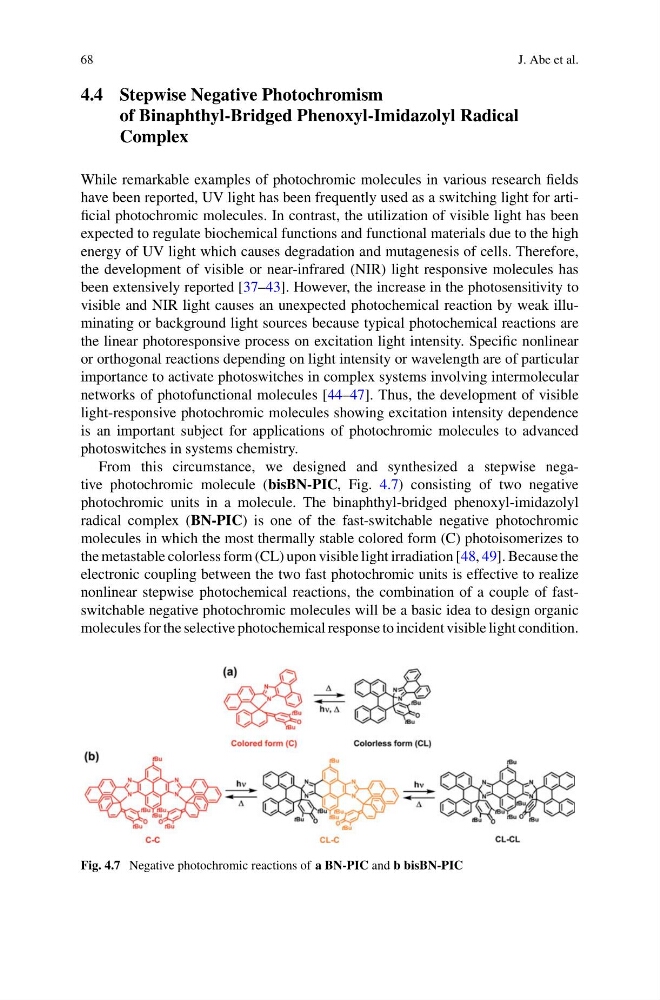
From this circumstance, we designed and synthesized a stepwise negative photochromic molecule (bisBN-PIC, Fig. 4.7) consisting of two negative
photochromic units in a molecule. The binaphthyl-bridged phenoxyl-imidazolyl
radical complex (BN-PIC) is one of the fast-switchable negative photochromic
molecules in which the most thermally stable colored form (C) photoisomerizes to
the metastable colorless form (CL) upon visible light irradiation [48, 49]. Because the
electronic coupling between the two fast photochromic units is effective to realize
nonlinear stepwise photochemical reactions, the combination of a couple of fastswitchable negative photochromic molecules will be a basic idea to design organic
molecules for the selective photochemical response to incident visible light condition.
Fig. 4.7 Negative photochromic reactions of a BN-PIC and b bisBN-PIC
J. Abe et al.
4.4 Stepwise Negative Photochromism
of Binaphthyl-Bridged Phenoxyl-Imidazolyl Radical
Complex
While remarkable examples of photochromic molecules in various research fields
have been reported, UV light has been frequently used as a switching light for artificial photochromic molecules. In contrast, the utilization of visible light has been
expected to regulate biochemical functions and functional materials due to the high
energy of UV light which causes degradation and mutagenesis of cells. Therefore,
the development of visible or near-infrared (NIR) light responsive molecules has
been extensively reported [37–43]. However, the increase in the photosensitivity to
visible and NIR light causes an unexpected photochemical reaction by weak illuminating or background light sources because typical photochemical reactions are
the linear photoresponsive process on excitation light intensity. Specific nonlinear
or orthogonal reactions depending on light intensity or wavelength are of particular
importance to activate photoswitches in complex systems involving intermolecular
networks of photofunctional molecules [44–47]. Thus, the development of visible
light-responsive photochromic molecules showing excitation intensity dependence
is an important subject for applications of photochromic molecules to advanced
photoswitches in systems chemistry.
From this circumstance, we designed and synthesized a stepwise negative photochromic molecule (bisBN-PIC, Fig. 4.7) consisting of two negative
photochromic units in a molecule. The binaphthyl-bridged phenoxyl-imidazolyl
radical complex (BN-PIC) is one of the fast-switchable negative photochromic
molecules in which the most thermally stable colored form (C) photoisomerizes to
the metastable colorless form (CL) upon visible light irradiation [48, 49]. Because the
electronic coupling between the two fast photochromic units is effective to realize
nonlinear stepwise photochemical reactions, the combination of a couple of fastswitchable negative photochromic molecules will be a basic idea to design organic
molecules for the selective photochemical response to incident visible light condition.
Fig. 4.7 Negative photochromic reactions of a BN-PIC and b bisBN-PIC